Friday, November 30, 2007

"A lot of people are scared"

Jim Wasserman in the Sacramento Bee:

Throughout 2007, borrowers in trouble with lenders have called here, written for help and cried in conversations about their desperate straits. For a newspaper, it's become a gut reality check, a window into this tough time of reckoning.
...
For some it's been easy, in e-mails or reader forums, to rip borrowers for overreaching, for not reading the fine print and for being completely irresponsible. Some were. But assigning blame can't mask the hurt out there. What we know for sure is what we hear on the phone, almost daily now. Well over two years after the housing boom ran out of steam, a lot of people are scared. People are fighting over money and horrified at how unutterably wrong their decisions to buy turned out to be. Story after story tells about their inability to sell or refinance to escape the nightmare.
From the Sacramento Bee:
Assembly Speaker Fabian Núñez said Thursday that the crisis in subprime mortgages has become so grave that Gov. Arnold Schwarzenegger should call a special session to deal with it.
...
In an illustration of the complexity of the crisis, though, one of the homeowners presented at the press conference as a victim said the house he lost was actually one of two that he owned. While many owners have lost homes they occupied, others were investors who saw the real estate run-up of the past decade as an investment opportunity.

Sacramento resident Carlos Villegas said he was forced into foreclosure when monthly payments on the house he bought in 2005 shot up from $2,200 to $3,550. "They gave me three days to move," he said. "I feel frustrated with the system.

In response to questions from reporters, Villegas said after the foreclosure, he moved back to a smaller house he had purchased 10 years earlier, which he had been renting out. Villegas took out an adjustable rate equity loan on his first house shortly before he bought the second, more expensive one for $385,000 in 2005, according to property records.

Afterward, Núñez's office pointed out that Villegas lost a substantial amount because of the foreclosure, including college savings for his children, and had to displace tenants who had been living in his first house.
From the Sacramento Bee:
Not everyone believes that Gov. Arnold Schwarzenegger's pact with mortgage lenders to help troubled subprime borrowers will dampen the impact of California's foreclosure crisis.
...
[S]ome doubt that freezing subprime loan rates for those who can't afford higher payments will make a dent. Thousands of 2006's subprime borrowers are already defaulting before their loans reset, said economist Chris Thornberg, head of Los Angeles-based Beacon Economics. "It's not the mortgage that's the problem," he said. "A lot of people bought houses they just can't afford."

Thornberg said there really isn't much anyone can do. Falling home values are aggravating a foreclosure problem that's likely to worsen, he said. Values will fall, he said, until most people can afford homes again.

Jeff Tarbell, managing partner of Sacramento-based Comstock Mortgage, also doesn't see much practical impact from the governor's announcement. Tarbell said it takes time to verify that a subprime borrower can't make higher payments – and lenders don't have the staff. Tarbell wants a freeze on rate resets – at least temporarily – across the country to allow the real estate market to stabilize. "We've got to stop the pricing decline," he said.
From the Sacramento Business Journal:
The Sacramento mortgage loan officer who purchased Dunmore Homes -- which in 2004 posted a quarter-billion dollars in revenue -- paid $500 for the troubled builder, according to Dunmore's bankruptcy case. That bargain-basement price has one of the company's major lenders crying fraud, and suing for payment of its outstanding loans and punitive damages.

Thursday, November 29, 2007

Sacramento Home Price Plunge Largest in 30 Years

Home prices in the Sacramento region fell by the largest amount on record, according to a report [pdf] released today by the Office of Federal Housing Enterprise Oversight. Sacramento's House Price Index (HPI) dropped 8.41% in the third quarter, the largest year-over-year decline since 1977, the year the government started tracking home appreciation for the Sacramento real estate market.

Top 5 year-over-year price declines since 1977:

2007 Q3: -8.41%
1983 Q3: -7.80%
1994 Q4: -6.67%
1995 Q1: -6.45%
1994 Q3: -6.24%

In the third quarter, the Sacramento real estate market ranked tenth weakest in the nation (out of 287 markets). Nearby Central Valley cities dominated the bottom 10 list, with Modesto at #8, Stockton at #5, Yuba City at #4, and Merced at #1.

Since peaking in 2005, Sacramento's HPI has dropped 10.1% [csv]. Prices have continued to fall at a more rapid pace than the housing bust of the 1990s. At this stage in the 90s bust, Sacramento's HPI had declined 5.3%.

From the Sacramento Business Journal:

In Greater Sacramento, home sales fell 30 percent compared the the previous year, but were up 9 percent from September. The median price of a single-family detached home in Sacramento in October was $309,260, 15 percent less than October 2006 and 5 percent less than in September 2007...according to a report from the California Association of Realtors.


From Bloomberg:
Inland California cities had six of the top 10 foreclosure rates among U.S. metro areas, RealtyTrac said. Merced in the state's Central Valley had the highest, with one filing for every 82 households, almost seven times the national average. Stockton and Modesto ranked second and third, respectively, and Riverside-San Bernardino and Vallejo-Fairfield were sixth and seventh. Sacramento ranked ninth.
From the Sacramento Bee:
By canceling a major office project in Sacramento this week, state officials sent the region a chilling holiday message: Don't look to us to bail out the economy.

Until lately, state government has been one of the bright spots in a community humbled by the housing slump. Since October 2006, the state has accounted for nearly half of Sacramento's job growth. The 400,000-square-foot CalSTRS headquarters being built in West Sacramento is one of the area's biggest construction projects.

But on Monday the Department of General Services scrubbed a proposed $520 million headquarters building for the Resources Agency. The project, approximately three times as large as the CalSTRS tower, was to be built somewhere within three miles of the Capitol and would have been one of the largest state office projects ever. The decision brought home the severity of the state's budget mess – itself a product of the worsening real estate downturn – and raised the possibility of further problems for Sacramento, home to nearly one-fourth of the state's workers.
...
Now the state appears to be lowering its profile in Sacramento real estate. Having requested bids from developers for the Resources building in August, the state announced Monday it couldn't proceed with "a project of this magnitude during this period of financial uncertainty."

Wednesday, November 28, 2007

"Prices soared beyond reason"

From Fortune:

If your business suffers from real estate blues brought on by plummeting prices, it may come as little comfort to know that this trend was supposed to have ended by now. When the market began its downturn in early 2006, some of the smartest economists in the country, as well as the CEOs of major home-builders and the National Association of Realtors, predicted that prices would rebound by mid-2007. Instead the experts have been humbled by the depth and breadth of the downturn - and the resulting sub-prime credit crisis has shaken financial markets around the world. Expect tremors to keep shaking the real estate market along multiple fault lines in 2008.
...
As a whole, the national housing market will finally hit bottom - and start bouncing back - at the end of 2008, says Celia Chen, director of housing economics at Economy.com....

The regions that will likely lag the national recovery are Phoenix, Las Vegas, south Florida and California's Central Valley. Although publicly-traded home builders packed these areas with inventory, prices soared beyond reason thanks to easy credit and an abundance of speculators who never intended to occupy the homes they bought.
From the Stockton Record:
Bad loans and mortgage foreclosures are threatening the economy, and the nation's housing market is collapsing. By the end of 2008, 2 million home mortgage foreclosures are predicted with the loss in real estate value expected to top $3 billion. San Joaquin County is listed No. 1 in foreclosure activity by Irvine-based RealtyTrac Inc....

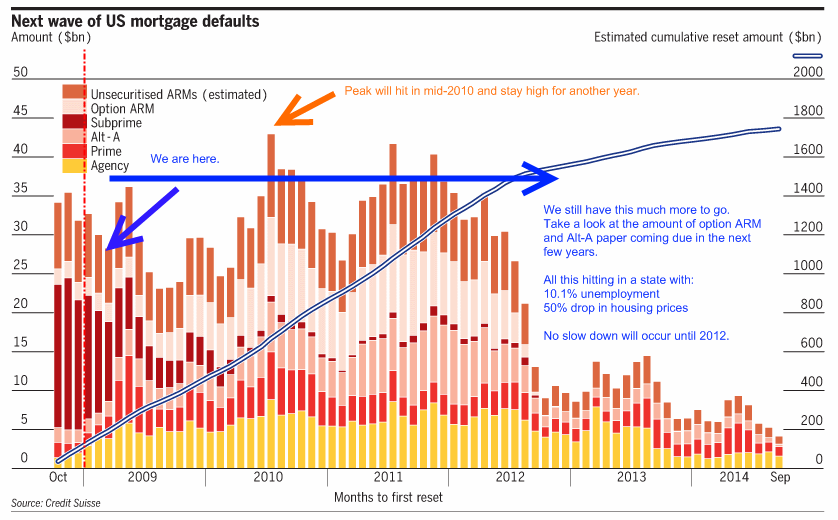
The situation will get worse before it gets better as adjustable-rate mortgages continue to reset at higher rates in the coming months. We're in the middle of a crisis of unprecedented proportion that strikes at the essence of home-ownership. It was created by a culture of greed....

Tuesday, November 27, 2007

Sacramento Housing Affordability Index - Q3 2007


The index is now at 17.2%. More on the NAHB/Wells Fargo Housing Opportunity Index here.

"Why are declining home prices bad news?"

From MarketWatch:

U.S. home prices were falling in every region of the country in September, according to a closely watched index of home prices released Tuesday. Home prices fell in September in all 20 major cities covered by the Case-Shiller price index, even in cities that had been holding up before the August freeze in mortgage markets, Standard & Poor's reported.
...
For the first time in this housing cycle, prices in all 20 cities dropped from the previous month, with the biggest declines in the former bubble cities of Miami, Phoenix, San Diego, Las Vegas, Los Angeles and Tampa. For the 20 cities, prices fell a record 4.9% year-over-year. Meanwhile, prices were down 5.5% year-over-year in the original 10-city index, the largest drop in the 10-city index since 1991.
From the LA Times:
Some analysts, including UC Berkeley professor Kenneth Rosen, believe the severity of the downturn will vary by region. Areas such as the Central Valley and the Inland Empire will be the hardest hit, he said, because these attracted a higher percentage of new buyers with shaky credit, and many of them are now defaulting on their loans. He believes values in these communities could fall by 15%.
Many price measures already show more than a 15% decline for the Central Valley's largest housing market.
But "in areas where there is very little new housing, where it's hard to build and a lot of wealthy people live, there will be little decline or maybe none at all."
...
But others call this wishful thinking, saying low prices eventually work their way to even the most affluent areas. "Every place takes the hit in the long run," said Christopher Thornberg of Beacon Economics, a consulting firm in L.A. If prices in high-end markets do not bend while prices fall in adjacent areas, many buyers will at some point choose the cheaper neighborhood, he said...Such movement eventually drags top-end prices down, he said.

Data gathered by Edward E. Leamer of UCLA's Anderson Forecast back that up. Since 1989, Leamer has tracked housing prices in the 20 least expensive and 20 most expensive ZIP Codes in Los Angeles County. He found that all areas fell by about the same percentage when they hit bottom in the 1990s downturn.
If anyone has historical data about how East Sacramento/Land Park/Davis/yada yada yada fared in the last housing bust, please do share.

From the Sacramento Bee:
Cities' housing nightmare

The deepening housing crisis will cut economic growth by more than 25 percent in 143 U.S. metropolitan areas next year and by more than a third in 65 metro communities, according to a new forecast for the U.S. Conference of Mayors. The new report [pdf] prepared for the mayors by financial forecaster Global Insight warns of cascading problems caused by falling home prices, an expected 1.4 million foreclosures and the pending reset of millions of adjustable-rate mortgages.
...
The cities with the biggest-percentage losses are Myrtle Beach, S.C.; the California cities of Merced, Madera and Napa; and Sarasota-Bradenton, Fla.
From Daniel Weintraub's California Insider blog:
Why are declining home prices bad news? Not only bad news, but a public "nightmare." It is great news when the price of energy, food, transportation, health care and consumer electronics drops. But for some reason it is bad news when the price of shelter drops.
...
So now that housing prices have stopped soaring and in some places are dropping, shouldn't that be good news? Shouldn't we be seeing stories filled with anecdotes about formerly priced-out middle-income families finally getting their chance at the American Dream?...I'd like to hear some of their stories. [dweintraub~at~sacbee~dot~com]
From the Modesto Bee:
Becky Ellis spent nearly 20 years in the mortgage industry, but the recent housing crash proved to be too "depressing" for someone who loves helping other people. "I wanted something cheery," said Ellis, 36, who considered switching to a banking career, but decided to get out of the industry and give retail a shot.
...
This year saw a swell in the number of job applicants for the holiday season, retailers said, a likely result of the housing fallout, economic crunch and rising unemployment figures in the Northern San Joaquin Valley.
...
J.C. Penney hired about 150 seasonal workers this year, a comparable number to last season, said Sarina Pescetti, assistant store manager. The most striking difference she noticed wasn't the number of applicants, but their backgrounds. "We had a variety of people who had worked in the housing industry," Pescetti said.

Monday, November 26, 2007

Real Estate Market "Weakness...No Longer Confined to Housing"

From the Sacramento Bee:

It would seem like one of the best locations to build a shopping center: Elk Grove Boulevard at Interstate 5, in one of Sacramento's fastest-growing suburbs. But retailers have been slow to flock to Stonelake Landing since it opened last March...[T]he Elk Grove center is 45 percent rented and has lost two tenants that had signed leases.
...
The weakness in Sacramento's real estate market is no longer confined to housing. Commercial real estate is starting to soften – more so in retailing, less in the office and industrial markets. Projects are slower to lease up, and rents are coming down. Developers and lenders are becoming substantially more cautious about proceeding with new projects.
...
[Garrick] Brown, the Colliers analyst, said certain pockets of the office market are getting hit particularly hard. They include South Placer, where it seemed practically every office park had a mortgage broker or some other business connected to residential real estate. "Suddenly, vacancy is hitting the 20 percent mark," he said, referring to South Placer.
...
Smaller, entrepreneurial tenants have become a big concern to developers. No longer able to finance their stores or restaurants through their home equity, they've gone missing in action.
...
"Real estate was great the last 10 years," Brown said. "You would build a shopping center and it'd be 100 percent full before you opened up. "That time is gone. We've just got to ride out this slow period."
From the Sacramento Bee:
Pressed by falling home values, high gas prices and a credit crunch, many appear to be buying at cheaper stores, shelving their plastic and trimming their shopping lists.
...
"Up to now we've been immune to the economy. We've grown our sales every year," said Debra Caselli, co-owner of the 9-year-old Calla Lily Linens in Sacramento's upscale Pavilions shopping center. "But things have changed." Calla Lily's repeat customers include some of Sacramento's "megawealthy," Caselli said, who buy everything from $8 imported soaps to $200 cotton bed sheets. They used to come to the store with long shopping lists. "Now they are cutting the list down to immediate family," she said, predicting Calla Lily sales would be flat for this holiday season compared to last.
From the Redding Record Searchlight:
It's a great time to buy. That's the chorus coming from real estate agents and builders everywhere as they attempt to prop up the sagging industry. The housing market has cooled, rates are low and inventories are up. That means more choices for buyers, the National Association of Home Builders (NAHB) notes.

But how many can afford to buy in Shasta County? Well, according to the NAHB's own housing affordability index, not many. In Shasta County, 20.3 percent of the homes sold in the third quarter of 2007 were affordable to families earning the area's median income of $52,700 a year, the NAHB reported last week.

Friday, November 23, 2007

Forbes Labels Sacramento "Worst" Housing Market

From Forbes:

Worst U. S. Housing Markets

1. Sacramento, Calif.

Over-building and speculation helped the Sacramento housing market become one of the fastest gainers in the country during the housing boom. It's now in a near free-fall.
From the Sacramento Bee:
Think back now to mid-2004 when Sacramento County's median sales price for resale homes broke through the $300,000 barrier. It was a sensational moment. "Housing prices hit milestone," The Bee reported. The newspaper account said it took 13 years for prices to climb from $100,000 to $200,000 – and only two to "rocket" to $300,000.

Now it's just as sensational seeing it slide back below $300,000. That's what happened in October, according to La Jolla-based DataQuick Information Systems. Half the resale homes that closed escrow last month in Sacramento County were priced below $295,000. From a buyer's viewpoint, that's an encouraging sign of growing affordability that will eventually revive this market.
From the Stockton Record:
Thousands poured into dining halls for free Thanksgiving meals on Thursday, and some organizers said this year was especially busy. St. Mary's Interfaith dining hall was packed by 11 a.m., with a line into the parking lot. "Definitely more crowded than last year," said Julian Cisneros, as he chewed some turkey. Organizers there expected to serve about 1,500 meals, 300 more than last year.

"It's the cost of living increase," said Mercedes Moreno, St. Mary's director of program services. "Some folks are getting laid off. Our economy is affecting everyone." Ted Van Allen of the Lodi Salvation Army said the housing market might be to blame.

Wednesday, November 21, 2007

NAR: Sacramento Price Decline 2nd Largest in Nation

From Bloomberg:

Prices dropped in 54 of 150 metropolitan areas in the third quarter and the median sales price tumbled 2 percent nationwide, the National Association of Realtors said today.
...
Palm Bay, Florida, had the biggest price decline in the third quarter, tumbling 12.4 percent from a year earlier. Sacramento, California, fell 10.5 percent and Sarasota, Florida, dropped 10.4 percent.
NAR Report [xls]

From the Central Valley Business Times:
Despite hundreds of homes being sold at foreclosure and builder auctions, home prices are still so high that most areas of California and even the Central Valley have some of the least affordable homes in the nation, according to figures compiled for the California Building Industry Association.
...
On a statewide basis, just 12.6 percent of all the homes sold could be afforded by a median-income family, up slightly from 11.7 percent in the second quarter.
...
Merced, which was the nation’s third least affordable area in the spring, is now ranked ninth, with 7.4 percent of its homes “affordable.” Modesto, which was 10th in the second quarter, is 14th in the third quarter, with 9.7 percent of homes priced as affordable. Stockton, which had been 15th, has moved to 22nd least affordable with 11.3 percent of homes in the affordable range, the CBIA says. Sacramento is now 29th in the nation. It had been tied for 25th in the second quarter. The report says 17.2 percent of the homes for sale in Sacramento were affordable in the third quarter.
...
Robert Rivinius, CBIA’s president and CEO, says the fact that affordability has not increased dramatically despite a housing downturn that has lasted over a year is “ample proof” that market corrections alone are not likely to allow the hundreds of thousands of Californians priced out of homeownership to be able to buy their first homes.

Tuesday, November 20, 2007

Mr. Freeze

From the Sacramento Bee (hat tip anon1137) (updated link):

In an unprecedented move designed to save thousands of California homeowners from foreclosure, Gov. Arnold Schwarzenegger announced a deal Tuesday with four mortgage lenders to freeze adjustable interest rates for some of the state's highest-risk borrowers.
From the East Bay Business Times:
The agreement announced Tuesday calls for the servicers - Countrywide Financial Corp, GMAC, Litton Loan Servicing and HomEq Servicing - to do three things: reach out to borrowers who may be in danger of defaulting on loans; streamline the process through which they determine whether a homeowner with adjustable rate mortgages can reasonably expect to make mortgage payments once the loan resets to a higher rate from an initial teaser rate; and cap those initial teaser rates for as long as five to seven years for homeowners whose adjustable rate mortgages are current, but who may be unable to make payments once their loans reset to higher rates.

These four lenders service more than 25 percent of subprime loans.
From Reuters:
"I think it's safe to say we would consider five years to be reasonable," said Countrywide spokesman Rick Simon. The company said the state program principles closely matched its plan announced last month to help more than 80,000 borrowers.

Litton Loan President Larry Litton Jr. said a five-year extension of current rates for some borrowers was justified given the housing market's slump, financial hardship in many households and anxiety among mortgage investors. "At the end of the day we're able to align the borrowers' interests with the investors' interests, saving everybody money," Litton said in a telephone interview.
From the SF Chronicle:
It was unclear for how long the loan servicers would freeze the interest rates. "The word that was chosen is it's for a 'sustainable' period of time," said Mark Leyes, a spokesman for the California Department of Corporations, which oversees nondepository lending institutions. "What does that mean? The answer is, it depends. It could be two years, five years, even seven years. The idea is until the housing market recovers. At that point, housing values would be restored; equity is restored, refinancing becomes an option. But nobody knows how long that's going to be."
News 10 Video

From Gov. Schwarzenegger's press release and video:
No one wants to have all those homes be dumped in the market, because that would just drive the price down even further. No one is gaining from that. What we want to do [has] an upside for everybody.

'Imagine trying to pump up the people in Sacramento'

From the Wichita Eagle:

Bernie Markstein was happy to be in Wichita instead of on one of the coasts on Tuesday. Markstein, director of forecasting and senior economist for the National Association of Home Builders, was one of the experts who spoke during the Wichita Area Builders Association's 2008 economic forecast at the Wichita Marriott. "This is fun talking to you guys," he said. "Imagine trying to pump up the people in Sacramento."

Monday, November 19, 2007

'We would've waited, but they told us we had to...buy now'

From the Sacramento Business Journal:

Meritage Homes, the nation's 12th-largest homebuilder, is the latest to cut costs in Sacramento by consolidating operations...The company follows others that have consolidated to cut costs, including Warmington Homes and Standard Pacific Homes....

All homebuilders have gone through layoffs. But Greg Paquin, president of new-home analyst The Gregory Group, said the closings and consolidations have been the unexpected effect of the housing slump. "It's a new phenomenon," he said. "We haven't seen this type of contraction before."

It could be a signal that the current slump is deeper than past recessions. Some builders say the relatively strong economy now compared with the previous housing slump still bodes better for the industry.
From the Sacramento Bee:
If you bought a house in the Sacramento area last year, chances are your annual income came to about $80,000. But your loan application said you earned a good deal more. A Bee computer analysis of more than 61,000 Sacramento-area mortgages over two years reveals striking discrepancies – gaps as high as 25 percent – between what homebuyers earned and what was listed on their loan applications.

Behind the discrepancies was a cascade of "stated income" loans that didn't require proof of borrowers' incomes or assets. Although statistics aren't available on the volume of stated income loans, experts say these mortgages pumped a considerable amount of air into the area's housing bubble – and helped bring about its collapse. By putting people into homes they couldn't afford, stated income loans contributed mightily to a culture of loose lending and a wave of foreclosures that's washing over the Sacramento region.
...
The Bee's analysis of census data shows that the region's homebuyers earned a median income of $84,000 last year, but the area's mortgage applications listed a median income of $102,000.
...
As the area's home prices have dropped 20 percent in two years, construction has stalled and unemployment has risen above 5 percent. Neighborhoods around the area are affected. The region has the nation's fifth highest foreclosure rate, with 6,500 homes lost since January. The housing slump has spawned a new breed of Sacramentan – the foreclosure refugee – and thousands more will be born next year, when another round of mortgages reset and the crisis deepens.
From the Vacaville Reporter:
They came, they saw, they bid. And when the proverbial smoke cleared following Sunday's housing auction, 18 new homeowners emerged victorious while their existing neighbors in a luxurious Vacaville development were somewhat less enthused. "We welcome them to our neighborhood. We're just upset that it's affecting our property values," said Kris McLean, one of the original homeowners in the upscale Meadow Woods subdivision off Fruitvale Road.

The concern expressed by McLean and a host of original homeowners in the exclusive DeNova Homes development is that the discrepancy in prices - what they paid versus the "steals" newbie owners snagged at auction - would significantly and negatively impact their property values.

Case in point - McLean and her husband paid top dollar for their $786,000 property in April. "We would've waited, but they told us we had to ... buy now," she recalled, addling that there was no allowance for haggling over costs.
From the Vacaville Reporter:
The busted housing market has taken its toll on real estate agents, mortgage brokers, home furnishers and construction workers who live and ply their trades here. Hundreds of homeowners are in foreclosure, and nearly every owner has seen the value of his or her property decline.
...
But it helps to keep things in perspective. For one thing, Vacaville, Dixon and, to some extent, Fairfield have fared much better economically than many cities and regions of late. Unemployment remains steady and below 5 percent, and is expected to stay that way.

Saturday, November 17, 2007

Sacramento Real Estate Market - November 2007 Water Cooler

Post off-topic links, observations, and stories about the Sacramento real estate market here. Please read the comment policy before posting.

Job Growth Will Save the Housing Market...Or Not

From the Sacramento Bee:

California's job market continued to stall out last month, as the housing slump infected the rest of the economy and increased the chances of a recession. Although the statewide unemployment rate was steady at 5.6 percent in October, some 15,800 payroll jobs disappeared. Job losses were recorded in practically every major economic sector, the state Employment Development Department said Friday.
...
Sacramento's picture isn't much brighter than the rest of the state's. The region's unemployment went up a tenth of a point, to 5.5 percent. That compares with 4.2 percent a year ago.

Last month's payroll job growth in greater Sacramento came to zero. Perhaps more striking, the retail sector, which should have begun hiring for the holidays, reported no gain in jobs. That suggests retailers – who recorded modest growth in sales across the country last month – are skittish about the season as consumers hunker down.
...
The news might not get much better. State government has been one of the region's bright spots lately, generating nearly half of Sacramento's new jobs in the past 12 months. But hiring could slow as the state faces a deficit in the next fiscal year estimated at $9.8 billion by Legislative Analyst Elizabeth Hill.
...
Nearly 8 percent of the Sacramento area's construction workers have lost their jobs in the past year; so have 11 percent of its mortgage lenders and 8 percent of its real estate agents.
...
Not surprisingly, the commercial real estate market is sagging, too, particularly among retailers. Sacramento brokers say vacancies have crept up and rental prices are coming down. Construction of new projects is waning.
From the Appeal Democrat
Yuba-Sutter’s jobless rate is up from a year ago with fewer jobs in financial activities and construction due to a housing slump. October’s 8.8 percent unemployment rate was up nearly two percentage points from the year-ago estimate of 6.9 percent, according to figures released Friday by the state Employment Development Department.
From the Modesto Bee:
Unemployment rates in the Northern San Joaquin Valley continued to climb last month, battered by the housing slump and seasonal cutbacks at manufacturing firms. Stanislaus County's unemployment rate last month was 8.5 percent, up from 8 percent in September, according to state Employment Development Department figures released Friday. It's also well above the October 2006 rate of 6.7 percent.
...
San Joaquin County also saw higher unemployment rates last month, at 8.1 percent. That's compared with 7.8 percent in September and 6.3 in October 2006. San Joaquin differed slightly from Stanislaus in that its largest losses were tied to the housing and mortgage crisis. The construction sector posted the biggest drop, losing 1,100 jobs compared to the previous year. "That's quite substantial for the area," Baker said. Construction was followed by the professional and business sector, which includes title and mortgage companies. It was down by about 900 jobs.
From the Redding Record Searchlight:
October unemployment in Shasta County reached a nine-year high, the state reported Friday. While the jobless rate in October nudged up to 7 percent from 6.9 percent in September, it was the highest October since 1998, when it was 7.1 percent. The unemployment rate in October 2006 was 5.4 percent.
From ABC30:
All six valley county's now have unemployment rates that are more than a point higher than a year ago. Including Merced which had the largest increase at one-point-six percent.

The struggling housing market is one of the biggest factors in the rising unemployment rate. The Valley has lost thousands of jobs in construction and other related industries over the last year alone.
...
"I've gone from 12 loan officers to 2 or 3 within the last six to eight months, which really is a significant drop," said Scott Crawford, All-American Mortgage. But Scott Crawford believes the situation isn't as bleak as it may seem. He says the market is simply returning to normal. "The only time a bust is created is when there's mass exiting of population, and we're the opposite here, we're still gaining population," said Scott Crawford, All-American Mortgage.
From the Stockton Record:
This was the first formal auction of foreclosed homes in the Stockton area, and the event drew a standing-room-only crowd of more than 300...This was an auction, with no minimum set bids, of 60 foreclosed homes that had sat on the market unsold for at least several months. All homes were "sold," although the banks that repossessed the homes can reject the top bids in coming days if deemed too low.
...
Cindy Mello, with Coldwell Banker The Vintage Group, had a half-dozen listings up for auction, and she said the top bids came in at about 40 percent under the current list prices. Although Hudson & Marshall says more than 90 percent of top auction bids are accepted by highly motivated banks, Mello said most of the top bids were discounted too steeply for most banks. "I just don't think the banks are going to give those discounts yet," she said. "That's just too low. For the banks, their sweet spot is about 15 percent below."

Friday, November 16, 2007

Mike Lyon: 'No one has seen this before'

From the Sacramento Bee:

A persistent housing slump that has relentlessly driven down home prices has now wiped out at least three years of home equity gains across much of the Sacramento region...For buyers, who have driven home sellers and much of the real estate industry mad by patiently remaining on the fence, it's fresh proof of a market getting ever more warm and friendly.

That's especially true in suburban neighborhoods with plenty of new construction. "I've got two sets of buyers looking at property in Lincoln, 2,943 square feet listed for $325,000," said Viki Benbow, a Coldwell Banker real estate agent. "It's like $106 or $107 a square foot. Those houses three years ago were selling in the mid-$500,000s."
...
DataQuick estimated that 27.6 percent of the region's existing home sales in October involved foreclosure properties. It was 35.9 percent in Sacramento County.
...
October ended with 15,716 homes still on the market in El Dorado, Placer, Sacramento and Yolo counties, according to Sacramento-based TrendGraphix....The number does not include foreclosures that have taken place but aren't yet on the market. DataQuick said 65 percent of homes that went into foreclosure between Aug. 1, 2006, and July 31 have not been sold yet.

In the first nine months of 2007, more than 6,500 homeowners have lost their residences to foreclosure in the eight-county region. That wild card concerns Lyon Real Estate's Michael Lyon. "No one has seen this before," he told a gathering of area home builders earlier this month.
October Home Sales by County
October Home Sales by Zip

From the Sacramento Bee:
Last week came another move in the continuing downsizing of the region's building industry. Arizona-based Meritage Homes closed a Sacramento division it opened in the late 1990s. The builder laid off about a dozen people and merged its operation into the Concord-based East Bay division, said Bay Area region president Dennis Welsch.
...
On another front, Lennar Corp. is halting sales at its 75-home Ironcrest project in West Roseville, said Sacramento division president Jeff Panasiti.
From the Modesto Bee:
Median home prices declined in Stanislaus, San Joaquin and Merced counties from October 2006 to last month. In Stanislaus, the median price dropped from $365,000 to $304,250, a decline of 16.6 percent. San Joaquin County prices, where the median was $340,000 last month, declined by 19 percent from $420,000 in 2006, and Merced County fell from $340,000 in October 2006 to $260,000 last month, a drop of 23.5 percent.

Foreclosure Violence

From KCRA:

Domestic violence counselors in both Stockton and Sacramento have noticed that as husbands and wives struggle more and more to make ends meet, they're starting to take their frustration out on each other...The Women's Center of San Joaquin County said since August, its domestic violence cases are up 12 percent, due in large part the director figures to the growing number of families losing their homes -- or close to losing their homes -- through foreclosure.
...
One woman who was interviewed by KCRA 3 and did not want her name used, said for two years she owned a home with her now ex-husband, but when the payments went from $1,700 to $2,300 a month, he started to change.

From News10 (video):
Less than a year ago, the house at 16671 Ore Claim Trail in Lathrop sold for $650,000, but neighbors say they never saw anyone move in. Three weeks ago, the lender filed a notice of default against the owner...who owes about $100,000 more than the home is worth...And on Monday night, an unusually violent fire blew out the windows of the home before the first firefighters arrived. Inside, they found the body of an unidentified man.
...
A source inside the San Joaquin County sheriff's department told News10 the man found dead inside the burned house was not the property owner. A spokesman for the department would only say the case is being handled by homicide detectives.

Thursday, November 15, 2007

Moody's Economist Says Central Valley Recession Has Begun

From the San Diego Union Tribune (hat tip HBB):

Steve Cochrane, senior managing director for Moodys.com and a specialist on California housing, said data indicate that a recession brought by the housing downturn has begun in the overbuilt Central Valley.
From the Associated Press:
Evoking Depression-era memories, Wells Fargo & Co. President John Stumpf on Thursday became the latest banker to predict continuing difficulties in the U.S. housing market as risky mortgages made to overextended borrowers disintegrate into large loan losses. Speaking at an investment conference in New York, Stumpf said the current real estate conditions are the worst he has experienced during his 30-year career. He then punctuated his gloomy assessment by harking back to the deepest downturn of the 20th century. "We have not seen a nationwide decline in housing like this since the Great Depression," he said.
...
"The losses have turned out to be greater than expected because home prices have declined faster and deeper than expected," said Stumpf. He cited the Midwest's "auto-belt" states and California's Central Valley—a swath stretching from Sacramento to Bakersfield—as Wells Fargo's biggest headaches.

DataQuick: Sacramento Median Falls Below $300,000

From the Sacramento Bee:

For new and existing homes combined: Sacramento County's October median sales price fell to $299,500. That's the first dip below $300,000 as the price slump continues and the lowest median price since April 2004. Sales prices have now fallen 22.6 percent from their August 2005 peak of $387,000, DataQuick reported.
...
For existing resale homes only: Sacramento County reported 1,306 sales with a median sales price of $295,000. That's the lowest since June 2004 and down 21 percent from an August 2005 high of $374,000, said DataQuick.
From the Stockton Record:
We're No. 1! Unfortunately, that's for the rate of foreclosure activity in the United States. The latest quarterly report on foreclosures nationwide once again put Stockton in the top position, with one foreclosure filing - notice of default, auction notice or bank repossession - per 31 San Joaquin County households, said Irvine-based RealtyTrac, which markets data on foreclosure properties.
...
"I'm busier than I've ever been," said Kevin Moran, a Coldwell Banker Grupe real estate agent specializing in foreclosed homes. "It's unprecedented, and it's multiplying quantumly." Moran had 35 foreclosed home listings in August. That has climbed to 90, and the pace is quickening. He got 12 new foreclosure listings last week, plus six more this week through Wednesday.
...
Steve Carrigan, economic development director for Stockton, said the mounting foreclosures already appear to be taking an indirect toll through reduced consumer spending. "The realist in me says everyone better prepare for the worst," he said. "I don't want to be an alarmist. It's more of being a realist. Foreclosures are a big problem out there with the psychology of the consumer. They have a hunker-down mentality."

Wednesday, November 14, 2007

Stockton Median Home Price Down 31%; Anderson Caves to Rebate Demands

From the Stockton Record (hat tip spacebar):

According to TrendGraphix, the median selling price in San Joaquin County slipped from $325,000 in September to $319,000 last month. That was down almost 25 percent from a high of $425,000 in July 2006. Stockton's median selling price slid from $279,000 in September to $264,000 in October. That was down almost 31.4 percent from a high of $385,000 in January 2006.
...
Broker Bob Riggs of Riggs & Associates GMAC Real Estate said most of those looking and buying are investors and speculators looking for great deals...A traditional sale to a family moving into a house remains a rarity, he said.
...
Dave Thurman of Dave Thurman Real Estate in Stockton said the market still hasn't stabilized, because buyers feel they can buy only below market value...Thurman also bemoaned the ongoing negative news about the county's real estate market, which he said kills momentum. There is the positive news, he said, in that it's a great time for a first-time buyer to buy a home with prices between $100,000 and $150,000 less than two years ago.
From the Tri-Valley Herald:
On Oct. 22, Paseo West homeowner Dave Cantrell, a spokesman for the current homeowners, met with Anderson Homes owner Larry Anderson and chief financial officer Craig Barton. As a result of that meeting, the homeowners were offered a rebate, which they agreed to take. They also signed a confidentially agreement that precludes them from discussing the settlement. I'm not going to retire on it, Cantrell said of the payment. But what the heck — it helped take a little of the sting out if it.
...
Anderson initially refused the homeowners request for a rebate prior to the auction. In a letter to Cantrell he wrote, In nearly 25 years of building homes, I have not asked a homeowner to pay more for a house when the value increased. After the auction, that sentiment apparently changed. Cantrell said he thought Anderson went into the auction expecting to get 90 percent of their asking price and that the price difference was not going to be as bad. But at the Oct. 13 auction, homes sold for about 70 percent of the original asking prices. After they saw that difference, they wanted to save face, Cantrell said. They took a big hit, but not as big as us.
From the Vacaville Reporter:
Plans for an auction of homes Sunday in Vacaville has perturbed several residents of a local upscale housing development, who are concerned about the potential effect on their property values. With help from Accelerated Marketing Partners, Pleasant Hill-based developer DeNova Homes is auctioning 18 of the houses in its Meadow Woods subdivision.
...
"We expect anywhere between a $200,000 to a $300,000 decrease in our property values overnight," said Meadow Woods resident Brian McLean...[T]he minimum selling prices in the auction range from $450,000 to $650,000 and the previous pricing on these homes ranged from $718,000 to $939,900.
...
"Anderson ended up going back to the existing homeowners and providing a good-faith rebate in that situation," McLean said, adding, "We're asking (DeNova) to step up to the plate and live up to the slogans." In their letter, Meadow Woods neighbors asked for $50,000 per residence to help offset the disparity caused by the auction. The response from Sanson was brief. "I appreciate the opportunity to keep the lines of communication open, but regret that we will not be able to agree to the request in the letter," he wrote.
From the Stockton Record (hat tip spacebar):
The San Joaquin County Sheriff's Office on Tuesday arrested five people and was searching for two others in the theft of appliances from vacant homes. The arrests were aided by Global Positioning System devices that the home builder KB Home had begun installing in appliances after a rash of similar thefts, the Sheriff's Office reported.
From the Associated Press:
Wachovia Corp. on Wednesday defended its $24 billion purchase last year of one of the country's largest mortgage lenders [Golden West], saying it "didn't anticipate" a housing-market slump that has led to delinquencies, defaults and bankruptcies at mortgage lenders nationwide. But general bank president Ben Jenkins added that "no one else did" either.
...
Last week, the bank said in a filing with the Securities and Exchange Commission that "the expected credit deterioration will likely be focused in certain geographic areas that have recently experienced dramatic declines in housing values." At that time, Wachovia's Chief Risk Officer Don Truslow said two areas of concern were in certain markets in California and Florida. Jenkins on Wednesday said the markets in California affected are the state's Central Valley and Inland Empire.

Tuesday, November 13, 2007

At Least the Pot Growers Mow Their Lawns

UPDATE - RealtyTrac's Q3 2007 Metros Report - Sacramento:

  • Properties with filings: 9,241
  • YoY Change: 408%
From the Associated Press:
Stockton, about 83 miles (133 kilometers) east of San Francisco, had the highest foreclosure rate in the third quarter among the top 100 metro areas, with one foreclosure filing for every 31 households, RealtyTrac said...Stockton had 7,116 foreclosure filings on 4,409 properties during the quarter, an increase of more than 465 percent from the same quarter a year ago, the company said...The California metro areas of Sacramento, Bakersfield and Oakland were also among the top 10 metro areas with the highest foreclosure rates, garnering the sixth, ninth and 10th spots, respectively.
From the Central Valley Business Times:
Your home mortgage may be completely up to date, but if there are foreclosures in your neighborhood, your home’s value is dropping, says a new study by the Center for Responsible Lending. In its new report [pdf], released Tuesday, CRL says the “spillover effect” is impacting 44.5 million homes across the country...Published research … indicates that a foreclosure on a home lowered the price of other nearby single-family homes, on average, by 0.9 percent, the report says.
...
Sacramento and San Joaquin counties in the Central Valley are among the nation’s top counties facing declines in house values and local tax bases due to subprime foreclosure, CRL says. Sacramento County is facing the potential of 9,257 homes being lost of foreclosure due to the subprime mortgage meltdown. In turn, those homes will lower the value of 404,930 homes in Sacramento County, the report estimates. The average drop in home value will be $4,966, the report says. In San Joaquin County, 6,200 homes will plunge into foreclosure in the next two years, impacting the value of 172,395 homes. The average drop in home price will be $7,074, the report says.
From the Associated Press:
California's Central Valley has been hit particularly hard. Thousands of homes were snapped up by San Francisco Bay area speculators who hoped to flip their homes and turn a quick profit. They were caught short when the housing market turned. Many investors and other buyers are now trapped by falling home values and adjustable rate mortgages that are resetting to higher rates. Some speculators have tried to rent their properties. Others simply walked away from the homes they bought just a year or two earlier.
...
In the Franklin Reserve neighborhood of Elk Grove, a suburb south of Sacramento, homeowners are fighting inner-city problems such as gangs, drugs, theft and graffiti. During the boom, the suburb sprouted 10,000 homes in four years, attracting investors from the San Francisco area. Now many houses stand empty, weeds overtaking lawns, signs lining the street: "Bank Repo," "For Rent," "No trespassing—bank owned property." A typical home's value has dropped from about $570,000 to the low $400,000s.
...
Franklin Reserve resident Susan McDonald said two of the homes on her block were turned into indoor marijuana farms. Both caught fire last summer after the pot growers tapped into the city's electric grid with faulty wiring. But McDonald, who has lived in the community for three years and is president of the residents' association, jokes that they make better neighbors than some. "The pot growers, they mow their lawns, they take out their garbage," said McDonald, an executive at a local bank. "There's been gang activity. Things have really been changing the last few years."
From the Elk Grove Citizen:
Foreclosure signs are showing up at a heightened rate around Elk Grove with trustee notices filling the classified ads, but some real estate agents are saying not to fear, the buyers market is here.
...
Team Leader of Keller Williams Realty, Mindy DeMain, said the trend is something buyers can take advantage of and that the state of the housing market isn’t as bad as some may think. “Right now, you can go buy that house that was your dream home three years ago but you couldn’t dare afford it because it was $600,000, $700,000; now it’s $400,000 and you can afford that house,” she said.
...
[Kris] Vogt [branch manager for Coldwell Banker] and DeMain agree on the idea that there is a misconception among some people and even the media that this can’t be a positive time for those interested in buying a home for what it is worth on the market, something that couldn’t be accomplished just last year. “If the first-time buyers don’t start buying soon they are going to miss the bottom,” DeMain said. “Investors are really starting to focus on purchasing and once investors start purchasing the property, the values will start coming up.”
...
With the bottoming out of the market unclear to most forecasters,...longtime Elk Grove real estate agent, Lori Mode, of Keller Williams Realty...predicts that it could happen at the beginning of 2008. “It will level off at some point next year,” she said.
From Reuters:
The U.S. housing market's skid is nowhere near over and could extend for another five or even 10 years, according to one of the most-watched housing economists. Robert Shiller, a Yale University economist and co-developer of Standard and Poor's S&P/Case-Shiller Home Price Indices, told Reuters that declines in home values in the most vulnerable markets could well double the losses recorded thus far.

What's more, Shiller, who is also co-founder and chief economist of the financial firm MacroMarkets LLC, said predictions for a bottom within the next year or so are probably wrong, with price declines in 2008 possibly worse than those seen this year..."The bottom is hard to predict," he said. "I do not see it imminent and it could be five or 10 years too."
...
Areas most vulnerable to home depreciation are those that rose the most during the market's heyday, plus those at the center of the crisis in the subprime mortgage market, Shiller said. California and Florida are high on this list.
From the San Jose Mercury News:
Meanwhile, along with Detroit and Sarasota, Fla., [Lawrence] Yun [economist for the National Association of Realtors] said California's inland counties are among the three worst performing markets in the country. "I am closely monitoring the inland counties of California," including Riverside, San Bernardino and the Sacramento area, he said. Subprime mortgages were used to finance a high percentage of home sales in those areas in recent years. On the other hand, the inland areas are "continuing to create jobs at a respectable pace" he said, which might soften the landing for home prices there in the face of high foreclosure rates.
CBS 5 Video: Manteca Looks At Entering Housing Market

From the Sacramento Bee:
Sheila Bair, chairwoman of the FDIC, proposed last month that lenders simply freeze interest rates on so-called subprime mortgages carried by people who live in the homes they bought and who have been current in their payments so far.
...
[W]hile a few people who borrowed more than they could afford would get relief, others who sat out the housing boom because they were more prudent would be penalized. While they saved money for a down payment on their first home, the higher interest rates caused by the bailout would mean higher housing payments for the same-sized loan, further postponing their ability to get into the market.

And that's not all. One of the effects of foreclosures is downward pressure on housing prices. The bubble financed by these easy loans pushed the price of housing out of the reach of many prudent first-time buyers. The current decline, while painful to some, is a correction that eventually will make homes affordable again and bring more people into the market. Freezing interest rates at below-market levels would prop up the price of those homes. That's great for anyone who already owns a house, but it's a blow, again, to those who sat out the boom hoping that they could buy a home when normalcy returned.
...
[C]onsumers who simply gambled that the market would continue to soar and that, after a time, they could refinance their unaffordable loans at a fixed rate, are not victims. They are adults who made a bad decision. And they should not be rewarded at the expense of renters who restrained themselves amid the frenzy and are waiting for interest rates and home prices to come back within a range they can afford.

RealFacts: Foreclosures Not Driving Up Rents

From the Central Valley Business Times:

Apartment rental rates held steady in the third quarter, despite people being forced out of their homes by foreclosures, says RealFacts, a Novato-based database publisher specializing in the multifamily housing market. Even in the Central Valley’s San Joaquin County, which has seen one of the nation’s highest per capita default and foreclosure rates, rents have increased just 2.6 percent year-over-year, with occupancy rates essentially unchanged, says RealFacts.
...
“So our conclusion is that there has been no effect on the rental market,” says Caroline Latham, chief executive officer of RealFacts. “This finding is not so surprising when you stop to think that many of the new condos and houses in subdivisions that were purchased in the past several years were not bought as dwellings but as speculative investments,” she says. “Buyers hope to hold the properties for 18 to 24 months and then sell for 25 percent to 40 percent profit. They never intended to live in the units and didn’t want to become landlords, so the houses were not effectively dwelling units; they were only an investment product.” Some estimates put this motive for investment in the housing market as high as one-third to one-half of all purchases, Ms. Latham says.
From Dow Jones:
Home Depot Inc. (HD) continues to see significant, regional differences in sales, with same-store sales varying widely to make up the overall 6.2% decline, executives said..."In those areas that have been the hardest hit by housing turnover and new home sales, we continue to feel significant pressure," he said. "It is no surprise that Sacramento, Las Vegas and Ft. Myers/Naples (Fla.) fall in this category, with Ft. Myers/Naples posting negative comps in excess of 20%."

Sunday, November 11, 2007

"Conditions Will Get Worse Before They Get Better"

From the Sacramento Business Journal:

Pacific West Cos., of Reno, Nev., was on a roll in recent years, selling out condominium communities in the Sacramento region. Then came 2007, and a troubled housing market. The company's Montessa Attached Homes in Rocklin fizzled. The project, slated for 171 condos, has pre-sold just seven since the spring. The development company started returning deposits to those buyers last week. "We are clearing out our inventory of buyers. We don't want to string them on forever," said Taylor Cohee, head of sales for Pacific West.
...
The Rocklin condo market has been hit hard by overbuilding in the past couple of years. Some of the big national builders dramatically cut prices on units there. D.R. Horton Inc. and Ryland Homes, a subsidiary of The Ryland Group Inc., sold some condos for $100,000 less than planned.
~~~
At a time when about one-quarter of homes sold in Sacramento are foreclosure properties, [Bruce] Slaton [founder & owner of SacramentoCondos.com] predicts conditions will get worse before they get better..."I think the foreclosure numbers are going to increase a lot between November and May because the largest pool of adjustable rate mortgages start indexing -- stepping up -- then. That will probably result in twice as large an inventory of bank-owned properties as we have right now. Right now, we have a bad housing market and a good economy. If we have a bad economy next year, that's going to open a new chapter."
~~~
Economy-watchers like to point to Sacramento's job numbers as a sign that the housing downturn isn't too devastating. What the region has lost in construction jobs it has picked up in government and services. The total job figure is as high as ever, and the economy remains strong.

That's great news for a construction worker with the skills to get a government or service job. Otherwise, the numbers from the state Employment Development Department are bleak. As of September, 69,100 people had construction jobs, down from 73,600 a year earlier and from 76,600 in September 2005 -- which also happens to be the peak for the industry. That's almost a 10 percent drop in the course of two years.
...
"Commercial hasn't slowed down very much. We know that it will if the housing side slows down long enough," [president and chief executive officer of the North State Building Industry Association John] Orr said. And with more players concentrating on commercial, that means more competition for the firms already specializing in it.
...
"Everyone's workload is still healthy," [Larry Booth, president of Frank M. Booth, a mechanical engineer and contractor]...said. "But the residential component of construction is still the biggest piece of the pie. To assume that the big part of the market slowing down is not going to affect the commercial industrial side -- I think it is going to affect us at some point."
~~~
Leo Koo used to have four salesmen on the floor at his Lifestyle Furniture Gallery on Arden Way. Now he has two. Sales have fallen by half in the past year, and Koo blames the downturn in the housing market. With fewer people buying houses, there is less demand for new furniture.
~~~
Dwindling margins and the hard-hit housing industry cut into third-quarter profits for local banks as more troubled real estate loans surfaced in the Sacramento region...[B]ankers are closely watching the once-booming housing market that has been a bust during the past several months.

Previously red-hot markets such as Sacramento, Merced and Fresno saw falling home prices and have farther to fall as the market slows, said David Harvey, managing partner of Hot Creek Capital LLC, a bank hedge fund in Reno, Nev. "Some of these markets are of a national concern to financial companies," he said. "The entire east side of the Sacramento Valley, where there was such a big rise in single-family housing development, is now stagnant."
From the Modesto Bee:
Looming budget cuts mean Modesto residents are about to see fewer services for their tax dollars. Reductions in the number of police officers, firefighters and park services are on the table this week as the City Council begins looking for more than $14 million to protect a reserve in Modesto's $135 million general fund...City Manager George Britton put a hiring freeze in place three months ago and asked Modesto executives to find ways to cut their budgets by 7 percent.
...
Modesto's budget recovered in 2005 and 2006 because the city benefited from a housing boom that raised its property taxes, construction-related revenue and retail spending that contributed to greater sales tax receipts...But the outlook started to worsen in March and April when revenues began to decline. Since then, Finance Director Wayne Padilla has refined the city's budget picture to reflect continuing shortfalls. Last month, a sales tax consultant advised the city to trim its revenue projections by $1.2 million. This month, Padilla cut another $1 million in expected revenue linked to property transfers.
From the Stockton Record:
A committee examining ways Manteca can create more housing that is affordable and attractive to police officers, teachers and other similar professionals wants city leaders to tap into the failing housing market that has left foreclosed homes dotting the city. The committee, formed in February when city officials saw a need for homes the middle class could afford, recommended recently that city staff examine ways Manteca could buy and reuse foreclosed or repossessed homes.
...
[I]nstead of building new housing, the city could purchase existing homes that are going for below their market value and resell them using a 99-year land lease, meaning the city would own the land and only sell the house on it, cutting down the buyer's total cost,"...[committee head Ben Cantu] said.

Turning foreclosed houses into affordable residences is not something many cities have done, according to Max Neiman, the associate director of research at the San Francisco-based Public Policy Institute of California. "It strikes me as very innovative to have cities looking at the foreclosure issue as an opportunity to deal with other problems," Neiman said.

Friday, November 09, 2007

Dunmore Homes Files For Bankruptcy

From the Associated Press:

Residential homebuilder Dunmore Homes Inc. filed for Chapter 11 protection in New York, the latest victim of the faltering U.S. housing market. The privately owned builder, based Granite Bay, Calif., near Sacramento, listed assets and debts each of more than $100 million in its bankruptcy petition filed Thursday with the U.S. Bankruptcy Court in Manhattan. The company didn't say what prompted it to seek bankruptcy protection. But Michael A. Kane of Granite Bay, the sole owner of Dunmore, according to the bankruptcy filing, said in court papers that the Chapter 11 filing was in the "best interests" of the company, its employees and its creditors.
From dunmorehomes.com:
“We have engaged our lenders in a process to restructure our debts,” said Michael Kane, Dunmore Homes’ owner, “and while certain creditors took positions requiring us to seek the protection of the bankruptcy court, we intend to continue focusing on our restructuring efforts while ensuring all creditors are treated fairly.”
Looks like the moths just got burned. From the Sacramento Bee:
On a perfect Saturday in June the lemonade flowed, cookies abounded and cheerful crowds flowed through Pardee Homes' eight model homes in Natomas. It was a memorable opening day in Natomas for a Los Angeles builder launching the first of its 660 houses near downtown.

Now, just five months later, Pardee has closed the project. Sales offices that opened during a national subprime loan crisis that quickly worsened into a credit crunch have been shut. Building crews have been laid off and deals made with only four buyers canceled. Three other regional builders have done the same in recent weeks. Their actions are the latest indicator of how brutal the Sacramento market has become for area home builders as they fight one another for sales.
...
Milwaukee-based Homes by Towne also has mothballed its 145-home project in Natomas called Sky Park at Natomas Field and a 50-home project in Elk Grove called Spring Gardens. The builder has stopped construction at its 227-home Yuba County project called River Landing at Plumas Lakes...Rocklin-based Nouveau Homes has taken similar action with a 51-home project in Lincoln called Crystalwood. It was the builder's only active development, according to Costa Mesa-based building industry tracker Hanley Wood Market Intelligence.
...
"They can't compete anymore. All these builders, they aren't making any money on any of these homes," said Kathryn Boyce, analyst for Costa Mesa-based Hanley Wood Market Intelligence. "They're losing money on all the homes they're selling right now." Ironically, Boyce said, it's the aggressive price cuts and deals that builders are using to woo buyers that are making more buyers leery. She said many fear their houses will be worth less a week after they unpack.
From the Modesto Bee:
It's been a tough year for builders, and those who attended Thursday's Central California Housing Summit heard little cheery news about the near future...New-home sales have plummeted 62 percent in Stanislaus, San Joaquin and Merced counties since their 2004 peak, said Rick Baldonado, regional director of Hanley Wood Market Intelligence. He said sales in the region's 248 subdivisions are so slow that, at the current pace, it would take nearly four years to fill all the empty lots..."Standing inventory is definitely a thorn in our side," Baldonado told the builders. He asked audience members to tell him when they thought the market would turn around, and the majority there predicted 2010.
...
To increase sales, the speakers agreed homes need to cost less...Alan Nevin, the California Building Industry Association's chief economist...predicted that empty lots in many large-home subdivisions will be sold at significantly reduced prices to other builders, who then may be able to build houses priced below $250,000.
From the Modesto Bee:
A Stockton builder's decision to halt work on an Oakdale Road subdivision means the company also is pausing on street improvements it agreed to install. Florsheim Homes postponed its Rose Way development in September after it began preliminary work on the 26-acre project between Mable Avenue and a planned extension of Claratina Avenue. As a result, Oakdale Road cuts off to a ditch on its west side.
From the Sacramento Business Journal:
A deal to sell Southport Industrial Park in West Sacramento has tanked due to the credit crunch, according to the broker marketing the high-profile property.
From the Appeal Democrat:
A decline in the housing market is not only affecting homeowners trying to sell their homes, but also Yuba County’s financial status. County officials estimated revenues from property tax values would increase by 11 percent for the 2007-08 fiscal year, but the housing market decline shows an increase of only 8 to 9 percent, a reduction of roughly $300,000. The projection has caused Yuba County officials to request an evaluation of building and impact fees.
From the Sacramento Bee:
Credit the global economy, said David Hill, executive chairman of Chicago-based Kimball Hill Homes, which builds in Sacramento and Stockton. Get over the idea of a domestic home building industry that relies on conditions inside the United States to thrive. The world's money is rushing in, he said, transforming the building industry that has so transformed the capital region in recent years.

"The Germans and many others are looking at a chance to own a piece of this great economy of ours," he told builders. Brush up on your foreign language skills, he advised local land brokers. As struggling area builders face prospects of land sell-offs, rich foreign investors will be there to buy.

Hill asked builders to think about who buys homes. Nearly one in three buyers now are recent immigrants – what Hill called "foreign-sourced homebuyers." And he sounded a warning. They're being made to feel unwelcome in the United States. "We're doing a lot of things in this country to make sure the foreign-sourced buyers can't get citizenship very easily, can't get documented very easily and are really looked at very suspiciously," Hill said. "All I know is there is fewer of them now. And they are subtracted from the demand."

Thursday, November 08, 2007

Housing Bust Casualties?

From the Sacramento Bee:

The NBA's longest active sellout streak officially ended at Arco Arena Tuesday with the Kings setting a home opener low for Arco, as well as recording the league's worst attendance for a home opener this season...The announced attendance of 14,908 ended the Kings' streak of 354 consecutive sellouts dating back to Nov. 26, 1999. Arco seats 17,317.
...
"That's sad and embarrassing," said Brandon Castillo, a season-ticket holder and Sacramento political consultant. "I was shocked when I walked in. It was empty. I couldn't believe it."
...
Danette Leighton, vice president of marketing and branding...attributed the decline less to the Kings' 33-49 finish last season and more to the region's struggling housing market.
From the Tri-Valley Herald:
For 28 years, the Manteca community has stood behind the Boys & Girls Club. However, heading into this year's telethon that is no longer a certainty. Due to a crash in the housing market along with residual affects of a lawsuit, there are a lot of questions about whether the Manteca community will give as generously as years past. "It's going to be an uphill climb," said Dave Bricker, a board member with the Lathrop/Manteca Boys & Girls Club. "We are facing one of our biggest challenges this year, but I'm optimistic that the community will again stand behind us."
From Bloomberg:
Toll Brothers Inc., the largest U.S. luxury homebuilder, said fourth-quarter revenue fell 36 percent and the cancellation rate rose to the highest ever as demand faltered in the weak housing market...The number of contracts in the company's western region of Arizona, California, Colorado and Nevada plunged to 17 from 131 a year ago.
From the Stockton Record:
The country's largest foreclosure real estate auction firm, Hudson & Marshall, is holding a series of auctions throughout the state next week to try to sell about 600 foreclosed homes in cities across Northern California. That includes an auction of 60 Stockton-area homes...."There's so much in the pipeline right now that any method, even a departure from the traditional, would be good if they sell," said Frank Orello, a real estate agent with Coldwell Banker Grupe in Stockton.
...
The auctions are reserve auctions, with no minimum starting bids, but sellers have the right to accept or reject any bid...Buyers also have to pay a "buyer's premium" of 5 percent of the winning high bid to Hudson & Marshall to cover various commissions and fees involving the sales.
...
Kevin Moran, another agent with foreclosure homes up for auction, said he doesn't expect to see many bargain sales at the auction. A family hoping to get a great deal might be able to find one at the auction, he said, but he expects the banks will be inclined to accept only as low as 4 percent to 6 percent below the current listing prices.
...
Hudson & Marshall spokeswoman Crystal...Wright said that with California foreclosures consistently climbing, Hudson & Marshall could be staging auctions in Stockton every 90 days or so until foreclosure activity dies down.

Wednesday, November 07, 2007

Fortune Predicts a 26% Decline for Sacramento Home Prices

From Fortune:

The millions of Americans who believed yesterday's happy talk about housing are now paying the price, from couples who stretched to buy second homes, to true believers who drove the Florida condo craze, to executives who can't take that great new job in Charlotte without suffering a huge loss on the house purchased at the bubble's peak in Sacramento. Now that the gilded forecasts have proved spectacularly wrong, homeowners don't know what to think about real estate's future.
...
Over long periods housing, like stocks and bonds, follows a set of economic fundamentals. No matter how far prices get unhinged in a speculative craze - and we've just witnessed a blowout - those basic forces eventually regain their grip...Over time the most reliable guide to home values is rents.
...
So what are rents saying about home values today? To answer that question, Fortune worked with Moody's Economy.com to estimate adjustments needed to get prices and rents back in balance...According to our calculations, prices in most markets will fall by double digits over the next five years.
...
[I]n many areas the outlook is far worse. In the major Florida cities, Orlando, Miami, and Tampa, prices need to fall 28% to 34%. It's a similar story in inland California markets such as Sacramento (-26%) and the East Bay (-31%).
...
[T]here is a second group of cities that we'll call the "boom towns." Among them are well-known disaster areas such as Las Vegas and Phoenix, and inland portions of California, notably the East Bay, the Sacramento region, and the Inland Empire, the sprawling suburbs east of Los Angeles, as well as Florida cities like Orlando and Tampa.

The overbuilt zone is characterized by rapid population growth, mile upon mile of new subdivisions and communities, and ample land for expansion. In the past the common wisdom held that despite all the open land, California was practically immune to overbuilding. The idea was that it was far too expensive and time consuming to transform vast swaths of raw acreage into building lots. The lesson of the bubble is that when prices climb high enough, builders - if it's humanly possible - will find a way to flood the market with new homes until the glut proves its own undoing.

It's in the boom towns that the correction will be both fastest and deepest. One reason is that the Southwest and California, along with Florida, posted the steepest rises in price. At the peak almost 40% of the buyers in places such as Sacramento, the East Bay, and Phoenix were either investors or families armed with subprime mortgages.
25 real estate markets poised to fall

Sacramento
5-yr home price forecast: -26.0% [9th largest decline out of 54 markets]
[5-yr rent forecast: 6.1% (8th smallest increase)]
Home price/rent ratio: 28.7
15-yr average: 19.4

From the Folsom Telegraph:
Sharon Wilcox, a licensed real estate agent and co-owner of a franchised Pacific Auction Exchange branch, believes auctions are becoming a more viable and acceptable way of selling property. "The market is in the toilet," she said. "Property values are dropping by the month and they're predicted to drop well into 2008; people looking to sell quickly are going to take a big hit if they have to wait and wait."
From BBC News:
I am a realtor in the Central Valley of California, one of the hardest hit areas in the recent housing crunch. I too own a home, and my husband and I are struggling not just because I am not making any commissions lately, but because everything is going up - food, gas, taxes, you name it.

We refinanced our home in November 2005 to do some much needed improvements. Now our adjustable rate mortgage (ARM) is due to adjust in November. We are not sure what it will adjust to which is very worrying as my income has been greatly affected recently.

This makes it very hard to get back on track anytime soon. Banks used to be happy to talk to us and lend us money. Now we really need help and they don't want to know us. All of this has made our situation impossible. We want to keep our home, and make the payments but if banks are going to turn their backs on us, then they deserve the losses they incur.

I have met families who have lost their credit, their home, their dignity and even their jobs. After that, what's left? Unless people are relieved of their prior credit damages, and are given a reasonable chance to pay back their debts, then they are in serious trouble. I have wished all affected families I have met good luck. I know how they feel. I am one of them too.

Tuesday, November 06, 2007

'I've never seen this many bank-owned properties and so many foreclosures'

From the Sacramento Bee:

Scared by growing numbers of bank-owned houses and for-sale signs in their neighborhoods, a handful of local cities are launching moves to help homeowners threatened with foreclosure. Their initiatives so far are limited to offering advice. Nobody's opening up the checkbook to bail out homeowners.
...
"We don't know how far this is going to go," says Jim Lynch, community enhancement manager in Citrus Heights. "We've had housing setbacks over my 35 years, but I've never seen this many bank-owned properties and so many foreclosures."

Rancho Cordova, home to 175 foreclosures since January, plans a December workshop looking at solutions for homeowners in default...Folsom officials also have begun talking with Neighborworks. The city has seen 90 foreclosures since the start of the year, according to Foreclosures.com....Sacramento, with 1,740 foreclosures since Jan. 1, has ramped up code enforcement efforts to deal with vacant housing.
...
[Reed] Flory [Rancho Cordova's housing services administrator] said the city is especially concerned about its new Sunrise Douglas subdivisions, south of Highway 50...[M]any of the homes there came onto the market in 2005 and 2006. Those were peak buying years for borrowers now facing adjustable-rate mortgage resets and falling home values. Rancho Cordova City Councilman Ken Cooley recently counted 79 homes for sale in Anatolia and fears some may be "fire sales" by troubled borrowers.
From the Sacramento Business Journal:
One of every nine property tax bills have been reduced compared to last year's assessed value in Sacramento County, the latest sign of a slumping housing market.
From the LA Times:
Gov. Arnold Schwarzenegger on Monday ordered all state departments to draft plans for deep spending cuts after receiving word that California's budget is plunging further into the red -- largely because of the troubled housing market. State officials have warned the governor that the likely deficit for next year has jumped from a few billion dollars to as much as $10 billion, threatening to wipe out the progress Schwarzenegger has claimed in getting the state's accounts in order.

In response, Schwarzenegger's finance department has ordered agency directors to formulate plans to cut budgets by 10% for the spending blueprint the governor will unveil in January, according to administration officials who spoke on condition of anonymity. That would mean substantial cuts in all state programs, including education, transportation and healthcare, the officials said.
From the Appeal Democrat:
Yuba County officials and a developer on Monday cited a weak housing market as one reason for delaying – and possibly scaling back – plans for Woodbury, a major development east of Highway 70 and south of Erle Road. The Sacramento developer, Reynen & Bardis Communities, has not renewed options to buy some of the 1,600 acres planned for Woodbury, which would include 6,250 homes, as well as stores, parks and schools, said Randy Margo, assistant county administrator.
From the Modesto Bee:
Engineering firms are feeling the slowdown in Northern San Joaquin Valley real estate just as much as other businesses. Officials with Modesto's Mid-Valley Engineering said they've cut 19 employees in the past few months, and other firms indicate they're also feeling the effects of a business slowdown. "We're paring down some because of market conditions," said Bob Lawson, chief financial officer at Mid-Valley, which has about 150 employees...Lawson and directors at other engineering companies said their slack is directly related to the dramatic downturn in real estate in the region.
Mike Lyon's North State BIA presentation [pdf]

Stick a Fork in the Round Soapy Thing

Monday, November 05, 2007

"To say the bubble has burst is an understatement"

From the Sacramento Business Journal:

The meltdown of subprime mortgage lending has changed the banking landscape for more than just individual high-risk borrowers. Even homebuyers with high credit scores have encountered tighter lending criteria. It's natural to wonder whether the ripples will extend into business lending as well.

Technically, they haven't yet -- banks say they have not tightened up their criteria for business borrowers. But while the standards might not have changed, the economy has. It's getting tougher for some businesses to meet the old thresholds. For many small-business owners, especially, the shockwaves from the tighter mortgage market have wiped out a longstanding source of cash: the entrepreneur's own home equity.
...
"Before the housing market went south, most people who were borrowing money to start businesses were using equity in their homes," said Panda Morgan, director of the Greater Sacramento Small Business Development Center...For those whose home equity has withered away, a loan is now a matter of presenting a bank with solid credit reports and business plans. And collateral. "If you don't have collateral because you are overextended, you can't get the business loan," Morgan said.
...
Yet even as late as June and July, entrepreneurs working with the development center were still able to tap the equity in their homes for loans. "Even though the market changed about a year and a half ago, the fallout has not taken effect until recently," Morgan said.
...
The housing market is not the only segment of the economy to sag. Office leasing in Greater Sacramento plunged in the third quarter, the first such drop in more than three years. Commercial real estate brokers say retailers such as furniture stores are ailing, too. The closer a company is to the housing market, the more likely it is to feel the pinch.
From the Star Bulletin:
Central Pacific Financial Corp., which three months ago assured investors it had no exposure to the subprime lending crisis, said yesterday that third-quarter net income plunged 55.8 percent after it took a $21.2 million provision for loan and lease losses due to a rapid downturn in California residential construction.

Clint Arnoldus, president and chief executive of Central Pacific, said the bank was hurt by the subprime downturn indirectly, after national homebuilders unloaded California inventory at 10 percent to 30 percent discounts and nearby local contractors who Central Pacific had provided loans to were left without buyers.
...
Joe Morford, an analyst with RBC Capital Markets, called the earnings "disappointing" but not necessarily surprising given Central Pacific's exposure to some of California's weaker markets like the Inland Empire and the Central Valley regions, where there have been significant declines in home values.
From the Tracy Press:
The rise in home foreclosures is an opportunity for people who want to buy homes now. About 20 of those prospective homebuyers turned up at the office of Fallavena & Willbanks real estate brokerage Saturday morning to see what kinds of deals they could get on houses that have been through foreclosure...Fallavena and three other real estate agents from the office led people on a caravan through Tracy neighborhoods to look at houses that are back on the market. Some of them are among Tracy’s newest homes.
...
The previous owners of a three-bedroom house on Maison Lane in the Edgewood subdivision apparently didn’t live there long enough to put in any landscaping in the backyard. "They moved in long enough to put up a few pictures, then the mortgage adjusted and they were out of here," said real estate agent Claire Trinkle, who helped organize the tour.
...
In one recent sale, the previous residents took anything that could be removed, including the dishwasher, stoves and the kitchen sink. And then, apparently angry at being forced to move out, they smashed the countertop tiles.
From the Sun-Post:
A committee will recommend that Manteca buy land where below-market-rate housing can be built and sold to middle-class folks, such as teachers and police officers. After months of falling home prices, a workforce housing committee will deliver its final report next week against a much less urgent backdrop... With many houses now selling for $100,000 less than the asking price in February, the committee has seen much of its work taken care of by a declining market....

“In reality, that is just a market fluctuation, and it doesn’t really address workforce housing,” [Ben] Cantu [committee chairman] said. “The slump that we’re in now hasn’t come down enough. Workforce housing is in the realm of $250,000 to $300,000. Even houses that are being repossessed sold for $400,000 or more.”
From the Modesto Bee:
Two years ago, economists, Realtors and others carried on a lively and unresolved debate about whether skyrocketing housing prices constituted a bubble -- a bubble that was destined to burst. Today, in Stanislaus, San Joaquin and Merced counties, to say the bubble has burst is an understatement. Plummeting prices, a major slowdown in home sales and widespread predictions that things will get worse before they get better suggest that this is something far more serious than a routine market correction.
...
It's obvious now that the demand for valley housing was artificially inflated by speculation and subprime mortgages that put many people into houses they couldn't really afford. And for all the new homes that were built, very few were truly affordable to those with typical valley incomes.