Cocktail Party Talk: How Many Bank-Owned Properties Are on Your Block?
From CNBC's Funny Business with Jane Weils:
[T]wo doors down [in West Sacramento] lives Karnial Saini, a realtor (the irony!) who says he put down 20 percent on his home when he bought it in '04, but got an adjustable rate mortgage he can no longer afford. "Yesterday I tried to refinance," he says, but his mortgage is for more than a half million dollars, "and the house appraises at $450,000." He says he is probably going to lose his home either through a short sale or by "just giving the bank the key."From the Tracy Press:
...
[W]hen I asked him if it's fair to bail him out, Saini admits not everyone deserves it. However, he didn't do a zero percent down loan, his home is just now less than his mortgage and he desperately needs a new mortgage. What he finds hard to understand is that the bank will agree to a short sale, but it refuses to lower the principal.
Chestene Dean, who moved from Minnesota to Tracy three years ago, called the state’s housing market a scam. She and her husband, Dennis, sold their stocks and borrowed from their retirement plan to buy a $600,000 home. Now they’re doing everything to keep the home, which now markets at about $390,000...The Deans wouldn’t say how many months they have been late on their mortgage payment, which is $4,700 a month. “There are other people hurting like us,” said Dennis Dean, glancing at the roomful of people. “Like them, we’re going to fight for our home.”From Marketplace:
Seth and Joanna Goslin paid a final visit to their former home a few weeks ago...They haven't paid their mortgage since last summer. Now they're in bankruptcy and foreclosure proceedings...We sat on the living room floor of their 1,200 square foot condo in Elk Grove, California...Seth is 33 and worked for a mortgage broker until he was laid off early last year...From Marketplace:
...
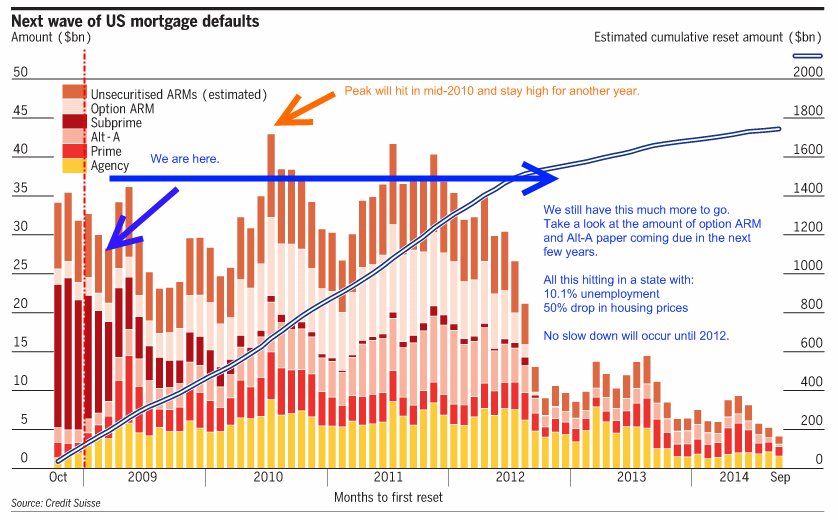
The Goslins bought their home with what's known as a 2/28 ARM -- the interest rate is fixed for only the first two years, then adjusts up. They also did 100 percent financing -- no down payment -- but later, they refinanced into an even riskier mortgage called an option ARM. It allows borrowers to make payments that don't even cover the interest on the loan. That's how they ended up owing even more than their purchase price.
...
Seth: I think because it's happening to so many, it doesn't really feel like a stigma. It sort of feels like... there seems to be a lot of sympathy.
Joanna: It seems like a couple of years ago, everybody at cocktail parties talked about how much their home value had increased and now it's, you know, how many bank-owned properties there are on their block.
[Realtor Alan] Waggoner and I do a little experiment. He checks the regular listings in Elk Grove. The average price is $447,000. Then he does the same search, but includes bank-owned homes and short sales -- those are the ones in pre-foreclosure. The total inventory more than doubles and it knocks the average price down to $370,000. The bank-owned homes have pushed the average price $80,000 lower.From the Sacramento Bee:
...
[Real restate agent Michael] Freeman: We have bank REO properties that are coming on... they're trashed and they are artificially driving the price down, because it's not really what the market would be bearing, but the buyer is going to take advantage of that.
Lenders took back the keys for 1,224 Elk Grove homes from October 2006, the earliest month for which figures are available, through the end of 2007, according to a Bee analysis of Federal Home Mortgage Disclosure Act data.From the Sacramento Business Journal:
The Sacramento County Association of Realtors expected thinner ranks this year with the housing downturn, and the prediction has held true...The association listed 5,577 Realtors as members this year, compared with 6,337 last year...The Placer County Association of Realtors also reported a 12 percent decline from last year, with about 2,300 active members this year, 320 fewer than in 2007.From Investment News:
Speculation is growing among analysts and home-building executives that the battered housing industry finally may be approaching a bottom, at least in terms of inventory of both new and existing homes. It could be the first sign that the hemorrhaging in the housing sector could be approaching an end. But if history is any indication, home prices may not start to bounce back for at least two years, and at least one analyst thinks it could take as long as four years.From the Sacramento Bee:
In the past, new-home sales typically started increasing about a year after supply and demand fundamentals stabilized, while home prices took at least two years to tick up, according to James F. Wilson, director of research and senior analyst with JMP Securities LLC of San Francisco...Mr. Wilson said that he has seen early signs of inventory stabilizing in certain markets such as Sacramento, Calif., and San Diego.
A fancy new campus rising in East Natomas has become the latest flash point in the toxic relationship between the Grant Joint Union High School District and the new school system that soon will absorb Grant. The new district, Twin Rivers Unified, will take over Grant and three other elementary districts on July 1 in a merger.From the Sacramento Bee:
...
Twin Rivers officials...are deeply worried about the current housing downturn, as well as a building moratorium in the Natomas basin while levees are improved. "Two and a half years ago, when they planned this and there was a housing boom, it made sense. Today it doesn't," said Rob Ball, Twin Rivers' associate superintendent. "We're going to have a brand new building and no students to put in it."
The economic downturn hasn't bypassed Loomis, population 6,529. The sales tax portion of its $3.5 million budget is down about 20 percent, largely from the struggles of construction- related businesses. But since Loomis' city government relies lightly on development fees, the town avoided the worst effects of the downturn.From the Sacramento Bee:
Sacramento, where unemployment has risen to 6.2 percent, is particularly vulnerable as the economy softens. Foreclosures have run into the thousands, and housing prices have fallen more than 25 percent in two years, making it among the hardest-hit markets in the country.From the Stockton Record:
...
[J]ob losses are spreading beyond the housing sector...The past few months in the Sacramento area have seen layoffs at employers as diverse as Intel Corp. in Folsom (112 jobs) and Sutter Medical Center's two main hospitals (54 jobs), although Sutter said all but 20 employees found jobs elsewhere in the organization. The general downturn loops back to housing: Consumers who have lost equity are less wealthy and less likely to spend.
You own a winery worth about $850,000, you've built up $1 million in real estate equity between the winery building and a couple of homes and, as a married couple, have a combined income well into six figures. So what have you got to worry about?
With the housing market collapse, a big new mortgage, uncertainty on Wall Street, a wife who is retiring this year partly for health reasons, looking to his own retirement in three years and a recent, sudden slump in wine sales, there was plenty to concern Rod Ruthel. "It was too many things happening at once. I was a little freaked out about it," said the owner of French Hill Winery in Mokelumne Hill.
He was particularly concerned when sales at the winery, normally a recession-proof business, had suddenly fallen by nearly half. Also worrying was a switch from credit card charges, usually nearly 100 percent of the trade, to one-third in cash - a sign customers were watching their spending more closely.