Showing posts with label El Dorado Housing Market. Show all posts

Tuesday, August 19, 2008

The Scarlet Letter

From the Sacramento Bee:

To some analysts, the region's rising sales – mirroring those elsewhere in inland California – suggested a path toward stability that could set in next year.
...
"I think in the Central Valley we're getting closer to the bottom. I still think it's going to be 2009," added Delores Conway, director of the Casden Forecast at the USC Lusk Center for Real Estate in Los Angeles. "But I think prices are bottoming out in Sacramento, the Inland Empire and some areas around Fresno."

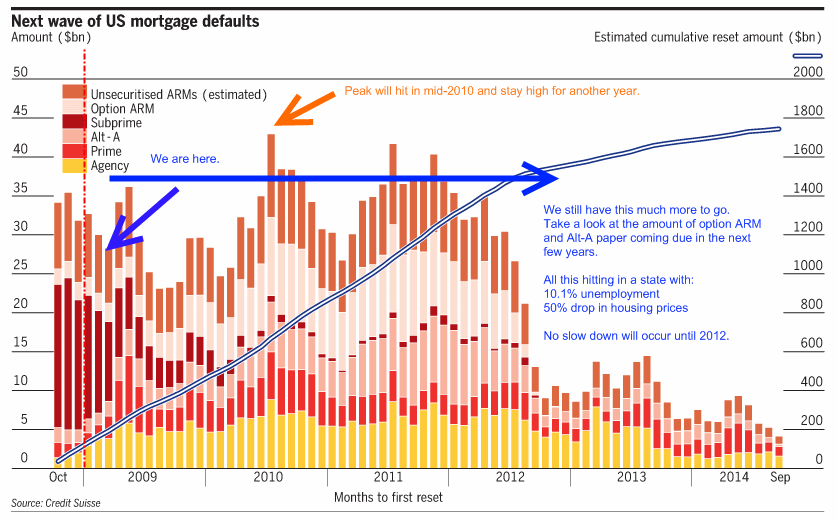
Caution abounds, however. Much rides on unemployment, which is rising in California, availability of credit, resets on a new wave of troubled loans and the pending loss of down payment assistance gift programs, analysts said.
DataQuick data via Home Front:
-By County [doc]
-By Zip [xls]

From the Sacramento Business Journal:
The price-per-square-foot of the average house in Sacramento County dropped to $141 and to $191 in El Dorado County, representing an overall regional decline of 33 percent from a year ago, according to Trendgraphix Inc., a real estate data tracking firm connected with Lyon Real Estate. Michael Lyon, CEO of Lyon Real Estate said bank-owned properties make up 63 percent of all sales and the inventory of those properties inventory continues to grow.
From the Sacramento Bee:
The housing market has collapsed. Growth pressures? Poof! Yet Elk Grove – or at least a large number of its council members – still continues the curious push to balloon the city's boundaries. Elk Grove is seeking to expand its "sphere of influence" over 10,536 acres south of the city, including parts of the Deer Creek and Cosumnes River floodplains.
...
Why this push? Why now? It's hard to say. There's no immediate need for Elk Grove to add rooftops. The city has scores of empty houses. What Elk Grove needs is new jobs, centrally located, so the city can evolve into a real city.
From the Modesto Bee:
The Modesto Bee offered buyouts Monday to all its full-time employees. The announcement comes four days after The McClatchy Company, which owns The Bee and 29 other daily newspapers, announced a companywide one-year wage freeze. "Unfortunately, the economy continues to worsen, and we must reduce expenses further," Publisher Margaret Randazzo said in an e-mail to employees. This is the second buyout The Bee has offered employees this year.
...
These actions follow last month's announcement that The Bee will cease printing in Modesto...That change will cost 33 full-time employees and 127 part-time employees their jobs.
A bit of déjà vu courtesy of InsideBayArea.com:
As the mortgage meltdown forces more homes into foreclosure in the Bay Area, some of these properties are being picked up by investors who are putting them back into the rental market...[A]s investors buy foreclosed homes and rent them out, the number of available rental properties is likely to increase, which could lead to lower rents down the road, observers say.
...
"We are starting to see a trend. Investors are picking up the homes and turning them into the rental market right away. ... We have not seen the foreclosures drive up rents anywhere right now" [said Eric Weigers, deputy director of the California Apartment Association.]...Foreclosure activity involving investors who are turning the homes they buy into rentals is indeed increasing the rental stock, said Steve Edrington, executive director of the state Apartment Association's northern Alameda County chapter..."I think we are in this transitional point where rents are going to slow down and sales of houses are going to pick up a bit because there is less inventory out there," he said. "The (foreclosed) homes are being bought and rented out and not being sold for owner-occupancy."
From the Stockton Record:
Stockton City Council tonight will consider an ordinance that will require vacant homes and other empty buildings to be posted with 24-hour contact information for the owner or local property manager on a street-facing, weather resistant, 4” x 6” sign. “Stockton has become a center for the foreclosure crisis,” says City Manager Gordon Palmer. “Our code enforcement officers have had a significant increase in the number of cases they are handling. This ordinance will help us quickly determine who the property owner or manager is and work with them to resolve problems and concerns before they deteriorate.”

Friday, June 13, 2008

Still Foreclosure Central Valley

From the CVBT:

With one in every 75 Stockton area households receiving a foreclosure filing in May -- more than six times the national average – the Central Valley city leads the nation in foreclosures. For the second month in a row, California and Florida cities accounted for nine out of the top 10 metropolitan foreclosure rates among the 230 metropolitan areas tracked in the report. Seven California cities were in the top 10, led by Stockton in the top spot. Other California cities in the top 10 were Merced at No. 3, Modesto at No. 4, Riverside-San Bernardino at No. 5, Vallejo-Fairfield at No. 7, Bakersfield at No. 8, and Sacramento at No. 9.
From the Sacramento Bee:
Sales prices for existing homes are down 40 percent from their 2005 highs in Sacramento County, and similarly down 36 percent in Yolo County, 31 percent in Placer County and 25 percent in El Dorado County.

The dollar volume of homeequity loans, too, has fallen. In 2007, homeowners in the four counties borrowed $2.1 billion less than they did in 2006, according to DataQuick Information Systems. During the housing boom's peak – 2002 through 2005 – consumers in those counties collectively tapped almost $22 billion in home equity. Sometimes even those who want to spend are finding their credit lines rescinded by lenders because of falling values, says Baker of D & J Kitchens and Baths.
From the Modesto Bee:
A combination of slow sales and a desire to do something different has led Gary Robinson to close his 33-year-old business, The Yard Lumber & Fence Supply in Modesto..."The timing just kind of fits," said Robinson, who explained that though the business is viable, he didn't want to keep it going during an economic downturn, waiting for sales to improve.
...
The Yard has about 20 employees, down from about 70 a year and a half ago, when Robinson said he consciously chose to scale back the business.
From the Lodi News-Sentinel:
Roughly 50,000 homeowners throughout San Joaquin County — one third of the total — will receive notices next month showing what they likely already know: That their home values are in a free fall. Ken Blakemore, the county's assistant assessor, said the notices should arrive July 10. They're the largest number to show declining values in a generation, if not ever, the longtime county official said.

Wednesday, March 26, 2008

Foreclosure Pets Phenomenon Intensifies

From News 10:

The Sacramento SPCA...is seeing a dramatic jump the number of animals being surrendered by owners who are going through foreclosure...During the last four months of 2007, the Sacramento SPCA took in 176 dogs and cats from people who said they were surrendering them due to "moving," said [Director Rick] Johnson. That is 100 more than the same four months in 2006. Johnson doesn't see the situation getting better any time soon.
From the Sacramento Bee:
The Sacramento City Council approved the $130 million sale Tuesday of its Sheraton Grand Hotel and garage on J Street – along with an unusual agreement to return about $23 million of the city's profits to the buyers as subsidies for additional downtown projects. Council members voted 8-1 in favor of the sale despite a public admonition by interim city Treasurer Tom Berke that more review is needed, particularly given the depressed state of the real estate market. He suggested the city might hold on to the hotel longer and wait for prices to rise.
...
Other council members called the price fair, and expressed fear that market conditions would deteriorate further and the deal would evaporate...Councilman Steve Cohn, addressing Berke, said, "If you're correct about how severe this recession is, now is exactly the time to sell.
...
In a brief appearance at Tuesday's council meeting, [David] Taylor said the Sheraton deal provides a way to keep downtown redevelopment alive during a bad economic cycle. "We were frankly seeing so many projects die downtown over the past 18 months that we were concerned about our ability to perform on some of the downtown projects we've been working on," he said.
From the El Dorado Hills Telegraph:
More than 70 people packed the main room of the senior center to ask questions and listen to updates about area road issues from a guest panel consisting of Richard Shepard, Department of Transportation director, Russ Nygaard, DOT deputy director, supervisors Rusty Dupray and Helen Baumann, and Captain Bill Donovan, of the California Highway Patrol.
...
Shepard and Nygaard were unable to give specific timetables for the completion of many DOT projects because of lack of funding, which Shepard said is directly tied to the housing market. "We’re facing a housing slowdown at the moment," Shepard said. "And 50 percent of our Capital Improvement Program revenue comes from housing development fees."
From the Associated Press via the Washington Post (hat tip Housing Wire):
Anticipating a surge in troubled financial institutions, federal regulators aim to increase by 60 percent the number of workers who handle bank failures. The Federal Deposit Insurance Corp. wants to add 140 workers in the division that handles bank failures, bringing the total to 360, said John Bovenzi, the agency's chief operating officer.
...
Gerard Cassidy, managing director of bank equity research at RBC Capital Markets, projects 150 bank failures over the next three years, with the highest concentration coming from states such as California and Florida where an overheated real estate market is in a fast freeze.

Friday, February 01, 2008

The Central Valley's 'Deep Recession'

From News10's Dana Howard:

Last September, I was driving through the newer neighborhoods in the northern section of Stockton, looking for people who were facing foreclosure. It was one of many stories about the rampant number of foreclosures in the Sacramento area.

My strategy was to knock on the doors of homes that had "For Sale" signs posted out front. Surely, I thought, many who would be selling their homes in what was then a climate of depreciating home values must be selling out of financial necessity, possibly to avoid foreclosure. We must have knocked on 50 doors. The overwhelming majority of the doors were unanswered. It wasn't because the owners weren't home, but because the owners would never be home. The houses were vacant.

People had plain given up, abandoned their homes. It was less than a month later that I did a similar story in the North Natomas community of Sacramento. Again, the same result. That said to me we are in for huge economic trouble that would go beyond the real estate and banking industries.
From homesforworkingfamilies.org [pdf report]:
Sacramento Metro Homeowner Vacancy Rates
2005Q1: 0.6%
2006Q1: 2.0%
2007Q1: 3.3%
2007Q3: 4.8% (4th highest rate out of 37 metros)
From Bloomberg:
"Conditions vary widely across the country, from a deep recession in the Central Valley of California to still boom-like conditions in parts of the Farm Belt,'' said Mark Zandi, chief economist of Moody's Economy.com in West Chester, Pennsylvania.
From the Associated Press (via CBS 13):
The house was ravaged -- its floors ripped, walls busted and lights smashed by owners who trashed their home before a bank foreclosed on it. Hidden in the wreckage was an abandoned member of the family: a starving pit bull. The dog found by workers was too far gone to save -- another example of how pets are becoming the newest victims of the nation's mortgage crisis as homeowners leave animals behind when they can no longer afford their property.

Pets "are getting dumped all over," said Traci Jennings, president of the Humane Society of Stanislaus County in northern California. "Farmers are finding dogs dumped on their grazing grounds, while house cats are showing up in wild cat colonies."
...
The situation has become so widespread that the Humane Society urged home owners faced with foreclosure to take their animals to a shelter. Shelters are trying to keep up, but the spike in abandoned pets comes at a time when fewer people are adopting animals. Home sales are plunging to their lowest level in decades, and new homeowners are often the most likely to seek a pet.

Even people who are buying homes are not adopting pets. "People are not bringing home puppies because times are tough, and animals cost money," said Sharon Silbert, president of Animal Rescue of Tracy, a community near Stockton.
...
Bloggers are furious with the "foreclosure pet" phenomenon, especially after seeing photos of emaciated animals on the Internet. Some critics say the pet owners have already proved they are irresponsible by buying houses they could not afford or mortgages they did not bother to understand. "They see a pet as property, no different than a worn sofa tossed into the alley when the springs pop," says a posting about foreclosure pets on About.com.
From the Stockton Record:
Amid all the anguish arising from the swelling volume of home foreclosures, there has been much talk about real estate fraud. But most of the complaints can't be criminally prosecuted, representatives of the San Joaquin County Office of the District Attorney said Thursday.

Most allegations won't mean charges either because the borrowers didn't tell the truth about income when applying for a loan or the buyers chose to believe they would be able to make the purchase work later with a refinance - but the market tanked and what amounted to speculation didn't pan out, said Robert Buchwalter, criminal investigator with the district attorney's office.

James F. Lewis, deputy district attorney in charge of the real estate fraud unit, told those attending a Northern California Housing Counseling Network quarterly meeting Thursday: "Some of these (filing complaints) are legitimately naïve and uneducated, and we have to try to figure out whether they are truly victims."
From News 10:
Facing a $55 million budget deficit, the City of Sacramento may be forced to cut funding for the city police and fire departments...Every department in the city, including the police and fire departments, has been ordered to submit proposals for 10 to 20 percent cuts.
From the Sacramento Bee:
City officials believe the involuntary layoffs are perhaps the first for Sacramento. "To my knowledge, we've never before laid off anyone," said Assistant City Manager Marty Hanneman. In the 1990s there were voluntary layoffs, he said.
From the Sacramento Bee:
More troubled housing talk: One of the biggest bank-owned home auctions yet is set for Feb. 16-17 at Cal Expo. Real Estate Disposition Corp., an Irvine auction firm, aims to unload more than 300 houses located in area counties during the two-day event. That's about one-third of the nearly 1,000 homes going on the auction block during seven days in Stockton, Sacramento, Modesto, Fresno and San Mateo.
From the Sacramento Bee:
The decline in new home construction means less money to build roads in El Dorado County. But some members the county Board of Supervisors expressed dismay that the El Dorado Hills area, long the county's fastest-growing community, appeared to be taking the biggest hit in terms of proposed road projects. "El Dorado Hills is a huge economic generator for us," said Supervisor Helen Baumann, whose district covers part of the community. "This is a huge statement to anyone wanting to come into the county."

Sunday, January 06, 2008

"Prices Are Still Too High for Potential Buyers" v. Consumer "Mental Disorder"

From the Sacramento Bee:

Dean Wehrli, vice president of the Sullivan Group Real Estate Advisors in Elk Grove: Foreclosures soar; buyers wait; credit tightens. The picture for Sacramento's residential market in 2008 doesn't look good...[P]rices are still too high for potential buyers. Consequently, prices will continue to regress in the second half of this decade to the place they should have been had we not been so frenzied in the first place. If we are waiting for equilibrium – when buyers hold as much "power" as sellers – then we will still be waiting by the end of 2008.
...
David Lyons, labor market consultant at the state Employment Development Department: The economic slowdown will translate into a weak labor market in the Sacramento region, with overall job losses outweighing those sectors still hiring. The regional economy is in for a very slow start to the year. The region generated a net gain in jobs in 2007, but the growth rate slowed to a crawl by year's end. As of November, the region had added just 6,600 net jobs in the past 12 months – a gain of 0.7 percent. It marked the first time the annual growth rate was below 1 percent since 1993. And 2008 is looking bleaker. It's very likely we're going to be in negative territory.
...
Dan Lankford, managing director of Wavepoint Ventures, an early stage investment company with offices in El Dorado Hills and Menlo Park: Most economists agree that the U.S. economy will slow in 2008. The Sacramento region will likely feel a more pronounced tapering off, given the boom of the last several years and the large role that real estate plays in the local economy.
From the Sacramento Business Journal:
Dean Wherli, a vice president with real estate adviser The Sullivan Group, offered a scenario last month during a presentation at an Urban Land Institute event that said if new-home prices around the region had appreciated at a more moderate rate -- say 6 percent instead of the fast-rising prices between 2000 and 2005 -- the price for a newly constructed home at the end of 2007 should have been about $319,000. Instead, the current median price is $385,990. The higher price means that, despite the deep discounts by new-home builders, the region's overall prices are still about 17 percent more than they should have been under the moderate-growth scenario. Wherli said if prices were to hold throughout 2008, by the end of the year they'd still be about 12 percent above the moderate-growth scenario.

Prices, however, seem unlikely to hold. Discounts are drawing a trickle of new buyers, so homebuilders are likely to continue to offer price reductions to lure more buyers.
From the Real Estate News blog:
Our local real estate market has already corrected itself from its past excesses. The median selling price for a county home is $100,000 less than two years ago...Since we all understand the financially successful concept of buying low and selling high, why is it that buyers aren’t?

Consumers are suffering from a mental disorder called media-itice. The affliction resulting from four years of being propagandized by the major media and the economic press about the collapse of the real estate, mortgage and credit markets. Beginning in 2003, consumers have been told that the real estate market was: popping, sinking, bursting, plunging, free-falling, imploding, exploding, collapsing and in total meltdown....Is it any wonder that potential homebuyers are put off from buying a home? Yes, there are some problems but isn’t all the hoopla over a small percentage of troubled homeowners a little too much?

Legislative changes in the mortgage, appraisal and credit industries, insuring market exuberance won’t happen again, will not change consumer immediate attitude toward real estate as a long-term investment and it will do nothing to perk up the county’s housing market. What our current local market needs is a stimulus that will attract homebuyers to El Dorado County.
From the Sacramento Business Journal:
The state's estimated $14.5 billion shortfall could hit Sacramento disproportionately hard if jobs around the Capitol are trimmed. Sacramento's loss of 7,200 construction jobs during the past year was mitigated by 6,000 new hires in government. Given the decline in sales-tax revenue and building fees that have hit all cities and counties, the region can't rely on government for economic growth this year.
...
Sacramento's core jobs are in financial services, construction and government, and none of them look especially strong in the coming year. Housing looks the weakest, with experts predicting further erosion in prices and even fewer sales than the estimated 7,500 new homes built and sold in 2007, down more than 50 percent from the peak years. Sales of existing homes aren't expected to recover this year either, with more foreclosures likely as another wave of adjustable-rate mortgages resets to higher rates. More than 14,000 existing homes were for sale in November 2007, 18 percent higher than a year ago, though down from the record high of 15,302 in September.
From the Sacramento Business Journal:
Sacramento's reliance on government, service, construction and financial service industries for growth in the office market could make for a lean year. With the construction industry taking a huge hit, there has been a ripple into the office market that those in the industry are hoping doesn't build into a wave. That means lease rates are stabilizing and concessions are rising. The region's office vacancy rate inched higher in the third quarter to 15.2 percent for nongovernment buildings larger than 5,000 square feet.
From the Sacramento Business Journal:
A stakeholder in Sacramento's Reynen & Bardis Communities Inc. has accused the builder of making just two monthly payments before defaulting on $19.8 million in obligations it took on this summer. The lawsuit brings the company among the ranks of other local builders struggling through the housing slump who have faced defaults and ended up in court as the market turns against them.

Thursday, December 20, 2007

Placer Popluation Growth At Lowest Level Since 1971

From the Sacramento Bee:

A few years ago, Placer and El Dorado counties were red hot, flush with Bay Area transplants and drawing more residents each year at a tremendous rate. Now that trend is cooling. Both counties grew at a slower pace in the past fiscal year than during any of the previous 35 years, according to population estimates released Wednesday by the California Department of Finance... Placer County hasn't seen a lower rate of population growth since 1971, according to state figures. And El Dorado's hasn't been this low since 1968.
...
The driver for the change appeared to be a statewide drop in domestic migration – movement from one part of the country to another. Instead, all of California's growth this year came from natural increase – more births than deaths – and immigration from other countries.
...
Changes in the housing market help explain the domestic migration trend, several experts said. With housing prices down everywhere, Bay Area bargain hunters may not have the equity to move or may be able to afford something closer to home.
...
Then there are the foreclosures. California residents who have lost their homes, [California's chief economist, Howard] Roth said, are opting to move out of state. In all, about 90,000 more people left California than came here from another state this year, and Roth said that trend may be cause for concern. When more residents leave than arrive, he said, it "often relates to what people think of California. Our economy is slowing down. We had a pretty big housing bubble that burst."
From the Sacramento Bee:
Rising construction costs and rapid growth have prompted Roseville elected officials to increase two developer fees and establish a new one, despite the sluggish housing market....City Manager W. Craig Robinson said cost pressures are affecting the city's ability to build promised facilities, many of which are needed to serve new development.
...
Building industry representatives, however, say the fee increases come at a bad time. "During this downturn, and probably for the foreseeable 18 months ahead of us, we think the market will continue to decline," said K. Hovnanian Homes' Frances Knight. "We suspect that the projections on building permits are going to be worse than estimated currently."
...
Wendy Gerig, Roseville Chamber of Commerce's chief executive officer, asked the council to delay the fee increases until the economy picks up. This year, a record number of businesses dropped their chamber membership because they folded or had financial constraints, Gerig told the council.
From the Sacramento Bee:
A recent Rancho Cordova forum, organized by Councilman Ken Cooley, drew about 80 people to City Hall to hear presentations by nonprofit organizations on options for those who miss mortgage payments and state and federal officials on what options they have to stave off foreclosure.
...
Past advice has gone out the window since the subprime collapse,...[Mike Himes, homeownership services director at NeighborWorks, a national nonprofit] said. Two years ago, the idea was to get into a house as fast as possible and eventually refinance the loan, he said. "Did anyone know two years ago there'd be a crash in the market?" Himes asked.
From the Stockton Record:
Stockton remained on top, with one foreclosure filing for every 99 households - more than six times the national average. Modesto had the No. 2 spot, with one foreclosure filing for every 104 households, and Merced took the No. 3 spot, with one foreclosure filing for every 106 households.
...
Steve Carrigan, Stockton's economic development director, said he doesn't see a downswing in foreclosures coming any time soon to the Stockton area. "It's bad, and it's going to get worse," he said. "We're going to have to weather this."

Weston Ranch Realty owner and broker Steve Clark said he hasn't seen any signs that the foreclosure scene is improving. A lot of people still come into his office hoping to list their houses in hopes of selling to avoid foreclosure, he said. Typically, though, they owe at least $100,000 more on the house than they could get for it, he said. "We can't list it," he said he tells them. "Nobody will buy your home and help you out of this mess."

There have been hardly any sales all this year, anyway, he said, adding that his office mainly handles property management for rental homes - an active scene. "I don't see a change any time soon," Clark said. "It's terrible, and I have a hard time seeing where the silver lining is."

Wednesday, August 29, 2007

From 'Making Lots of Money' to 'Waiting Tables at Denny's for $8 an Hour'

From the Sacramento Bee (hat tip Cymst & Fanchew):

The downturn in the housing market -- with job losses in the industry really kicking in during 2007 -- is starting to hit the region's breadwinners. "Job growth has slowed down quite a bit in the first months of 2007," said Howard Roth, chief economist at the California Department of Finance. "Construction, home sales -- it's all going down."

Which is not news to Rachel Brandon of Sacramento. She shook an emphatic "no" when asked Tuesday if she is better off than she was in 2005. "My career for the past 10 years was in the mortgage industry," said Brandon, who is 39. "I have a license to do loans. Two years ago I was making lots of money -- I was making deals in my pajamas from home. Now I'm waiting tables at Denny's for $8 an hour."

Still, she's optimistic. "I really like my job at Denny's," she said. "I'm learning quite a bit, and someday I'd like to have my own cafe. But, two years ago if you asked me if I'd be working for $8 an hour today, I'd have said 'God, no way.'"
From the Folsom Telegraph (hat tip Patski):
Folsom and El Dorado Hills seem somehow insulated from the recent shockwave of declining home sales reverberating through other parts of the Sacramento region.
...
Still, potential homebuyers in the area, spurred by the nationwide media blitz in regard to declining home sales, are more apt to take a hard stand in search of a real deal. "Some buyers have the mentality right now that they think they have to lowball on home sale offers," said Jeff Traxler, a realtor for REMAX Gold in El Dorado Hills..."The psychology of the buying public right now is that if they buy something they want a good deal," [Patrick] Hake [of REMAX Gold in Auburn] said. "A lot of people want to negotiate the asking price down. There are a lot of lowball offers going out, but most are being rejected.
...
Then there are buyers who believe they can predict when the real estate market will actually bottom out. "There are people trying to time and buy at the perfect moment," Hake said. "The few people who get lucky and do that will probably tell people how smart they are for the rest of their lives. But the truth is, the market could go back up for six months and then go right back down again."

As a general rule, real estate agents are trying to put a positive spin on the situation.
...
Although Folsom and El Dorado Hills home sales numbers have declined slightly, there's certainly no widespread panic among realtors in this area. 'It's certainly not a positive thing to see sales numbers go down," Hake said. "I'd much rather see the numbers go up. I'm not making the assertion that the market is increasing in Folsom by any means. I'm just making the assertion the Folsom market is not having as many problems as some of the other areas."
From the El Dorado Hills Telegraph:
Folsom and El Dorado Hills are located in the ninth worst market - the Sacramento metropolitan area - for home foreclosures nationwide, but they've been spared the carnage somewhat...Sacramento County saw 3,840 notices of default filed between April and June 2007, a 184 percent jump compared with the same quarter in 2006, reported DataQuick. El Dorado County, with 222 notices filed, saw a slightly smaller increase of 158 percent. But Jim Foster, who works with JM Morgan Funding in Folsom and lives in El Dorado Hills, said neither area was as hard hit as regions like Elk Grove, Lincoln, and South Sacramento.
...
When foreclosures do occur in Folsom, they're mostly among younger couples who financed their house with no payment down and adjustable-rate mortgages - the phenomenon that's rendered fast-growing areas like Elk Grove rife with lost homes...Foster knows of two or three Folsom couples in their 20's who allowed the bank to foreclose on their homes, opting to rent instead. "They weren't even behind on their mortgage," Foster said. "They just figured they could rent a house for half the payment, and twice the square footage."
...
El Dorado Hills is a slightly different animal, he said. On his own street, Powers Drive, Foster has watched foreclosures on at least two $1 million-plus homes in the past six months. "A lot of these people were dialed into real estate as mortgage brokers or builders and this industry has taken a big hit," he said. "Some are making one-tenth the money they made before."
From the Merced Sun-Star:
As usual, Merced's poverty rates ranked well above state and national averages, which both held steady at about 13 percent. What's different about this year's data is that Merced County is faring worse than its Central Valley neighbors.
...
Simon Weffer, a sociology professor at UC Merced, linked Merced's grimmer poverty picture in part to the recent housing boom and subsequent bust. Merced's building activity and home sales reached record highs in 2005, raising incomes and lowering poverty along the way. Now the slowdown is hitting Merced harder than its Central Valley neighbors. "It's important to realize that what's going on in Merced is not happening in other counties," said Weffer. "Part of it is that the housing market hasn't collapsed as badly in other counties.

Wednesday, August 22, 2007

'Kind of a Real Estate Bust'

From the Sacramento Business Journal:

San Diego-based sub-prime lender Accredited Home Lenders Holding Co. said Wednesday it is not taking any new loans and it is closing "substantially all" of its 60 lending offices and five support locations as of Sept. 5.

Accredited has retail branch offices in Sacramento, Folsom and Roseville, and it has a centralized retail office in Sacramento.

The moves are part of a restructuring in response to turmoil in the mortgage industry. Those moves will cost 480 people their jobs.
From the Inman Blog:
What a week. Since Friday, banks and mortgage lenders have announced more than 13,000 layoffs.
From the Associated Press (hat tip Sonoma Housing Bubble):
...[M]ore than 25,000 workers nationwide...have lost jobs in the financial services industry since the beginning of the month -- with more than half coming since last Friday. With few exceptions, the cuts are the direct result of woes in the nation's housing market.
...
Since the start of the year, more than 40,000 workers have lost their jobs at mortgage lending institutions, according to recent company layoff announcements and data complied by global outplacement firm Challenger, Gray & Christmas Inc. Meanwhile, construction companies have announced nearly 20,000 job cuts this year....

It's an employment collapse that threatens to rival the massive layoffs in the airline industry that followed the Sept. 11, 2001, terrorist attacks, when some 100,000 employees lost their jobs.
From the Roseville Press Tribune (hat tip Jeff):
A downturn in property values is showing up on Placer County's assessment rolls, with a drop in assessed values taking a bite out of growth. Placer County Assessor Bruce Dear told the Board of Supervisors at a budget workshop Tuesday that the county's assessment roll increased from $52.3 billion last year to $56.8 billion - an 8.52 percent jump. But the $4.5 billion increase for the year would have been nearly $1 billion more if real estate values hadn't decline, forcing a downward adjustment on about 18,000 mostly residential properties.
...
"The market activity in the spring was kind of a real estate bust," he said. "It suggests the numbers will continue to decline significantly in this assessment roll." For a county that had experienced assessed value increases of never less that 12.76 percent a year since 2001, this year's 8.52 percent rise has already spurred county budget officials to warn that the slowdown in property tax revenue could escalate in the next two years.
...
Sacramento County discontinued offering medical and dental subsidies retiring after May 31 because of a projected $33 million shortfall. El Dorado County is reducing its workforce by 26 positions through early retirements and layoffs, he [Placer county CEO Tom Miller] said.

DQNews July 2007 Results (Take 2)

Let's try this again. Year-over-year (yoy) change in median prices for the 4-county area (resale single family residences and condos as well as new homes):

  • El Dorado: -0.94%
  • Placer: -6.52%
  • Sacramento: -11.10%
  • Yolo: -5.37%
Sacramento County's median price has now declined 14 consecutive months on a year-over-year basis. The number of California counties with yoy declines has doubled since last July (from 11/32 to 22/32). Five counties registered double-digit drops.

Thursday, July 26, 2007

DQNews July June 2007 Results

Change in Median Sales Price from July June 2006 (resale single family residences and condos, new homes)

El Dorado: -0.82%
Sacramento: -11.17%
Placer: -4.33%
Yolo: -4.39%

About [edit] A year ago, this blog noted that 11 counties registered year-over-year price declines. Now 25 out of 32 counties have joined California's depreciation club (whose founding member was Placer). Nine counties made the exclusive double-digit depreciation list.

Tuesday, July 24, 2007

California Breaks 90s Foreclosure Record; Another High For Sacramento

From DQNews:

Trustees Deeds recorded, or the actual loss of a home to foreclosure, totaled 17,408 during the second quarter. That is the highest number in DataQuick’s statistics, which go back to 1988. That was up 57.8 percent from 11,032 for the previous quarter, and up 799.2 percent from 1,936 for last year’s second quarter. The prior peak of foreclosure sales was 15,418 in third-quarter 1996....
...
Roughly half, 54.6 percent, of the homeowners in default emerge from the foreclosure process by bringing their payments current, refinancing, or selling the home and paying off what they owe. A year ago it was 88.0 percent.
From Bloomberg:
The number of defaults resulting in foreclosures is the highest since DataQuick began keeping records. The previous high was in early 1994, when about 30 percent of defaults resulted in foreclosures, Karevoll said.
...
Homeowners received 53,943 default notices, more than double the 20,909 filed a year ago....Last quarter's default level was the highest since the fourth quarter of 1996, when 54,045 notices were recorded in California...The number of default notices sent to homeowners in California...has averaged 34,172 quarterly since DataQuick...began tracking the data in 1992.
From the LA Times:
When the increase in housing stock over the last decade is taken into account, foreclosures are running roughly equal with the 1996 peak.
...
"We're clearly in for a worse third quarter and an even worse fourth quarter," said John Karevoll, chief analyst at DataQuick Information Systems, which compiled the data.
...
Karevoll said the default numbers reflected a wide regional disparity. They were at record levels in Riverside, Contra Costa, Sacramento and most Central Valley counties, where many of the state's first-time buyers live.
From the Sacramento Bee:
Sacramento County, with 1,662 foreclosures and 3,840 notices of default, had the region's greatest share of foreclosure related activity.

"It's like that book, 'The Perfect Storm,'" said Sacramento real estate agent Carey Covey, a specialist in marketing homes repossessed by banks. "All the factors have come together to create this situation."
Sacramento County:
  • Notices of Default (NOD) Year-over-Year Change: +184%
  • Foreclosures Year-over-Year Change: +850%
Placer County:
  • NODs: +127%
  • Foreclosures: +659%
Yolo County:
  • NODs: +201%
  • Foreclosures: +10,200%
El Dorado County:
  • NODs: +158%
  • Foreclosures: +2,125%

Wednesday, May 23, 2007

In Come The Waves: Government Job Layoffs?

From the Sacramento Bee:

The El Dorado County Board of Supervisors on Tuesday rejected an increase in building permit fees and instead directed staff members to cut $1.6 million from the Building Services Department budget through layoffs or by transferring employees to jobs in other county departments...The board held out hope that creative solutions would be forthcoming in the next two months that would minimize or avoid layoffs.
...
[Development Services Director Greg] Fuz had proposed a 35 percent increase in building permit fees to compensate for declining revenues caused by a slowdown in housing construction. The demand for building inspection services remains high, he said, but the decline in single-family home construction, the department's largest revenue generator, has created a funding gap.

In 2006-07, $1.6 million from the county's general fund was required to supplement the department's budget, and that figure would increase to $2.2 million in the coming fiscal year without cost cutting or fee increases, Fuz said.

Noting that the demand for services remains high and citing difficulties in recruiting employees in recent years, Fuz said he sought the fee increase to avoid disruption of current services and to be ready to handle an upturn in the housing market.

But representatives of area building industry associations urged the board to reject the fee increase, saying their members are laying off employees and struggling to stay in business.

Monday, May 21, 2007

Housing Bust, Budget Crunch

From the Sacramento Business Journal:

The North State Building Industry Association typically frowns on escalating building fees, but the organization didn't object to a 30 percent fee increase in Sacramento County.

Those one-time increases to building permit and plan check fees are estimated to add about $875 to the cost of building a 2,200-square-foot home. Supervisors on Tuesday approved the fee increase, effective July 1, to replace reduced fee revenue stemming from the decline in new-home construction.
...
Similar fee increases of 35 percent have been proposed in El Dorado County to deal with falling revenue from the housing bust.

Unlike cities, many county building departments are self-sustaining, meaning they don't draw general fund revenue, said Harold Bixler, Sacramento County building chief. This fiscal year, the county expects building-permit revenue to decline 15 percent to less than $2 million, which is significantly less than during the boom years. "We're in quite a bit of a budget crunch," Bixler said. "What I take in fees is what I have to run this office."
Is the use of the phrase "housing bust" a first for this publication?

Wednesday, May 02, 2007

Zacramento

From the Sacramento Business Journal:

Median home values in the Sacramento area dropped 7.4 percent in the first quarter from a year ago [and down 9.2% from peak], the latest evidence the housing market slowdown continues in the region.

Yolo County endured the region's largest decline in value, at 13.2 percent to $394,990, according to Zillow.com, an online real estate tracking company in Seattle.
...
Sacramento County had the region's second-largest drop at 8.1 percent to $354,681. Existing home prices in El Dorado and Placer counties fell 6.4 percent and 3.5 percent, respectively.
...
All 35 communities in the four-county region -- from Antelope to Woodland -- reported declines in price. [Also, all but one neighborhood in the city of Sacramento suffered price declines, according to Zillow.]
Click here to compare to other price indexes.

Monday, April 23, 2007

Not So Soft Landing: Sacramento Median Price Down By Double-Digits YOY

March 2007 median price statistics from DataQuick's dqnews.com (and archived here):

  • El Dorado: -13.72%
  • Placer: -7.79%
  • Sacramento: -10.53%
  • Yolo: -12.59%
Statistics are for resale single-family residences and condos as well as new homes. Percent change is from the same month last year or "year-over-year" (yoy).

Significantly, this was the first time Sacramento County's median price breached the negative double-digit threshold for this particular price measurement. It was also the 10th consecutive month of yoy price declines.

Click here to compare with other Sacramento housing market price indexes.

Friday, April 13, 2007

'It's Kind of a Tough Market'

From the Sacramento Bee:

For two months, it looked like Sacramento might finally be climbing out of its housing slump. Then the bottom fell out of the subprime loan market and threw home sellers a curve.

"It's kind of a tough market," said Pradeep Gosai, who relisted his $529,000 house in Natomas this week after turning down offers last year that were "different from what we wanted." "Now it's a lower price than last year. I hope we make it," he said.
...
Builders and real estate agents attribute the unexpected March slowdown to negative publicity from the subprime lending industry meltdown and tightening of lending standards that eliminated would-be buyers.

Sacramento real estate agent Carey Covey said many first-time buyers no longer qualify for today's more demanding loans. Across the nation, lenders battered by rising defaults and foreclosures are again requiring down payments from buyers and detailed proof of income.

"They actually wanted the buyers to have a pretty good credit history and a job and some income coming in," said Covey, who now is trying to sell 42 properties repossessed by the banks.
...
March closings represent sales started in December, January and February before extensive publicity about imploding subprime lending firms and tougher new lending rules.
...
DataQuick Information Systems reported this week that the median price of [all] homes fell from February to March in five of eight area counties -- dropping by $20,000, to $460,000 [-13.4% yoy], in El Dorado County, for example, and by $15,250, to $340,000 [-9.3% yoy], in Sacramento County....[M]edian sales prices of existing homes remain about 6 percent lower than last year in Yolo and Sacramento counties and about 7 percent lower in Placer.
...
The inventory of resale homes on the market continued its seasonal rise in March, according to Sacramento-based TrendGraphix, raising the specter of further price declines and fierce seller competition ahead. TrendGraphix reported 12,500 listings -- 1,090 more than last month -- in El Dorado, Placer, Sacramento and Yolo counties, while the Gregory Group showed new home builders have 4,268 houses in their unsold inventory, a 15-week supply.

"Inventory is still the elephant in the living room," said Gold River real estate agent Randy Dunham. "That's why we've had an almost 1 percent drop in values each of the last six months."

Price/sales chart
Inventory graphs
Price by zip chart

From the Sacramento Business Journal:
New-home sales rose 30 percent in the first three months of the year compared with the same period in 2006, a sign that aggressive pricing might be continuing to lift Sacramento homebuilders out of the depths of the slump.

New-home inventories, however, crept up after falling last quarter for the first time in two years, according to a report released today. And homebuilders aren't certain what the fallout will be from the subprime mortgage meltdown as lenders are floating fewer loans to homebuyers with questionable credit.

"Pricing is down, and that's part of the reason why sales are up," said Greg Paquin, president of the new-home analyst The Gregory Group, which tracked the first quarter new-home sales figures for the six-county Sacramento region.

The average new home in the region sold for $465,100, down 6.3 percent from a year ago. His figures show the median home price has dropped even more -- 9 percent to $423,900. Homebuilders have dropped those prices to compete for buyers.
...
He noted there were a record 390 separate new-home projects within the six-county area selling homes and competing for buyers. So while sales numbers were up, the overall sales rate for the region has stayed level for the past six months. The region's new-home inventory -- everything from a completed home to a lot ready for construction -- increased by 8.7 percent. Analysts believe inventory is key to a turnaround because a large supply gives buyers plenty of options and increases competition, further dropping prices.
...
What does all this mean for the rest of 2007? "That's anybody's guess," [Doug] Pautsch [Sacramento division president for Centex] said. "This year should be similar to last year. It's not going to skyrocket."

Sunday, March 25, 2007

Sacramento Housing Market Statistics

More DataQuick median price numbers for February via dqnews (and archived here):

  • El Dorado: -1.34%
  • Placer: -5.38%
  • Sacramento: -6.98%
  • Yolo: -10.00%
Data is for resale single-family residences and condos as well as new homes.

Since Placer County became the first California county to register a price decline back in January 2006, the 4-county region has largely dominated the California depreciation club. In February 2007, that distinction passed to Merced County, which registered a 14.67% decline.

Significantly, February was the first month in which all listed Central Valley counties chalked up year-over-year (yoy) price declines, with Kern County finally succumbing:
  • Fresno: -6.33%
  • Kern: -1.83%
  • Madera: -5.27%
  • Merced: -14.67%
  • San Joaquin: -7.11%
  • Stanislaus: -9.38%
  • Tulare: -4.09%
Here are February results from the California Association of Realtors. This data is based on MLS single-family homes sales in the Sacramento region.
  • Change in median price (yoy): -1.2% [8th month of yoy declines]
  • Change in median price (from peak): -5.2%
  • Change in homes sold (yoy): -17.5% [23rd month of yoy declines, 18th month of yoy double-digit declines]
Here are the Sacramento Association of Realtors (SAR) results for February. Figures are for MLS single-family home sales in Sacramento County and West Sacramento. Additional statistics are available here.
  • Change in median price (yoy): -1.5% [8th month of yoy declines]
  • Change in median price (from peak): -6.4%
  • Change in homes sold (yoy): -14.7% [21st month of yoy declines, 18th month of double-digit declines]
The SAR sales graph has been updated. Click to enlarge.


Interestingly, in SAR's press release [pdf], the organization acknowledged the impact the sub-prime implosion is likely to have on the Sacramento housing market.
The Association of REALTORS® is aware that the widely publicized restructuring in the sub-prime lending market will likely have a dampening effect on real estate sales, at least in the short term. "Being entangled in risky loans and a declining market is clearly painful for lenders as well as mortgage borrowers,” said [SAR President Tracey] Saizan. "More disciplined lending policies will be good in the long run for home buyers and the mortgage bankers who serve them."
Given the mortgage meltdown, will sales peak in March as they did last year?

Want more? Julie Jalone has TrendGraphix's press release for February. Based on the press release and the information available at golyon.com, the average price per square foot in Sacramento County declined 5.0% from last year and 9.4% since peaking in September 2005. Pending sales dropped 8.5% from the prior year.

Wednesday, February 28, 2007

Location (Negative), Location (Negative), Location (Negative)

For the first time in the current housing bust, every reporting zip code in Sacramento County showed a price decline in January from year ago levels. The following graph shows the percentage of zip codes registering price drops based on the median price per sq. ft. of resale single-family detached homes. Click to enlarge.


Agent Bubble has been kind enough to provide average price per sq./ft. data for all residential MLS listings in Sacramento County (for January):

  • Change in price since last year: -9.9%
  • Change in price since 2005 peak: -12.0%
Meanwhile, the California Association of Realtors released their price and sales data for January 2007. The data is based on MLS single-family homes sales in the Sacramento region.
  • Change in median price since last January: -3.4%
  • 7th month of year-over-year (YoY) price declines
  • Change in median since price peak: -8.6% (down $34,110)
  • Change in homes sold since last January: -20.9%
  • 22nd month of YoY sales declines, 17th month of YoY double-digit declines
DataQuick's dqnews.com also has January's city/county numbers for combined sales (resale single family residences and condos as well as new homes). Yolo County continues to lead California in year-over-year price declines.
  • El Dorado: -6.81%
  • Placer: -9.01%
  • Sacramento: -6.25%
  • Yolo: -22.50%
January's DQ stats are archived here.

Friday, February 16, 2007

Hope in Sacramento? Sales, Prices, Pendings Down; Inventory, Foreclosures Up

From the Sacramento Bee:

How does the capital region's housing market look so far this year? Not unlike last year -- but with a bit more hope that the free-fall in prices and sales may be ending.

The new year opened last month with the fewest escrow closings for a January since 1998, according to property researcher DataQuick Information Systems. The firm reported similar slides to 1990s levels in the Bay Area and Southern California.
...
DataQuick reported 2,522 buyers of new and existing homes picked up the keys last month in Amador, El Dorado, Nevada, Placer, Sacramento, Sutter, Yolo and Yuba counties -- down from 2,999 the same time a year ago.
...
Median sales prices, meanwhile, continued a months-long trend of falling below the same month a year earlier in seven of eight capital-area counties. Only Nevada County saw higher sales prices than in January 2006.
...
Sacramento County reported a median January sales price of $345,500 for all new and existing homes, down 6.6 percent from the same time last year. In December the year-over-year decline was 9.1 percent. Likewise, Placer County's median $423,500 median sales price was down 10.8 percent from January 2006. In December prices were down 18.2 percent from a year earlier.
...
January also ended with 10,971 existing homes for sale in El Dorado, Placer, Sacramento and Yolo counties, according to Sacramento-based real estate researcher TrendGraphix. That's nearly triple the number of homes for sale in January 2005 and a major contributor to falling prices, analysts say.
...
Many in the real estate industry predict that a housing recovery could take hold during the year's second half. But others worry that too many homes for sale and growing foreclosure activity could prolong or worsen the region's housing slump.

Saturday, February 10, 2007

Sacramento's Zindex

From Zillow Blog:

Overall, across the U.S. areas Zillow covers, home values showed their first year-over-year (YoY) decline since the start of the data series in 1997, with the Zindex recording a slight decrease of 0.48% from its Q4 2005 level (see the figure below). This is substantially down from the year-over-year increase of 5.0% in Q3 and the quarter-over-quarter (QoQ) change of -4.8% for Q4 is significantly off the 2.4% QoQ increase in the prior quarter.

Performance varies widely by metropolitan area as seen in figure below showing year-over-year appreciation rates for the top 25 largest metro areas. Seattle, Portland and Charlotte appear to be booming with YoY increases above 11%. Greenville, Sacramento and Boston are lagging with YoY decreases greater than 5%.
You can download the Sacramento spreadsheet here [xls]. Some highlights:

YoY Zindex Change
  • El Dorado: -4.81%
  • Placer: -5.97%
  • Sacramento: -6.74%
  • Yolo: -8.64%
  • Sacramento (city): -6.75%
The spreadsheet also contains information by city and neighborhood.
  • Cities in the region with a negative Zindex: 84%
  • Neighborhoods in Sacramento (city) with a negative Zindex: 90%
What is a Zindex?
The Zindex home valuation index is the median Zestimate valuation for a given geographic area on a given day.
How does it differ from the median sales price statistic?
One popular method is using the median sale price of homes over a certain period of time, such as a month. While interesting, this measure is problematic because it is influenced by the mix of housing sold in the period of time associated with the metric.

For example, if high-end homes were not selling very well, but mid-range homes were, then the median sale price will be lower than it should be. It will not be an accurate reflection of the "general" level of home values because the median is taken from the set of mid-range home sales that happened in the period, ignoring the high-end homes that didn't sell. The median sale price would be a perfectly accurate reflection of home values in an area if every home were bought and sold in the particular time period. Since this is highly unlikely, the median sale price is biased to the extent that the homes sold in a given period are not completely representative of all the homes in the area.