Tuesday, September 30, 2008

Bee: "Bailout rejection could hurt Sacramento region's recovery"

From the Sacramento Bee:

The rejection of the Wall Street rescue plan may have jolted Sacramento's struggling economy and harmed the fragile recovery in the region's housing market...[Real estate broker Steven] Krohn, who's also an economist, had been seeing evidence lately that housing prices were firming up in Sacramento. Now he wonders where the market's going. "We have a lot more gloom and doom than confidence," Krohn said.
...
Others, though, were pleased with the House vote. Rick Hagstrom, chief operating officer at Tri Counties Bank in Chico, called the bill "a gross disruption of free markets" and said its proponents were exaggerating the severity of the problem. There's money available, he said, but borrowers are becoming gun-shy.
...
Kevin Harper, a resident of Cool in El Dorado County, had his house repossessed this year. A carpenter who worked on bridges, he was injured on the job. Unable to work, he said the banks wouldn't help him stay out of foreclosure. Now, he has no interest in seeing Wall Street bailed out. "I think they should have to pay exactly like I had to pay," he said. "I had to declare bankruptcy. Those fools, they should, too."
From the Sacramento Bee's Editorial Page:
Could more Republican members of the House of Representatives act like adults, please? If they can bring themselves to do so, the House may yet do the responsible thing and pass the financial bailout bill that failed on Monday. If not – well, let's not dwell on such a depressing prospect. What happened Monday was depressing enough.
Looks like The Bee may need its own bailout soon enough:
The McClatchy Co. had its credit rating downgraded again Monday amid continuing fears about the Sacramento publisher's falling revenue and profit. Standard & Poor's Ratings Services said it was concerned about McClatchy's announcement Friday that it had renegotiated its bank loans to provide more breathing room for the company. While investors seemed to welcome the news, S&P took it as a sign that McClatchy's troubles are deepening more quickly than expected amid a weak economy and competition from the Internet.
From the Associated Press:
The three vulnerable Democrats voting "yes" [on the bailout bill] were Tim Mahoney of Florida, Paul E. Kanjorski of Pennsylvania and Jerry McNerney of California. Some of those who voted for the bailout said they did so in possible conflict with the districts they represent.

McNerney, a wind engineer and political neophyte before his election to Congress in 2006, said his district opposed the bailout but he felt it was best for the economy. "People's jobs are a great deal dependent on this," he said, as well as "their home loans and all of their livelihood."
From News10:
Doris Matsui, D-Sacramento, also supported the bailout plan, stating that it would have taken responsible steps toward solving the financial crisis..."We must protect people's jobs. We cannot stand by and watch as businesses are forced to cut back operations. We have to preserve people's retirement accounts, their ability to access credit to buy a home, to open a small business or take out a loan to send their children to college," said Matsui.
From the Financial Post:
At first glance, anyone who understands economics can see that there is something wrong with this picture. The taxes that will need to be levied to finance this package may keep some firms alive, but they will siphon off capital, kill jobs and make businesses less productive elsewhere. Increasing the money supply is no different. It is an invisible tax that redistributes resources to debtors and those who made unwise investments.
...
[W]hat should be done when that pyramidal scheme starts crashing to the floor, because of a series of cascading failures or concern from the central bank that inflation is getting out of control? It’s obvious that credit will shrink, because everyone will want to get out of risky businesses, to call back loans and to put their money in safe places. Malinvestments have to be liquidated; prices have to come down to realistic levels; and resources stuck in unproductive uses have to be freed and moved to sectors that have real demand. Only then will capital again become available for productive investments.
...
As Friedrich Hayek wrote in 1932, “Instead of furthering the inevitable liquidation of the maladjustments brought about by the boom during the last three years, all conceivable means have been used to prevent that readjustment from taking place; and one of these means, which has been repeatedly tried though without success, from the earliest to the most recent stages of depression, has been this deliberate policy of credit expansion. ... To combat the depression by a forced credit expansion is to attempt to cure the evil by the very means which brought it about ...”

Monday, September 29, 2008

John Courson - The Next MBA President?

From the Sacramento Bee:

A veteran Sacramento mortgage banker who has been lobbying Congress to pass the $700 billion bailout has been accused of defrauding 11 of his former branch managers and embezzling $879,000 from them in the collapse of his Folsom mortgage brokerage in 2007. The allegations against John A. Courson, owner of the defunct Folsom-based Central Pacific Mortgage Co., are described in a civil lawsuit filed last year by eight of Central Pacific's former branch managers in California, two in Maryland and one in Florida.

Courson, 66, is chief operating officer of the Mortgage Bankers Association of America in Washington, D.C...Courson, a resident of Rancho Murieta, was named chief operating officer July 22. He is scheduled to become MBA president in January.
...
Florida branch manager and owner Jenny Mann alleges she lost $20,000. "When I saw he was appointed chief operating officer, I nearly died," Mann said from North Florida, where she lives. "Don't they know he did this to us? I would have assumed he would never work in this industry again."
From the Sacramento Bee:
Bertram Chatham, owner of a Citrus Heights Halloween store, says he's just as good a businessman today as he was a year ago. So when Wells Fargo & Co. slashed his available line of credit this summer from $26,000 to $10,000, he knew he'd gotten snared by the nation's credit crunch. The reduced financing prodded him to scale back his operation this fall, at a cost to the economy of about 30 jobs..."Credit is drying up," Chatham said. "Not just for the big banks but the guys on the street."
...
"No matter how you feel about Wall Street and the high-finance executives on Wall Street, you have to understand that no matter what, this would eventually land on Main Street's door," said Joe Anfuso, president of Central Valley homebuilder Florsheim Homes. "It's going to end up on everybody's front door in terms of credit cards being revoked, no more home equity lines, small business lines of credit, payroll lines of credit."
From the Sacramento Bee:
Hard times are swelling attendance at job fairs both locally and across the state. At McClellan Park on Thursday, 400 job seekers went through in the first hour of the state Employment Development Department "talent transfer" fair, designed to help unemployed workers from the depressed housing industry get into jobs where their skills are in demand. The five-hour fair drew nearly 1,000. State officials said job fairs are seeing about twice as many participants as they were getting only two years ago. Local companies said they're seeing two to three times the candidates they had at recruitment events in 2006.
From News10:
At Sacramento Crisis Nursury, every bed has been filled the last two weeks and Director Sue Bonk says the economy is the reason. "There are no jobs, and the stress level in people's lives is just getting over the top," Bonk said....Domestic violence counselors say phone calls to crisis centers are up this year and that many victims are afraid to leave abusive homes and face a worsening economy.
From the Sacramento Business Journal:
Matt Lemos earned $80,000 a year as a customer relations manager at Pulte Homes Inc. when he was laid off in June 2007. This year, he expects to make $20,000 to $30,000 less from two companies he started using his landscaping background and development contacts.

Lemos is not alone. Personal income growth slowed in 2007 in most U.S. metropolitan areas, but Greater Sacramento fared worse than the national average, according to estimates released last month by the U.S. Bureau of Economic Analysis. “California is bearing a larger brunt of what started as the housing crisis,” said Suzanne O’Keefe, an economist with the Sacramento Regional Research Institute. “And we seem to be losing jobs in more and more sectors as the time passes.”
From News10:
A Stockton company that paints dead lawns green is busier than ever because of the foreclosure crisis. The business is called Greener Grass Company and 40 times a month [versus 10 times in the first six months], owner Nick Terlouw is making brown yards look green again.
From the Modesto Bee:
Mark Wilbur, owner, McRoy-Wilbur Communities Inc: "As a builder, it is very painful to deal with this foreclosure problem, but a hands-off approach will ultimately be best for everybody. Many of the people 'losing' their homes have simply chosen to walk away because of declining values. Making victims for political gain seems to be rampant in both parties.

"A major reason many loans have not been modified or rewritten is that the owners cannot show economic hardship. The current mentality is to ignore your debt if it is not financially beneficial. The media has been just as guilty as our politicians in convincing people they have been victimized rather than irresponsible."
From the Modesto Bee:
When the mortgage bubble burst, Americans were "shocked" at how many Wall Street buccaneers had been gambling in a vast pyramid scheme with someone else's money. Paper fortunes were made buying and selling questionable subprime mortgages on the silly assumption that such gargantuan inside profiting would always expand -- even as the number of home buyers able to buy overpriced properties was shrinking.
...
All that remains of this Ponzi scheme is the election-year blame game...Who re-elected these shady politicians of both parties?...We citizens did -- red-state conservatives and blue-state liberals, Republicans and Democrats alike. We may be victims of Wall Street greed -- but not quite innocent victims.
...
We created the cultural climate for this shared madness. Television shows advised how to "flip" a house after putting in cosmetic improvements. Real-estate seminars and popular videos convinced us that homes were not places to live in and raise a family but rather no different from piles of chips on a Vegas table.

Local Reps Overwhelmingly Support Bailout Bill

The U.S. House defeated the bailout bill 228 to 205. Here's how area representatives voted:

Voted Yes:

Dennis Cardoza (D-Atwater)
Wally Herger (R-Chico)
Dan Lungren (R-Gold River)
Doris Matsui (D-Sacramento)
Jerry McNerney (D-Pleasanton)
George Miller (D-Martinez)
George Radanovich (R-Mariposa)
Ellen Tauscher (D-Alamo)

Voted No:
John Doolittle (R-Roseville)
Mike Thompson (D-St. Helena)

By the way, Laura Richardson (D-Long Beach) also voted for the bailout. (shocking!)

LA Land has the entire California delegation list here.
For a full list, see here.
Congressional districts map here. (Update: Map of votes here)

Saturday, September 27, 2008

Sacramento Real Estate Market - September 2008 Water Cooler

Post off-topic links, observations, and stories about the Sacramento real estate market here. Please read the comment policy before posting.

Friday, September 26, 2008

Walking Away from the Horse

From the Sacramento Bee:

It's a little late to ask this now. But what if we had missed out on that roaring housing boom in Sacramento? Would the values of our homes today actually be higher? New research shows that median new-home prices in the Sacramento region are now only about $26,000 above what they'd be if prices had simply appreciated 5 percent per year since 2000.
...
Given that today's prices are falling, they're on track to reach the region's theoretical "natural price point" before long, [Dean] Wehrli [vice president of the Sullivan GroupWehrli] said...Wehrli said he believes Sacramento is closer to its "natural" price point than other parts of California. Why? Because "it took so much pain so quickly," he said.
From MarketWatch:
In a presentation on its WaMu acquisition, J.P. Morgan forecast a 58% peak-to-trough slump in California home prices if the U.S. enters a severe recession.
From the Sacramento Business Journal:
In Sacramento, the median price was $220,890, down 33.6 percent from a year ago August, but up just under 1 percent over July [according to CAR]. Sales, however, were up 107.4 percent.
From the Sun Post:
In the last few months, the Grace Foundation located in El Dorado Hills has been inundated with phone calls from animal owners seeking help. "People are calling and calling and saying 'can you please take our horse,'" said Nancy Conley, director of volunteers at the organization.
...
More people are looking to place their horses at the foundation because of skyrocketing feed prices and the foreclosure crisis that is forcing many rural homeowners off their property... She said it has been "unbelievable" how many more people are looking to place their horses in a safe place.
...
Often...horse owners who can no longer take care of their animals are choosing to just walk away from the problem...Animal control supervisors in both Sacramento and San Joaquin counties say they are seeing more and more abandoned horses as well as horses just ditched on abandoned, foreclosed properties....San Joaquin County Animal Control Director Ernest Molieri also said the number of abandoned horses is on the rise, as well as other livestock such as cows, pigs, donkeys and chickens.
From News10:
YouWalkAway.com took its sales pitch on the road to Stockton, at the center of the nation's foreclosure crisis. "Our goal is to empower families," said Dan Pinto, the company's communications director in a presentation to several dozen homeowners gathered at the downtown Sheraton Hotel, which itself is in foreclosure.
From the Modesto Bee:
"There are a good amount of foreclosures going on in our valley. The most in the nation. Why? Because of over-leveraging from homebuyers accommodated by a credit establishment that was hungry for profits. Should they be bailed out? No.

"I had a house handed back to me earlier in the year. I had sold it and carried back the paper. The buyer came to me after two years of making payments and wanted to hand me back the keys. I asked him 'Why the payment is not going up. You're still making the same amount of income as before so why do you want to walk from your obligation?' 'Well.' he said, 'the home is not worth even close to what I paid for it two years ago.' I think about that remark and its the same philosophy playing out on a lot of the foreclosures. Yes, there are the resets going on which is unfortunate, but a good part of the foreclosures are coming from people who had little to no money in the deal and-or refinanced their house once or twice actually pulling money out who are now walking because of decreased values."
...
"One last remark. I retired from the building business in early 2002. I said then in the Modesto Bee that I thought things were heating up when I had buyers pulling their names from a hat to get in line to buy a home. I went to the sidelines and was called Chicken Little because I had said the sky was falling in. Well, I hate to say it, but that seems to be exactly what's happening now. I'm not a prophet but the homes I sold in 2002 went from $350,000 to $850,000 at the peak now they're back down around the $350,000-$450,000 range."
From Rocklin & Roseville Today:
[W]e don’t need a plan that keeps people in homes they should never have been in. They can buy or rent one that matches their capacity to pay, just like the rest of us.
From the Sacramento Bee:
Three words describe business at Capital Confections where the mood is as dark as the chocolates behind the display case. "Horrible, horrible and horrible," said owner Teresa Higgins.

Her industry's mantra: chocolate is recession-proof. But quiet days and fewer customers are telling Higgins otherwise. People are placing fewer special orders for the parties and weddings that are such an important part of Higgins' business in Town & Country Village. Counter sales are shrinking. July was the slowest month she's had in her 12 years as owner and she worries how she'll fare during the winter holidays.
...
Add high fuel costs, the housing market's nose dive and Sacramento's summer-long budget morass, and shoppers in the shadow of the Capitol are holding onto their money, waiting for the clouds to pass.
Ben Jones on the beginnings of the Housing Bubble Blog

Wednesday, September 24, 2008

"Prices must adjust to economic reality"

From the Stockton Record:

Doldrums - a sluggish state in which no development or improvement occurs - is the word for the California economy during the next 18 months to two years, according to the economic experts at the UCLA Anderson Forecast who released their quarterly report this morning. "We have a no-growth forecast for the next 12 months," University of California, Los Angeles, economist Jerry Nickelsburg said Tuesday....

Nickelsburg said Anderson Forecast economists have been regularly predicting an overall slowdown in the state's fortunes, but it's become "a little slower than we expected. We did not expect the problems to be as pervasive as they have turned out to be."
From the Contra Costa Times:
This current statewide slump began in late 2007 as a "mild recession," states a new report by the Stockton-based Business Forecasting Center at University of the Pacific. "The shallow but long downturn (in California) will extend into the spring of 2009 as the United States and much of the world joins the state in recession," the UOP report said.

The new problem that has emerged is the housing-related ailments that plague the economy throughout the state have begun to infect industry sectors other than real estate, said Jeffrey Michael, director of the UOP Business Forecasting Center. The first half of the downtown was housing-related. California is entering into the second half of its downturn as more industries tumble, Michael said.
From the Sacramento Bee:
For Becky Green, a single mom living with her grandparents, Jeff Young, a contractor without any houses to build, and Susan Case, who yearns to return to bartending, the Red Hawk Casino is an employment jackpot waiting to pay out. Monday, all three were among 500 people at the second day of the casino's job fair in El Dorado Hills seeking work as waiters and waitresses, housekeepers, slot technicians and other positions. So far, more than 14,000 people have applied for 1,750 jobs at the Shingle Springs Indian casino scheduled to open in December.
From the Manteca Bulletin:
The year-round education program at Manteca Unified will be history after this school year. Trustees Tuesday agreed to take the elementary sites in the Weston Ranch community off year round....

In the past, Manteca Unified found YRE necessary in Weston Ranch because schools were impacted from the staggering growth in the area. But much has changed since then. The area has witnessed a decline in student enrollment due in part to the high number of home foreclosures, in turn, forcing families to move away.
From Inman News:
In the Stockton, Calif., area, which has been a national foreclosure hotspot, Glenn M. Race of Prudential California Realty said that he has seen a slowdown in the response to buyers' offers for bank-owned properties (REOs) that have completed a foreclosure process. "It seems like (banks) are hedging their bets that the government will bail them out so they won't have to go through the sales process," he said.

And there are prospective buyers who "seem to be overwhelmed with the bad news and fear has temporarily paralyzed them into waiting. Many buyers have said, 'What's next? Let's hold off until we find out.' "
From the Merced Sun-Star:
The San Joaquin Valley may be the epicenter of the home mortgage meltdown, but regional lawmakers remain leery about the $700 billion bailout package now being crafted on Capitol Hill...The congressional caution largely tracks what the lawmakers have been hearing from residents. The trend is all in one direction. Democratic Sen. Dianne Feinstein said that "virtually all" of the 12,000 e-mails and telephone calls her office has received have come from people opposed to the White House bailout proposal.
From the Sacramento Bee:
[Republican Rep. Dan] Lungren said administration officials have convinced him that something must be done, but he added: "It bothers me very much - the idea that somehow we're capitalists when you're making money and we're socialists when we have losses."
...
Republican Rep. John Doolittle...says the federal government cannot afford to be "the automatic savior" for every U.S. company facing financial peril...Doolittle, of Roseville, joined 30 other House Republicans who sent a letter to Paulson and Federal Reserve Chairman Ben Bernanke, asking them to stop using federal funds to save private firms. While "no one wants to be the ones who says no to a fiscal rescue," they wrote, bailouts that delay short-term financial pain can ultimately cause much more damage to the economy in the long run.
Ron Paul on CNN:
When builders realize they have overbuilt and have too many houses to sell, too many apartments to rent, or too much commercial real estate to lease, they seek to recoup as much of their money as possible, even if it means lowering prices drastically. This lowering of prices brings the economy back into balance, equalizing supply and demand. This economic adjustment means, however that there are some winners -- in this case, those who can again find affordable housing without the need for creative mortgage products, and some losers -- builders and other sectors connected to real estate that suffer setbacks.

The government doesn't like this, however, and undertakes measures to keep prices artificially inflated. This was why the Great Depression was as long and drawn out in this country as it was. I am afraid that policymakers today have not learned the lesson that prices must adjust to economic reality.

Monday, September 22, 2008

"It was inevitable that prices would start to drop"

From the Sacramento Bee:

Federal intervention in the financial system could wipe billions of dollars in bad mortgage debt off the books of Wall Street. But will it help end the housing crisis in Sacramento?

Not directly, analysts say. But eventually it could help curb the defaults and foreclosures at the root of economic problems locally and the nation as a whole...The Sacramento region – Amador, El Dorado, Nevada, Placer, Sacramento, Sutter, Yolo and Yuba counties – recorded more than 21,000 foreclosures from January 2007 through the first half of 2008, according to MDA DataQuick, a La Jolla property researcher.
From the Sacramento Business Journal:
In Greater Sacramento, non-residential private construction is down 26.7 percent [in the first seven months of the year YoY], including industrial buildings, offices and hotels...Companies such as HMH have been heading for the safety of public projects as the economy falters and financing for offices, shopping centers and condos has dried up.
...
There are signs, however, that taxpayer-funded construction is also starting to decline under the strain of the economy. And that means competition could escalate...“There’s not going to be a lot of state funding for education projects,” said Phil Nemeth, managing principal at HMC Architecture, an Ontario-based firm that concentrates on schools and health care facilities. That’s because a state pool of education bond funding is evaporating with no plans to replace it. “We’re expecting that in March of next year that bond money will run out,” Nemeth said. “A lot of districts are relying on locally funded bonds.”
From the Manteca Bulletin:
The average previously owned home closing escrow in Manteca is costing $180,000 less than it did at the market's peak in 2005. There were 705 homes that have closed escrow through Monday within the City of Manteca with an average sales price of $249,456. That compares to the peak average price in 2005 of $429,000.
From the Stockton Record:
[San Joaquin] county unemployment sits at 2.4 percent higher than the 7.8 percent jobless rate for August 2007, and that's a direct reflection of how the real estate downturn and resulting financial crisis has pounded employment in those sectors, EDD market analyst Liz Baker said. Year to year, construction is down by 2,100 jobs, and real estate and financial employment has declined by 1,000 jobs, the EDD's report indicated.
From The Moderate Voice:
Of course, as long as the housing prices continued to go up, then people would be able to refinance and get out of the bad loans. But nothing lasts forever and, as we saw, a once a housing glut started to develop, it was inevitable that prices would start to drop. But in the Central Valley, we had an additional problem.

Because most people had purchased new homes with no money down, they had no stake in the property. In addition, many of them were urban transplants who felt (and I’ve had people say this to my face) that living in the Central Valley was ‘beneath them’.. So you had huge numbers of people simply give up and not fight to save the house.

Again, I think that this is one area where some blame is to be assigned. People knew they were getting into risky loans and, in the case of the transplants, they didn’t make any effort to save the house. However I understand that money only goes so far and I wouldn’t fight to save a home in a place I didn’t like.

John Lockwood's Kinda, Sorta, Maybe Mea Culpa

Realtor John Lockwood, Sacramento Real Estate Blog:

Because of this experience of being surprised by how high the market could go, I realized as the market decline accelerated that I should not be surprised if prices got really low — though naturally as a homeowner and as someone who’s income is tied to the real estate market, I hoped they wouldn’t. So for the most part, the decline in prices has not surprised me too much. It actually took place more slowly than my critics predicted (those who predicted I’d be out of business by 2006) — but to give my critics their due, the decline in value from 2006-2008 has justified much of their pessimism.
...
Will home prices fall some more? Yes, I believe they will. How much? I don’t know...We may reach equilibrium in certain areas within the next year or two, but I don’t see recovery taking place that quickly.

Friday, September 19, 2008

'You have a lot of sellers waiting for a healthier market'

From the Sacramento Bee (updated link):

Sacramento-area unemployment went up two-tenths of a point, to 7.4 percent, largely due to a massive decline in state government jobs. Unemployment hasn't been this high in Sacramento since January 1996.
From the Sacramento Business Journal:
The metro area lost more than 4,000 government jobs from the previous month, and others sectors lost jobs that typically grow during August, the latest data from the Employment Development Department showed Friday. The Sacramento region fell to an estimated 903,800 wage and salary jobs, down 4,500 in a month and 9,900 from August 2007.
From the Sacramento Bee:
"I've never seen anything as concerning as this," said George Hudak, a 74-year-old retiree in El Dorado Hills. "I don't know whether it's a self-fulfilling prophecy or what, and I think a good deal of the panic out there is a result of what's being publicized on TV and in print. "It just seems that since the housing market started going to hell, everything I read every day in the business section of the Sacramento Bee was bad stuff. And I don't know how much of that resulted in things getting worse."
...
Russ Fehr, Sacramento's city treasurer, said news is bad in just about every aspect of municipal finance -- from revenue generation to funding projects to investments. "I'm afraid, I truly am," Fehr said. "It wakes me up at four in the morning."
From the Sacramento Bee:
Today, there are almost 5,000 fewer homes for sale [on the MLS] than in August 2007. That's when the region set its newest inventory record of 16,262 for-sale signs. Analysts say it's not just sales that have done the trimming. It's the determination of sellers to wait out this market. "To me that speaks of the number of people who don't want to compete with foreclosures," said Andrew LePage, analyst with MDA DataQuick. "You have a lot of sellers waiting for a healthier market, hoping for one in the not-too-distant future," he said.

Last year, real estate agents feared inventory might reach a disastrous 25,000 this year. They got lucky so far instead.
Or maybe not.

From the Sacramento Bee:
Investors again made a big splash in the market. One in five escrows closing last month in Sacramento County were by investors, said Andrew LePage, an MDA DataQuick analyst.
Prices/Sales by County

From the Modesto Bee:
Merced County homes sold for a median $150,000 in August. That's down 47 percent in one year and 60.8 percent from the December 2005 peak...Stanislaus County median sales prices fell to $185,000 in August. That's a one-year drop of 41.3 percent. Even more depressing, it's 53.3 percent below what homes were selling for at the building boom's December 2005 peak...San Joaquin homes sold for a median $207,000 in August. That's down 44.1 percent in one year and 54.8 percent from the November 2005 peak.
From the Appeal Democrat:
Figures released Thursday by MDA DataQuick showed median price declines of more than 30 percent for homes in Yuba and Sutter counties for August compared with August 2007. Sutter County's home price dipped below $200,000 to a median $190,000 last month — well below the $275,000 figure reported for August 2007. MDA DataQuick figures showed homes in Yuba County dropped to $178,000 in August. That's down from $274,000 for August 2007.
From the Sacramento Bee:
The turmoil washing over Wall Street has created waves that reach all the way to Sacramento's locally owned banks and credit unions. Money flowing into conservative havens favored by smaller players has cheapened the value of investments such as government-backed securities. Commercial real estate loans are losing value. Credit remains tight. "All banks are struggling to some extent with credit issues," said Anker Christensen, chief financial officer of Sacramento-based River City Bank. "No one is untouched."

Still, bank executives and finance experts agree that smaller players are generally in better shape than big banks right now...[O]fficials with River City and El Dorado Savings said that they've seen an uptick in new accounts recently, although they wouldn't disclose details. Both attribute the business to disenchantment with their bigger rivals.
From the Sun Post:
A six-story office complex and bank headquarters that was supposed to dominate Manteca’s skyline has been set back at least two years due to troubles in the real estate market and financial industry. The Oak Valley Community Bank has decided to pause construction on its 96-foot-tall office building at 1455 Moffat Blvd. until the local real estate market picks up, the bank’s Executive Vice President Rick McCarty said this week.
From the New York Times:
Many Americans are discovering an unfortunate twist to the housing crisis: even after selling a home and moving away, they might have to keep paying on it for years, even decades.
...
[B]anks are agreeing to let some short sales go through. But instead of writing off the unpaid portion of the debt, they want homeowners to sign a note promising to pay some or all of the balance due. This was the situation confronting Mike and Linda Kelly, who needed to sell their house in the foreclosure-plagued Central Valley of California when Mr. Kelly got a new job 75 miles away.

The Kellys owe $300,000 on their house...but the best offer they could get gave the bank $220,000. CitiMortgage said it would approve a sale at that price, but at the last minute told the Kellys they needed to pay $166 a month for the next 20 years, a total of $40,000. “When you are ready to participate in the loss, feel free to call me,” a Citi loss mitigation specialist, April Easter, wrote to them in an e-mail message.

Thursday, September 18, 2008

"The Acceptable Lust"

From the Sacramento Bee:

Sacramento-area home sales tailed off slightly in August from their July highs, while median prices in Sacramento County, the largest sector of the region's real estate market, held steady at $210,000. Though only one month's worth of data, it show the first time since May 2007 that median prices in Sacramento County have not fallen from the previous month.
...
Sacramento County's $210,000 median sales price...is down 32.7 percent from the same time last year, and off 45.7 percent from the county's August 2005 high of $387,000.
From the Sacramento Bee:
The refinancing wave is on. Prompted by the financial chaos on Wall Street and the move by investors to the kind of bonds that fund mortgages, rates have plunged fast the past two weeks. But here's the bad news: Those in need most of refinancing probably can't. Credit standards are tight, locking out all but the most qualified borrowers.

"Credit standards are getting higher all the time," said William Martin, chief executive officer of the Bank of Sacramento. Martin said many lenders have taken such big losses on mortgages that they simply have less money to loan.

The dramatic drop in values over the past two years also means it will be difficult for many borrowers who now owe more than their homes are worth to refinance. "For every one we're accepting we're having to turn away two because there's not sufficient equity for the property," said Brent Wilson, a mortgage strategist with Sacramento's Comstock Mortgage.
From the Sacramento Business Journal:
The Modesto Bee this week announced plans to lay off 12 employees, including its sports editor....The layoffs are part of a companywide effort announced this week by The Modesto Bee’s parent, The McClatchy Co., to reduce its work force by another 10 percent, or about 1,150 full-time positions.
From the Sacramento Business Journal:
The McClatchy Co.’s credit rating was downgraded by two notches Wednesday as Moody’s Investors Service put the Sacramento-based newspaper publisher deeper into junk bond territory. Moody’s lowered McClatchy’s credit rating to B2 from Ba3....
From Portfolio.com:
In all the public finger-pointing about the American real estate bust, surprisingly little attention has been paid to its origin...However terrible the sins of the financial markets, they’re merely a reflection of a cultural predisposition. To blame the people who lent the money for the real estate boom is like blaming the crack dealers for creating addicts. Americans feel a deep urge to live in houses that are bigger than they can afford. This desire cuts so cleanly through the population that it touches just about everyone. It’s the acceptable lust.

Consider, for example, the Garcias. On May 30, the New York Times ran a story about a couple, Lilia and Jesus Garcia, who were behind on their mortgage payments and in danger of losing their homes. The Garcias had a perfectly nice house near Stockton, California, that they bought in 2003 for 160 grand. Given their joint income of $65,000, they could afford to borrow about $160,000 against a home. But then, in 2006, they stumbled upon their dream house. The new property was in Linden, California, and, judging from its picture, had distinctly mansionlike qualities. Its price, $535,000, was a stretch.

Then, of course, the market turned. The Garcias failed to make their mortgage payments and couldn’t sell their original house. They owed the bank about $700,000 and were facing eviction. The mistake supposedly illustrated by the Garcias’ predicament was that they held on to their former home in Stockton as an investment. The moral: Americans are in their current bind because too many of them saw houses as moneymaking opportunities.

But the real moral is that when a middle-class couple buys a house they can’t afford, defaults on their mortgage, and then sits down to explain it to a reporter from the New York Times, they can be confident that he will overlook the reason for their financial distress: the peculiar willingness of Americans to risk it all for a house above their station. People who buy something they cannot afford usually hear a little voice warning them away or prodding them to feel guilty. But when the item in question is a house, all the signals in American life conspire to drown out the little voice. The tax code tells people like the Garcias that while their interest payments are now gargantuan relative to their income, they’re deductible. Their friends tell them how impressed they are—and they mean it. Their family tells them that while theirs is indeed a big house, they have worked hard, and Americans who work hard deserve to own a dream house. Their kids love them for it.

Tuesday, September 16, 2008

'A couple of years ago everybody thought they were rich'

From the Sacramento Bee:

Wall Street's meltdown is fast becoming Sacramento's problem, too. The three-headed monster gripping the financial markets Monday will put more economic pressure on the Sacramento area. Credit markets will tighten, which could hurt the fragile recovery in the housing market. Businesses will find it harder to expand. Pension plans might suffer. A lot of people will feel poorer and more afraid.
...
It's not just a psychological problem. The housing market crash has erased billions of dollars in wealth throughout Sacramento and the state. The latest problems on Wall Street – with the Lehman debacle coming a week after the bailout of mortgage giants Freddie Mac and Fannie Mae – are making things worse. "A couple of years ago everybody thought they were rich," said Chris Thornberg, head of Beacon Economics consulting firm in Los Angeles.
From the Sacramento Bee:
Inside their homes, residents are plotting against each other. They have attacked one another in legal filings, lodged complaints with the state attorney general and jousted at meetings. Two men – one disabled and one in his late 60s – even grappled with each other on another resident's front lawn.

The root of the tension lies in the depressed real estate market. An influx of renters into the 55-and-older development has angered homeowners, some of whom charge that renters have allowed underage people to live with them longer than is allowed. There's talk of teenagers and diapered babies in the swimming pool.

About 30 of the development's 136 homes sit empty and are controlled by a court-appointed receiver. Another 25 have been rented out by Sun Meadows' developer, Allen Warren. Outside investors also have leased homes to renters.
From the Stockton Record:
Foreclosures accounted for four out of 10 of the 4,419 single-family homes on the [San Joaquin County] market last month and made up eight out of 10 of the closed home sales, the [TrendGraphix] report said.
...
The median selling price fell again. The median selling price last month of $205,000 slid by $10,000 from July. The monthly median hasn't been that low since January 2002, when it stood at $200,000 countywide.
From News10:
San Joaquin County may be at the center of the nation's foreclosure crisis, but that hasn't stopped builders from putting up new homes. The Meritage Company continues to build in Lathrop, in a neighborhood called Riverstone.

It's surprising to University of the Pacific Prof. Dr. John Knight who teaches finance and real estate. "It's hard to understand, how the new homes can compete on a price basis, with the existing homes that are empty. It's very hard to understand," said Knight.

Monday, September 15, 2008

Sacramento's Population Boom

From Home Front:

Three years after Sacramento became one of the first cities in America to see its real estate market sliding back down the hill, one of the first metros to tell the investment world that all had gone way, way too far this time, the Wall Street fallout is worsening...Did the Wall Street crowd get this housing boom all wrong or what?
From the Sacramento Bee:
The economy's downturn hits home with Paul Petrovich, one of the Sacramento region's most prolific retail developers. Consumers aren't spending as they once did, construction credit has tightened and retailers right now don't have much appetite for opening new stores.
...
Q: How is the credit crunch affecting your business?

No one is immune. The banks are coming to us and saying, "Look, this isn't 2005 or 2006 anymore. We want you to pay down our loan by $2 million, $4 million. In fact, I've had to do that on three projects recently. Developers with sound fundamentals who didn't go buy a jet or live a lavish lifestyle, who have experienced downturns and knew the good times wouldn't last forever, they have the capacity to deal with this. But I don't care how good you are, if things don't eventually get better, there won't be many people left standing.
From the Sacramento Business Journal:
C.C. Myers’ dream of building a luxury golf community north of Auburn has sunk the contractor an estimated $109 million into debt and could cost him his ownership in the renowned company that bears his name. Counting potential liability for construction projects, his liabilities total $309 million, according to documents filed this week in his bankruptcy case. The Chapter 7 bankruptcy liquidation could wipe out a lifetime’s worth of assets for Myers, whose efforts to rebuild roads and bridges have earned him national acclaim. At stake is $45 million in personal property, including his 45 percent ownership of C.C. Myers Inc., valued at $13.5 million, his $5 million Fair Oaks home, a $10 million Lake Tahoe vacation home and land holdings.
From Bloomberg:
U.S. foreclosure filings rose to a record in August as falling home prices made it harder to sell or refinance homes to pay off the mortgage, RealtyTrac Inc. said.
...
California had eight of the 10 metropolitan areas with the highest foreclosure rates, led by Stockton at one in 50 households. Merced, Modesto, Vallejo-Fairfield and Riverside-San Bernardino ranked second through fifth. Bakersfield, Salinas- Monterey and Sacramento, the state capital, ranked eighth through 10th.
From the Sacramento Bee:
"For Sale" signs sprout on suburban lawns, brown and neglected, signaling foreclosures. The bulletin board at the One-Stop county job center features such opportunities as cashier, carwash attendant, karaoke jockey, secret shopper. Empty storefronts are like missing teeth along Marysville's historic downtown district, and a line forms by 10 a.m. at the Olivehurst Recycling Center – cash for cans.
...
From once prosperous new housing developments south of Marysville to stubborn pockets of poverty in nearby Olivehurst, the county of 72,000 is hurting more than almost any other place in California. On the index of human suffering, Yuba County ranks abysmally high. Unemployment: second-highest in California. Foreclosures per capita: No. 10 in the state. Poverty rate: third among the state's 40 largest counties.
From KCRA:
The continuing housing and foreclosure crisis in Northern California has caused a bunny bonanza. The number of rabbits currently arriving at the Sacramento SPCA is double what it normally is at this point in the year, officials said.

Thursday, September 11, 2008

'People Are Moving Out of Here'

From the Stockton Record:

An unprecedented dip in enrollment in Lodi Unified has district officials contemplating teacher layoffs beginning next year. Lodi Unified schools, specifically elementary schools in north Stockton, are seeing a sharp decline of 356 students this fall. The trend, which is expected to continue into next year, is new to the district, Trustee President Ken Davis said..."We've never lost enrollment; we've always been a growing district," Davis said. "We think it's directly related to the foreclosure crisis. People are moving out of here."
From the Sacramento Bee:
"If we could get to a point where a quarter of sales in Sacramento County were short sales, we would see price stabilization more quickly. The neighborhoods would be maintained and the properties would not be invitations to crime," said Scott Thompson, partner in Mortgage Resolution Services in Carmichael. In July, 70 percent of Sacramento County's escrow closings were homes foreclosed by banks, then discounted for quick sales.
From News10:
Tenants in a new subdivision who paid their rent on time were shocked to learn their homes are in foreclosure...At least a half dozen neighboring homes on Clay Creek Way in north Sacramento are in various stages of foreclosure according to data from Foreclosures.com. All of them were purchased new from builder AK Custom Homes in 2007 and 2008 and appear to be rentals.
...
Property records shows [Derricka] Jones owns three homes on Clay Creek Way and all three are in default. All of them were purchased this year and information contained in the default notices suggests not a single mortgage payment was ever made.
From the Sacramento Bee:
Under continued pressure to reduce costs, The Bee cut its work force on Wednesday by another 7 percent, this time through voluntary buyouts. The Bee said 87 full- and part-time employees accepted a buyout offer that followed a previous round of layoffs and attrition in June that shrank the staff by 8 percent.
...
Revenue is down 15 percent this year at The Bee's parent, The McClatchy Co. of Sacramento. Advertising has fallen 22 percent at McClatchy's California papers.
From the Sacramento News & Review:
California, where McClatchy owns five newspapers, has been one of the markets hardest hit by the housing downturn. In Sacramento, the median home price has fallen 43 percent in three years.
...
Predictably, no one saw it coming—not Wall Street, not the federal government and certainly not McClatchy. “We never anticipated this kind of decline,” [CEO Gary] Pruitt conceded. “We never thought that this would happen. You run all sorts of models and scenarios, but we never thought there would be this kind of decline. Actually, no one predicted this kind of decline for the newspaper industry, this precipitous.”
...
McClatchy recorded its last full quarter of revenue growth in early 2006. As the economic vortex gained speed and momentum, display-advertising revenue from home builders, big box stores like Home Depot and Lowe’s, and medium-sized department and furniture store chains was sucked down the drain...Since Pruitt began engineering the risky, controversial purchase of the Knight Ridder newspaper chain three years ago, McClatchy’s price per share has plummeted nearly 90 percent.

Wednesday, September 10, 2008

'If you make $2,500 a month, you certainly should be out there looking to buy a home'

From the San Diego Union-Tribune:

Consumer belt-tightening has led some diners to curtail their visits to fancier eateries, providing a new stream of clients for Rubio's, [president Dan] Pittard said.
...
In addition, Rubio's has been finding its own islands in the storm, opening stores in metropolitan areas that have been hit hard by the mortgage crisis, such as Sacramento.

But one of Rubio's best-performing new restaurants is in Rancho Cordova, a well-to-do Sacramento suburb that has so far avoided being dragged down by the wave of foreclosures and unemployment.

“Even in metropolitan areas that have been adversely affected by the subprime crisis, some trade areas are just fine,” Pittard said. In other words, there are some islands out there. All you have to do is look for them.
From the Sacramento Bee:
As the economic downturn deepens in Sacramento, three more area employers have instituted layoffs in recent weeks. The cutbacks are all in Rancho Cordova – at Aerojet, Wachovia Bank and failed mortgage lender IndyMac Bank – and affect 247 workers in total, putting further pressure on the metro area's economy.
From InsideBayArea.com:
San Joaquin County set a record with 18,158 defaulted tax bills, reaching an 8.5 percent delinquency rate.
From the Modesto Bee:
"Qualifying for loans has never been tougher," said Paul Carroll, owner of Carrollton Mortgage Co. in Modesto. "We have to prove everything now." Lenders no longer approve "no documentation" loans, which were common a few years ago. Now borrowers must demonstrate they can afford loan payments, verify their income and have decent credit scores.

For those who qualify, Carroll said home prices are cheap and mortgage rates are low: "If you make $2,500 a month, you certainly should be out there looking to buy a home."

Many investors are doing just that, and their loan rates also have dropped about half a percent since last week. "I'm setting up investor pools to buy a lot of houses, and I mean a lot of houses," said Mike Zagaris, president of PMZ Real Estate in Modesto.

Tuesday, September 09, 2008

'Fore!'closure

From CBS13:

The sounds of 'fore' on a local golf course may soon be silenced due to a foreclosure of sorts. Like many homeowners facing foreclosure, the owners of Wild Wings Golf Course near Woodland say they can't pay their bills and plan to walk away from the property. The closure would mean homeowners who bought homes with a golf course view may soon be seeing brown instead of lush green fairways.
...
With a backyard view of course the D'Amico family is wondering what will happen to there property value. When the development started in 2005, homes were going for $750,000 plus. Now, residents fear Wild Wings will turn into weeds.
From News10:
Brandenburg Development of San Jose is behind in it's property tax payments and water bills and says the golf course loses money every month. "Brandenburg has offered the property to the County for a one-dollar donation," says homeowner Stephanie Young-Birkle.
...
But Yolo County is balking so far. The County faces a continuing budget deficit and has been laying off workers.
From the Sacramento Bee:
A financial dispute involving one of Sacramento's signature condo complexes apparently is turning nasty. As we hear it, officials with project investor Resmark Equity Partners LLC of Los Angeles entered the L Street Lofts building early Friday with the intention of changing locks and assuming control. Representatives of developer Sotiris Kolokotronis then arrived at 1818 L St. and tensions escalated, resulting in police being summoned.
...
What's behind the financial dispute between Resmark and Kolokotronis? It could be Resmark's concern that fewer than half of the 92 units – priced between $389,000 and $1.2 million – have been sold since L Street Lofts opened last year.
From Hovnanian earnings call via Seeking Alpha:
Ivy Zelman – Zelman & Associates

Ara, you point out some positives that referring to markets, Northern Cal and Augusta and Stockton and other areas where the market’s seen an improvement in existing home sales, you know ironically the increase in existing home sales is coming from foreclosures and dominating markets as much as 50% to as high as 75% of those existing home sale increases, and we know that through title companies and work we’ve done that half of those and maybe even more, many are being purchased by investors.

The good news is that it’s moving inventory. The bad news is that there’s for every house that’s taken off, there’s more in the pipeline to come. The other bad news is it’s taking share from your new home market and your prices, although in many cases you may not be making money now, are likely to go lower because appraisals are coming in lower because the comparables are foreclosures. So I’m really having a hard time seeing the light at the end of the tunnel that you seem to see.
From the Sacramento Bee:
Sacramento-area homebuyers flocked to mortgage offices Monday to lock in some of the year's lowest interest rates following a weekend federal takeover of mortgage giants Freddie Mac and Fannie Mae. But inside one of the nation's hardest-hit housing markets, which has seen billions of dollars in home equity erased the past two years, it was still tough to gauge the longer impact. The early consensus among local mortgage brokers, home builders and economists was that the government takeover can't hurt and might be good for Sacramento's real estate market. At the very least, some said, it averts the possible disaster of a credit meltdown and means things won't get worse.
...
Brian Jacobosky, a Folsom house hunter, said he's pleased to see rates fall after the federal takeover. But he said, "That's not going to change our game plan." His family is browsing for a home after selling a house in Arizona and moving to Sacramento. Jacobosky thinks he'll get more financial mileage from declining sales prices than fluctuating interest rates.

Monday, September 08, 2008

'Rewarding Risky Behavior Will Only Perpetuate the Problem'

From the Sacramento Bee:

Nearly 7 percent of home loans in El Dorado, Placer, Sacramento and Yolo counties were 90 days or more delinquent during June...up from 2.8 percent the same time last year...First American CoreLogic reported today.
From the San Jose Business Journal:
Home builder Taylor Morrison Inc. has merged its Bay Area and Sacramento operations into a new Northern California division with its divisional office based in Sacramento. The company has cut its regional staff by about 33 percent, or roughly 35 people, said Steve Wethor, western region president for Taylor Morrison.
From the Sacramento Bee:
[T]he growing store closings and empty commercial spaces are an eerie echo of the housing downturn that has slammed the region...For the longest time, the retail sector and commercial real estate were relatively immune to the meltdown that spread through residential real estate. No more. An almost identical chain of events that took down housing in Sacramento is spreading into shopping and its vast network of building owners, leasing agents and national investment brokers.

"As the bottom was dropping out of the housing market, I hardly noticed a thing," said Scott Crowle, associate director of national retail for Encino-based brokerage firm Marcus & Millichap. "Then it trickled down to my business." Crowle works in the broker's Rose-ville office. It recently released a national index that ranked Sacramento's retail scene in the bottom quarter of 43 U.S. metro areas.
...
Like home builders in 2005 and 2006, commercial developers in the region overbuilt in 2007 and are still building as consumer spending slows...As with housing the past two years, there is too much supply in the commercial sector and too little demand. Building values are falling. Rents are, too.
From the Sacramento Bee:
The tough times have hit the RV industry hard. Three area dealers – La Mesa RV Center in Davis, Dan Gamel's Rocklin RV Center and Nu Star RV Center near Rancho Cordova – recently announced they're closing up shop...The reasons are all too familiar: Look to low consumer confidence, flat household incomes, high gas prices and tight credit for the decline.
...
Henry Myers of Sacramento isn't waiting for the economy to improve. He was shopping the RV lots in Davis – including La Mesa RV Center – looking for a large trailer. "I know you hear this everywhere, but it's true: Now is the best time to buy," Myers said. "If you have the money to buy a house, prices now are lower than they have been in years. The same thing is going on now with (RVs)."
From the Sacramento Bee:
First the banks took away C.C. Myers' pride and joy. Then they moved to take away nearly everything else. The result was bankruptcy. Stripped of his beloved Winchester Country Club housing development and facing the potential seizure of numerous personal assets, Myers filed for Chapter 7 personal bankruptcy protection last month.
...
"I think this was his baby," said Donna Lucas, a retired Winchester homeowner whose living room overlooks the Sierra. "I just can't imagine the pain of putting your heart and soul into something at his age and losing it all. It's just tragic; it really is."
From the Press Democrat:
The Santa Rosa bank has more bad loans than any other local financial institution, the result of a risky bet on builders in the Sacramento region near the peak of the housing boom...About three-fourths of Exchange Bank's problem construction loans were made to builders with projects in the Sacramento area, according to bank officials.
...
"They were proven developers with proven market success. They went to a market with very attractive performance. It was what we perceived as an intelligent risk," [bank president William] Schrader said. "If you look back now, you might call that an aggressive move. We certainly didn't see the full magnitude and I don't think any of the major players there saw a correction coming like this one."

What once was a promising region for Sonoma County builders has become a quagmire of homes that take months to sell.
From the Stockton Record:
For church Sunday, Pastor Kyle Hedwall had his congregation bring lawn mowers, form crews and spread throughout Mossdale Landing, a subdivision full of brown and weed-filled lawns in front of homes left vacant by foreclosure...Hedwall...mowed lawns on his street before calling for Sunday's mow. About 30 people mowed nearly 50 lawns, he said.
From the Stockton Record:
Dale Nichols, president and CEO of a real estate corporation that owns a Help-U-Sell realty franchise in Stockton and another in Lodi, said he expects the foreclosure market to have pretty much completed its run in San Joaquin County by next spring. Most adjustable-rate mortgages will have already reset by next year, he said, and the mortgage industry will be under growing pressure to work with struggling homeowners to keep them in their residences. "I'm looking for 2009 to have more stability in the market," he said.

Nichols said he's also seeing a lot of people looking at Stockton-area real estate via the Internet. "Basically, there's been a lot of bad press about the real estate meltdown in Stockton, and that has caused investors to come in and look at the market," he said. "They're absolutely buying."
From CNBC:
The federal rescue of Fannie and Freddie is just one sign we aren’t at the bottom of the housing mess yet. Other signs are all over Stockton, California. First dubbed “The Foreclosure Capital of America” a year ago, I came back this month, expecting to find some signs of a turnaround. I was disappointed.
...
[N]o one seems to think we’re through the worst of it. “If we have the bulk of defaults in the pipeline now, we could wash it out within 12 months,” realtor Kevin Moran told me. When I asked if he thinks the “bulk of defaults” is in the pipeline, he answers, “No.”
...
Realtor Kevin Moran is hanging on, hoping to ride it out. You could say Moran himself personifies all that’s happened in Stockton. Since we first met a year ago, his income has collapsed, and his own home went into foreclosure. Like a lot of other people around here, he’s trying to regroup. “My ego wants to say it happened to everybody,” he says. “And then my other side wants to say how foolish I was, and I think the truth is somewhere in between the two.”
From the Stockton Record:
The outer bands of a Category 5 mortgage hurricane began strafing San Joaquin County about 18 months ago, uprooting families, damaging homes, devaluing property, devastating whole neighborhoods and destroying lives. Yet the eye of this financial storm remains months away from passing over the Central Valley. The analogy to Hurricane Katrina that struck the nation's Gulf Coast three years ago was heard numerous times Saturday afternoon during a congressional field hearing on the foreclosure crisis that drew four members of Congress, nine key witnesses and about 100 interested onlookers to a meeting room at the Stockton Arena.
From CVBT:
[Rep. Dennis] Cardoza says 25 percent of his district has been, is now or will be in foreclosure. “We have some devastating consequences,” he says. There have been more 12,000 foreclosures in San Joaquin County since January 2007 and “there’s no relief in sight,” says Steve Guiterrez, who has been a county supervisor for 12 years.
...
Foreclosure nightmares are not confined to Stockton. Merced Mayor[/Realtor] Ellie Wooten detailed the statistics for the hearing. There have been 2,185 foreclosures in Merced County so far this year, equal to one home out of every 20, Ms. Wooten says. It will just get worse, she says. Fifteen percent of Merced County mortgages are now delinquent by 90 days or more, she says. One out of 12 property owners unable to pay property taxes, she says.
From the Modesto Bee:
"We risk creating a moral hazard with government intervention to step in and save those who would otherwise lose their homes," warned state Sen. Michael Machado, D-Linden. "Rewarding risky behavior will only perpetuate the problem."

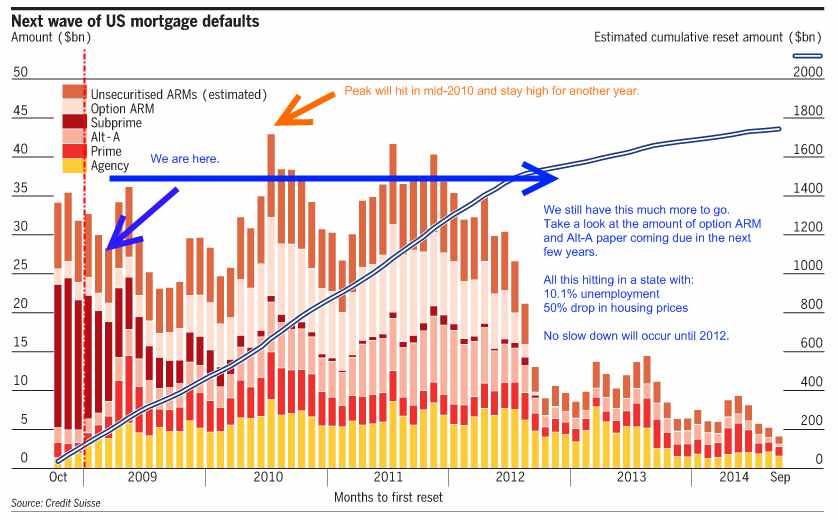
Machado predicted "the hardest hit areas of the Central Valley are likely to take at least two years before they hit bottom, and even longer before they begin to recover." He said foreclosures likely will keep increasing because so many valley residents took out risky adjustable rate mortgages that soon will require much higher monthly payments. "Unable to refinance due to minimal equity and tight underwriting standards ... many of the borrowers with payment-option ARMs (adjustable rate mortgages) are likely to become the next wave of foreclosures," Machado said.

Friday, September 05, 2008

"Some Unsolicited Advice"

From the Sacramento Business Journal:

IndyMac Federal Bank has let go 128 employees from its offices in Rancho Cordova, a figure 70 percent higher than previously reported. Many of the employees have been off work since July, when federal regulators took control of failed IndyMac Bancorp Inc. Some employees were able to work through Friday, closing out files and shutting down the office.
From Mr. Mortgage:
For some reason, as purchase volume is rising sharply Mortgage Insurance volume is plummetting. This is a strange phenomenon. First time home buyers and current renters are not the 20% down crowd but investors/speculators are. For one reason, because most non-owner occupied loan programs require more down payment but many speculators also put more down to try to avoid detection if they are calling the purchase a ‘primary residence’ or ’second/vaction’ home.

We know that 45% of all home purchases in the State of CA were from the foreclosure stock and similar numbers hold true in other bubble states around the nation. The largest sales increases are coming directly from the subprime epicenters such as the Central Valley, Sacramento and the Inland Empire. Could speculators be once again in control of the real estate market? For their sake and ours when these buyers find themselves deeply underwater and amidst plummetting rents in the near future, I hope I am wrong. But the MI readings may show otherwise.

They think they are ’investors’, but I call them ’speculators’ because if they really looked at the micro aspects of the market...they would see they are trying to catch a falling knife. This first group of speculators are likely the old-school real estate folk who feel that if you buy at replacement cost plus land value you can’t go wrong. They can.

I personally know a few of these gamblers with offers out on a dozen homes at any time in the Central Valley. Funny, they have been doing this since last year year and every month prices still fall. They don’t seem to get angry but just keep putting in more offers thinking the values are getting even better. That’s subjective. If rents are falling, mortgage rates rising and underwriting guidelines tightening, then homes are becoming even more expensive even if it is not reflected in the price…yet.
From the Sacramento Bee:
Foreclosures are still rising in the region, meaning the supply of bank-repossessed homes will grow for at least another year. But are the number of defaults finally beginning to level off?

Yes, says Alexis McGee, president of Foreclosures.com, a Fair Oaks Web site for real estate investors. McGee's numbers from Sacramento County show that defaults peaked in April and flattened out in May, June and July.
...
"It looks very stable on the pre-foreclosure front to me," she said. "It does not look like things are getting worse." If so, that's an indicator of some stabilization in this battered real estate market. But it's not a certainty. Even McGee hedges a bit, given the tricks that short-term numbers can play.
Interesting that McGee recently pulled foreclosure statistics off her website.

Over the last few months, I've been wondering why Dennis Wyatt, managing editor of the Manteca Bulletin, seemed to be hawking real estate almost daily from the pages of his newspaper. (For example, is this a news article or an ad for Florsheim Homes?) Today's article helps explain why:
Six months ago today I made a major positive change in my life. I became a homeowner once again.
And a word to the wise for the rest of you bubble sitters:
Now for some unsolicited advice. If you think you want to own a home, don't wait for prices to drop...This is arguably a once in a lifetime opportunity. Do not squander the opportunity by dragging your feet.
From Home Front:
I know the tidal wave is coming, a wave of foreclosures, REOs, and auctions that will likely dwarf the subprime reset. So, I am completely shocked at the number of realty-related talking heads who are staring blank eyed at the masses with giant car-salesmen smiles on their faces saying, "We are almost at the end, the end is in sight, the housing market is stabilizing, etc.." And here is the punch line we all heard 5 years ago, "This is the best time to buy!"

Thursday, September 04, 2008

GMAC To Close Local Offices

From Home Front:

Regionally, GMAC is closing three offices in Gold River, Yuba City and Stockton and laying off 20 staffers, said GMAC spokeswoman Jeannine Bruin.
From the Merced Sun-Star:
County Bank laid off about 20 employees Tuesday -- the first time in its 31-year history that the bank has been forced to cut back on staffing.
...
County Bank has remained unscathed from foreclosures because it didn't carry any home loans. However, it did lend money to developers, who've been having a hard time paying off construction loans.
...
Though no more layoffs are in the works, [company spokesman Thomas] Smith didn't rule them out. "Are housing values going to decline further?" he asked.
From the Sacramento Real Estate Blog:
The average home that sold in Sacramento County this August fetched $235,367, down 33.1% from last year’s average price of $348,698. The median sale price was down 33%, from $313,500 in August of 2007 to $210,000 in August of 2008.
From the Sacramento Bee:
More than a year after a collapse of two big residential tower projects in downtown Sacramento, a still more ambitious generation of downtown living is coming into view. Much depends on the economy and other variables in the next 20 to 30 years. But serious plans exist for up to 15,000 residential units north of downtown at the railyard and nearby Township 9. If all goes as hoped, the first of these homes, condominiums and townhouses may open in a rebounded housing market – and one also shaped by high-priced gasoline that discourages long commutes.
~~~
[Developer] Suheil Totah believe[s] they'll hit the "market" perfectly, opening a lot of this in 2012. They believe, as do most, that the housing market will be soaring again.

Tuesday, September 02, 2008

'More Than a Rough Patch'

From the Sacramento Bee:

New data show Sacramento homeowners continue to take a big hit as the nation's foreclosure crisis churns through a second difficult summer. One of every 145 households in Sacramento, El Dorado and Placer counties faced foreclosure in July – 5,290 properties – according to Realtytrac, Inc. data service, saddling Sacramento with the 11th worst foreclosure rate in the country.
...
All this, along with sinking home values and a bad economy, has Sacramento resident Leovardo Lopez, a pool builder, on edge this weekend. The 42-year-old Lopez's work hours recently were slashed. He was lucky; most of his co-workers have been laid off, but he fears he will not have a big enough salary next month to make his mortgage payment. Worse, the home he bought in 2005 is worth $150,000 less than he paid.
From the Modesto Bee:
"I'm looking for anything. I just need to make a living," said [Jerry King] the former Beck Properties home warranty representative..."First, I was looking for the same pay. Now, I'm looking for anything. I just need to make a living."
...
Despite increased worker productivity since the 2001 recession, workers' wealth has not increased, Berkeley economist Sylvia Allegretto said. But they are feeling the economic bust..."The labor market has hit more than a rough patch as job loss has occurred in each month of this year," Allegretto said.
From the Modesto Bee:
As the economy shrinks, enrollment at community colleges is expanding. Modesto Junior College's enrollment ballooned almost 4 percent over last year to 18,474 students.
...
"They're living in a different day and time financially. I don't think I've ever talked to so many people who have lost everything," [MJC counselor Kim] Bailey said. The Northern San Joaquin Valley's jobless rate hit 11.3 percent in July. At the same time, the region lost 3,000 homes to foreclosure. Economists say the housing market collapse is having ripple effects on the economy and forcing layoffs.
From the Stockton Record:
[Joe] Anfuso said Florsheim has sold houses in the past two months to perhaps four or five buyers who decided to buy new after finding the foreclosure market more difficult than they expected or discovering that the homes were "more challenging" than they expected. "The competition (for foreclosures) is fierce," he said. "You have people who have bid five, 10, 15 times and are getting beat out. They start asking, 'Is it really worth it?' Our agents are fielding a lot of questions from people who are looking at that market and don't like that process."

Greg Paquin, president of the Gregory Group, a real-estate information and consulting service in Folsom, said builders can be competitively priced against foreclosures, but most people don't seem to realize that yet.
From the Sacramento Business Journal:
Salt Lake City-based Woodside Homes, the Sacramento region’s 15th largest builder in 2008 based on sales volume, has announced it will file for Chapter 11 bankruptcy reorganization by Sept. 16, Big Builder Magazine reported Thursday.
From the Modesto Bee:
[Patty] Amador, whose 20-year-old Modesto mortgage company is among the region's largest, will share her concerns about recent changes Congress made to mortgage finance requirements. She said the valley's large number of foreclosures have lowered home prices, which has enabled sales to "bounce back" because first-time home buyers now can afford homes.

"Many of these buyers have the ability to qualify for loans and make payments on safe, fixed-rate mortgages. Unfortunately, few have the funds necessary for the down payment or closing costs," Amador said. "Recent legislation has not only eliminated a widely used financing tool, known as Nehemiah, but will also increase the amount of required down payment along with the monthly payment as a result of increase mortgage insurance requirements."
...
Many first-time buyers...depend on down payment help to become homeowners, Amador said. "Now is not the time to be taking away financing tools, nor increasing costs to borrowers, if we are going to come out of this 'crisis' anytime soon," Amador said. "If we back financing tools with prudent underwriting, we can bring this market back without the risk of a reoccurrence of bad loans to the wrong borrowers."