Friday, March 31, 2006

Agent: March Not Looking So Sunny

I stumbled upon a new housing blog (link also on right) hosted by Rocklin & Roseville Today, a local online news site. Julie, the agent/blogger had this observation about the Sacramento real estate market in March 2006:

The January numbers were "to early to tell" how the 2006 real estate market in Sacramento would shape up. Now we have February reports which are more positive than we have seen for the past few months, but still don't paint a very clear picture of what is going to happen this year. If it were just the numbers, I would say some of the local pundits are correct in predicting a "return to normal" after the last five years of double digit increases and bidding wars on anything with a "for sale" sign in the front yard.

Based on my personal business and talking with colleagues the past few weeks, the steam we started to feel building in mid January and early February has been dampened by the last three, almost four, weeks of winter weather. The rain and cold seems to be keeping buyers inside or at least not driving from the bay area. Right now, I am not feeling as bold as I was last month when I made three positive predictions. Even though I was right about modest growth in the median price and increased sales volume, I was wrong in predicting a slight decrease in the inventory of homes for sale. With the prediction for more rain this month, I don't think we are going to see February performance as the start of a new positive trend for the year. I will, however; predict if and when the rain ends and warmer weather gets here, we will see a nice surge in activity as the buyers start getting out and looking again.

Julie's prior/parallel blog is here.

Thursday, March 30, 2006

Where Everybody Knows Your Name...and the Mayor Wants to Sell You a House

Looks like Merced's housing piggy bank is cracked. Last week, the LA Times published a brutally honest piece on Merced's housing bust. Definitely worth the read. Now, the local paper, the Merced Sun-Star, has some local reaction to the article. Looks like everybody in Merced is a real estate agent, including most of the politicians!

Local experts agree with dreary housing article

Real estate is a driving force in Merced's economy. Five of seven members of the City Council draw their livelihoods from it -- four are licensed to sell homes, including the mayor.

It's little wonder that an in-depth Los Angeles Times article spotlighting the city's rapidly cooling housing market has made the rounds. "I think half the town has read it," said Mayor Ellie Wooten, a veteran real estate broker with Century 21 Salvadori Realty in Merced. The article follows the city's real estate market from the heady days of the past few years to the grinding slog of today.

"It's changed rapidly," said Wooten. "It boils down to supply and demand, and right now apparently we have an oversupply." Wooten said prices are "eking down" but she doesn't expect housing prices to collapse soon...The throngs of investors from the Bay Area and Los Angeles have thinned, she said...

While many newly opened subdivisions sit empty, developers in Merced have 7,000 new houses in the works. Hundreds are expected to go on the market this spring...

Councilwoman Michele Gabriault-Acosta said about 200 resale homes were on the market when she got her license to sell homes in July. The number has since grown to more than 600. "Everybody was trying to jump on the bandwagon and make a big profit," she said. "Now it's a buyer's market, last summer it was a seller's market."

Councilman Carl Pollard, who got his license to sell homes in August 2004, said the days of multiple offers above asking price are definitely gone. He said $30,000 and $40,000 breaks on homes are not uncommon. "Sellers are giving concessions, but if you look at the market, they're still not moving property," he said.
Don't forget to look up at the banner ad. You might see Mayor Ellie Wooten's real estate ad: "It makes sense! In today's housing market to rely on an experienced realtor."

And in nearby Atwater, Mayor Rudy Trevino, who also is "in the real estate business," comments on a halted new-home project and the local housing market.
The housing market has cooled in the years since Florsheim first proposed building Atwater Ranch, noted Trevino. "One of the things that hasn't been taken into account is the fact that the market has changed considerably since this whole thing started," said Trevino, who is in the real estate business. "It raises the question of how viable a project of this size is now."
Here are some excerpts from the LA Times article:
The good times have already ended here, in the same way slamming into a wall reduces your speed. A house will fetch 20% less today than it did last summer, brokers say, assuming it finds a buyer at all..."It's like everyone got together and said, 'Let's not buy for a while,' " Gregory says...

Just a little while ago, Merced was an investor's dream. The Office of Federal Housing Enterprise Oversight reported this month that prices in the city and surrounding area increased 31% in 2005. The housing agency ranked Merced first in price appreciation in California and ninth in the nation.

That already feels like ancient history, an era when agents would list a property and within hours people would be madly bidding against one another. In five years, Gregory never had a listing that lasted longer than four days...

The phenomenon occurred throughout the Central Valley. According to the Housing Enterprise Oversight numbers, the leading edge of the nation's real estate mania was not San Francisco or Manhattan or Miami, no matter how giddy those markets seemed to their residents, but in some little-known agricultural communities.

The housing agency's No. 1 U.S. city for price appreciation over the last five years was Madera, an old logging town northwest of Fresno that rose 144%. Yuba City, north of Sacramento, was second. Third place went to a Florida city, Port St. Lucie. Fresno and Merced, both at 142%, rounded out the top five.

Andrew Leventis, a Housing Enterprise Oversight economist, contemplated this ascending arc in a region that is not a tourist destination or retirement haven, where incomes are not growing and unemployment is perpetually high. He then used an un-economist word: "Shocking." "It's difficult to know what was driving these high rates of appreciation," Leventis said.

To people in Merced, however, there's little mystery. This was a classic bubble, where people paid increasingly higher prices because they were sure that someone would come along and pay even more. Economists call this the "greater fool" theory...

Officially, this city of 77,000 has 640 homes for sale, about 10 times as many as last summer. But agents say that if you add homes for sale by their owners, new homes being sold by builders and the dwellings that would-be sellers have pulled off the market in despair -- none of which are in the agents' centralized database -- the real number is at least twice that. The Merced Sun-Star's Sunday real estate supplement has 40 pages of ads.

Many of those ads are for new developments. The city lists 47 active subdivisions where 7,173 homes are going up. For builders with excess inventory, it's let's-make-a-deal time. At the sales office of Shadow Creek, whose prices range up to $523,000, signs on the front door and walls proclaimed: "Ask us how to save $40,000 off a new home!!!" "If you want to ask for more, just do it," the saleswoman advised. She said a $60,000 break would probably be fine.

Over at Summer Creek, the saleswoman offered a $75,000 discount, subject to a few restrictions, like using a preferred lender. There was also a $3,000 referral fee available -- talk a friend into buying there, and the money's yours.

Ryan Burchard, a San Luis Obispo radio host, examined one of Summer Creek's model homes with his two daughters. "Some of these salespeople seem a little jumpy, a little desperate," he said. "It's like walking onto a used-car lot." Burchard might be moving here this summer, but he felt no urgency to buy. "Every other house here is for rent," he said. This is a very good time to be a renter in Merced. A new $450,000 house, owned by an investor waiting to flip it -- or sell for a quick profit -- can be had for less than $1,000 a month. That's a silver lining for locals who missed out on the boom...

If the overextended are vulnerable, the investors are at least disappointed. Liubo Hong, a Silicon Valley engineer, bought a four-bedroom on University Drive in February 2005 for $312,000. He's been trying to sell it since October for $389,500. In the late '90s, Hong said, "I got caught up in the stock market. I got in near the peak. I wish I had gotten in earlier." He's trying to rectify that mistake with real estate. "The market may get better in the spring," the engineer said with hope in his voice. "Or next year. Or in three to five years." The leaflet for Hong's home calls it "ideal for investors." But he's receiving only $925 a month in rent, less than his mortgage, and Merced is running low on fools.
Before the Boom:
Before the escalation began, 8 out of 10 home buyers in Merced County got a safe, fixed-rate loan, according to research firm DataQuick Information Systems. As the boom proceeded, interest rates fell, which should have increased the appeal of fixed-rate loans.
During the Boom:
Instead, buyers switched to adjustables, which saved them money in the short term at the cost of a riskier future. By last summer, 80% of buyers in Merced got adjustable-rate loans...

The number of agents registered to sell in Merced went from 200 to 1,200 as property prospered...

When houses rise in value, households are, at least on paper, worth more, giving them a cushion in bad times. But many homeowners have been treating that equity as if it were income and spending it. In Merced, they would go down to the car dealers even before their refinancing cash-out check came through.
After the Boom:
The only thing worse than the real estate market here is the market for real estate agents. They've been coming down to the Auto Toyz and Auto Store used-car lots looking for work. "Everyone who applied recently, about eight people, they all were Realtors," said Nico Pineda, who until recently was hiring manager for both lots. "But things were slow for us, so we had to turn them down."
Ouch.
In come the waves...

Wednesday, March 29, 2006

Sacramento Inventory Graph

A new blog has taken the inventory numbers from the Bubble Markets Inventory Tracking blog and created some nice graphs of major markets including Sacramento.

See Sacramento Inventory Graph Here

The blogger has this comment on Sacramento:

Is the housing market a bursting bubble? Some markets clearly do appear to be bursting. Phoenix, Sacramento, Las Vegas, and Orange County all have about twice as many new homes coming on the market as are being sold each month.

'Overhang' in Sacramento, New-Home Sales "Plunged" 45% in February

The LA Times looks at Sacramento's dismal new-home market.

In the West, which includes California, the sales plunge was even worse: down 29.4%, partly reflecting stalling sales in Sacramento and the Central Valley and in other Western states such as Arizona...

[N]ew-home sales in the Sacramento area have been much weaker, DataQuick said. Although sales there were up 13% in February from the previous month, that was after January marked the worst month in six years. As many new homes were sold in December as in January and February combined, according to DataQuick. And sales plunged 45% in February from the year before...

At certain new-home communities in Sacramento, for instance, builders slashed prices to close sales... "The Sacramento market went up very quickly, perhaps too quickly," said Patrick Duffy, a market analyst for Hanley Wood Market Intelligence..."It's like car dealers," Duffy said. "Once you start offering incentives, then everybody starts expecting them."
Meanwhile, Lennar, the No. 3 U.S. homebuilder has identified Sacramento as one of its weaker markets.

Lennar said it is using price reductions and other carrots to lure prospective buyers in softer markets such as Sacramento and San Diego, California, and Nevada and Colorado.

Lennar Corp. (LEN) Chief Executive Stuart Miller said he remains optimistic about the company's earnings prospects for the rest of the year and into 2007 despite cooling market conditions. "Market conditions have been slower in many of our major markets across the country," said Miller, during a conference call Tuesday. "Not only have price escalations slowed materially in most markets, but traffic has been cooling down as well..."

Miller acknowledges the company has faced some oversupply issues due to speculators - or flippers - deciding to sell - rather than buy - homes. This has created an "overhang" in certain markets that saw huge price increases over the past few years. Gross said demand has slowed in Sacramento, San Diego and Tucson, and the company significantly boosted incentives in Minnesota, Illinois, Colorado, Northern Virginia and Nevada in order to move sales.

Tuesday, March 28, 2006

Who Needs a House? Modest(o) Condos Have Granite Countertops!

The Modesto Bee and the Sacramento Bee report on the Central Valley condo craze.

From the Modesto Bee:

The owners of four large Modesto apartment complexes began selling their 361 units as condominiums last year. Now the owners of another 327 Modesto rental units in four more complexes are considering converting them to owneroccupied condos...Last year, Modesto converted more than 5 percent of its rental units into individually owned condos. That was more than double the conversion rate for the nation and California, according RealFacts...

Before putting former rental units up for sale as condos, the conversion companies usually do extensive makeovers. The units typically get new flooring, paint, granite countertops and kitchen appliances. The roof, plumbing, electrical, heating and air conditioning systems often are upgraded, as well. The condos converted last year sold well, but many of them remain on the market.
From the Sacramento Bee:
Only three years ago new condominiums and apartments converted to condos were a bare 2.2 percent of new-housing sales in the six-county Sacramento region - El Dorado, Placer, Sacramento, Sutter, Yolo and Yuba counties. Last year they reached 18 percent, according to Costa Mesa-based housing analyst Hanley Wood Market Intelligence. Long a second-class housing option in a spacious, once-inexpensive region that loves its traditional single-family home, condominiums reflect the capital area's harsh reality of skyrocketing land prices and homes beyond the reach of many buyers...

Newport Beach-based John Laing Homes spotted the trend nearly six years ago and started building condominiums three years ago, said Mark Levens, vice president for Northern California sales and marketing. "You look for voids in the market," he said. "Now everybody is running into that void in the market..."

The rush to condominiums, especially in suburban areas such as Natomas, West Sacramento, Elk Grove and Folsom, increasingly shows an inland metro area coming to resemble larger California cities and similar-sized urban areas nationally, say those familiar with Sacramento's growth.

"What's been going on in San Diego is going on in Sacramento," said Steve Bolli, sales director for Reno-based Pacific West Companies, building condo projects in Elk Grove, West Sacramento and Folsom. Bolli said condominiums, long unfavored in Sacramento for fear of smaller spaces, noisy upstairs neighbors or perceived poor prospects for appreciation, are increasingly popular with Sacramento-area cities that want to see more people on less land and provide residents more affordable options.
Comparing the Sacramento condo market to San Diego may not be such a good idea, considering the troubles now occurring in San Diego and elsewhere.

The Sacramento Bee also has an article on the "commercial condo" movement.

Monday, March 27, 2006

The Open House: Making the "Seller Feel Like Something is Happening"

The Sacramento Business Journal examines the return of the open house and agent "caravans."

The popularity of open houses as a selling tool blossoms and withers with the housing market, and with the careers of individual real estate agents. While some agents swear by them, others find they're not worth the time...

Making connections: Leigh Rutledge, a Realtor with Dunnigan Sierra Oaks for 25 years, said she hasn't done an open house in many years, and doesn't miss them. She said 1 percent to 2 percent of homes are sold through open houses nationwide, a statistic that's not enticing enough for her...

Smoke and mirrors? Nightingale uses open houses to show off new listings, or to "breathe life into something that's been on the market for awhile," she said. If a property sits on the market for a few weeks, she circles back and does another open house to sort of "reintroduce it." Rutledge said once she explains the ins and outs of an open house, most sellers decide not to have one. With today's slower market, there will probably be an increase in open houses, especially since many agents will hold an open house just to make the seller feel like something is happening, she said...

A caravan of agents: Many agents are reviving tours or caravans, a particular day when a property is open only for real estate agents, Vlasek said. A common technique 20 to 30 years ago, tours fell out of fashion about a decade ago, and are now coming back into vogue. Vlasek said the changes in the marketplace in the past six months are spurring tours...

Rutledge said the popularity of tours or caravans fluctuates with the market. She participates in caravans with her colleagues about once a week, and finds them a useful marketing tool. "Homes are on the market longer now, so Realtors are getting together and helping each other get these properties sold," Rutledge said...

Maybe it's Not the Rain in Redding, Sales Down 45%

The Redding Record Searchlight, which in the past has given much attention to the weather, now entertains the notion that the housing downturn may be more than a seasonal one.

Home sales in February fell 45 percent from a year ago in Shasta County...Meanwhile, the median sales price for a home in Shasta County in February was $260,000, a 16.6 percent jump from a year ago. Homes had been appreciating more than 20 percent annually in Shasta County since 2000... Association of Realtors statistics showed 1,285 pieces of property listed two weeks ago in Shasta County, nearly double the amount in March 2005 when there were 669 listings. The average number of days a home stays on the market has gone from 97 a year ago to 120 today...

While area real estate agents blame the season -- winter is traditionally a slow time for home sales -- and the wet weather, they also acknowledge that the market has turned. "I don't think slowdowns have ever had much to do with the weather, unless it's a blizzard or hurricane," said Holden Lewis, who covers real estate for Bankrate.com. "If people want to buy a home, they won't let the rain stop them. Weather affects home construction, but I'm not sure about home re-sales."

Sunday, March 26, 2006

Housing Bubble Reason #468: Thieves

The Stockton Record reveals one of the secrets behind the housing bubble.

Brazen thefts, burglaries and vandalism are hammering builders at construction sites across San Joaquin County. But it is home buyers who ultimately may pay for these crimes. In one case, a Lathrop man is scheduled to appear in court this week on charges that he stole a tractor from a construction site and used it to remove trees from his neighbor's property for $500 before dumping the damaged tractor...

"You and I are paying for these thefts," said George Brown, who heads the program's Fresno office. "If the public thinks the market is driving up home prices, they're only partially right. It's also theft from construction sites."

Friday, March 24, 2006

"Shock" & Awe in Elk Grove: "What is Happening?"

The sudden turn in the housing market is catching the attention of the Elk Grove School District, according to the Elk Grove Citizen (links change often).

A somewhat shocked school board listened to a staff report projecting a dramatic dip in enrollment at the middle and high school levels. Five of the high schools will be below the board's goal of 2,200 students at each high school campus. Christine Penna, associate superintendent for secondary education, said the under-enrollment in the majority of high schools and middle schools for the 2005-06 school year will result in the need to reduce staffing significantly at the start of the school year.

[A]nother factor is the slowing of the new housing building and also a decline in the numbers of high school students coming from even the new homes. The school staff anticipated a growth of about 3,000 students each year and this slowed considerably.

Board Member Bill Lugg said he was "shocked" at the report, asking "Is this a temporary glitch?" He asked Constantine Baranoff, Associate Superintendent for Facilities, "what is happening?" Baranoff said that slower growth in the housing market was the main factor. Some of the board members even suggested slowing down the building of the new high school and middle school in the new Madera Planned Community (formally Laguna Ridge.) Baranoff said that Franklin High and Johnson Middle School are impacted. The Madera community plan has 30,000 new homes and he felt any delay in the new south area high school would add to the crowding of those campuses.

Superintendent Steven Ladd said he had consulted with a group of veteran realtors and they said they expected a short flattening out of the new housing market, but then it will be back at a steady growth, but not the explosive growth the district had experienced in the last five years.
A prior post on this subject is here. Meanwhile, a local Elk Grove blogger discusses the impact of declining prices on the city of Elk Grove's coffers:
Much like the cocky young man looking to pick a fight, the city eventually is going to run into a problem and the problem is now appearing on almost every street in the community - houses for sale with the now ever-present "Price Reduced" placard.
Last July, the blogger had this observation about the Elk Grove housing bubble.

Finally, the Elk Grove Citizen reports that the city of Elk Grove is recommending the approval of a condo-conversion proposal that will add 432 units to Elk Grove's rapidly expanding housing inventory.

Thursday, March 23, 2006

Who put the ramen in Sac"ramen"to?

A Field Trip Beyond Our Bubble

Did you recently stumble upon this site looking for Sacramento Centex or top ramen prices? A warm welcome to you! For those just getting started in the wonderful world of housing blogs, I thought I'd take you on a little tour of what is available outside our "little" Sacramento housing bubble. All of the links below are also located on the right side of this blog. Warning! You are about to enter the BubbleZone. If skepticism is not your thing, please go to the rear of the bus and use the emergency exit here or here.

Our first stop is The Housing Bubble blog by Ben Jones. For sheer volume of information, this is the best housing bubble blog on the web. Constantly updated with stories from across the country, this blog has a very active commenting community. Bubble Meter is a good source for news and information on the national real estate situation. The blog also does a great job keeping tabs on the ever-expanding world of housing blogs :-)

Two of my favorite regional blogs are the Marin Real Estate Bubble blog and The Boy in the Big Housing Bubble blog. The Marin blog's author, Marinite, reminds me of an Old Testament prophet crying in the wilderness, warning a willfully ignorant populace. Marinite's post on the last bubble in Southern California was one of the first things I read when I discovered the mysterious world of bubble blogs last year.

And how could you resist a blog with such a clever name! The "Boy" in the Big Housing Bubble is actually a journalist by day, and his writing shows. A great place to visit when you crave something beyond my highly honed cut & paste talents.

Other well-established and frequently updated regional blogs include: Seattle Bubble, Professor Piggington (San Diego), The Jersey Shore Real Estate Bubble, Southern California Real Estate Bubble Crash, The Massachusetts Housing Market, The Housing Bubble in Washington DC, and the Northern New Jersey Real Estate Bubble. The Northern NJ blog recently examined the collapse of the 1980's New York housing bubble.

Since launching this site, new blogs seem to be popping up all the time. Some promising ones include: Sonoma Housing Bubble, BubbleTrack, South Florida Real Estate Bubble, and Northern Virginia Bubble. You can keep tabs on this expanding universe here and here.

If you are curious about exploding inventories in other markets, then the Bubble Markets Inventory Tracking blog is a must see. Watch Phoenix inventory go from 10,000 to 37,000+ 38,000+ in just 9 months! Another important data tracking site is Housing Tracker, which keeps tabs on median asking prices and inventory numbers from across the country.

If you are looking for something a little less serious, Overvalued has some great photos of boarded-up million-dollar homes. Burbed has wonderful photos of Bay Area "steals." Flip This follows the follies of the flipper class. The blogger is especially fixated with a West Sacramento flipper who appeared in the Sacramento Bee.

Think the housing bubble is confined to the United States? The Vancouver Housing Market Blog keeps us informed about the housing bubble in Canada. Finally, no tour would be complete without a nod to The Economist's July 2005 article, In Come the Waves. If you haven't read it yet, you should.

Wednesday, March 22, 2006

Lodi Inventory "Near Record Highs," Elk Grove Surpasses October High Water Mark

The Lodi News-Sentinel reports on the cooling Lodi housing market. Buried among the soufflé talk are these factoids:

[T]he average sales price reached an all-time high of $450,000 in November 2005....The average sale price of a single-family home in Lodi settled to $387,851 in February. Homes that would sell in about 30 days a year ago are now on the market for an average of 65 days, according to Lodi real estate agents. But sales are keeping pace; inventory was near record highs at 277 last month...

Buyers are slowly regaining the upper hand in the local market, agents say, and dollars are doing the talking. "We have fewer buyers, larger inventory -- It's all about price," said Theresa Williams, of Katzakian Williams Sherman Real Estate Co.
Athena, over at the Sonoma Housing Bubble blog has this commentary about the article.

Meanwhile, the Elk Grove housing market is experiencing a spring rush of inventory. Since October, I have been tracking the Elk Grove area (zip codes 95624, 95757, and 95758) using Metrolist MLS (link also on the right, under "Tools"). Yesterday, the inventory of single-family homes surpassed the October 2005 peak. Here's the breakdown:
  • October 24, 2005: 1,411
  • January 3, 2006: 1,034
  • March 21, 2006: 1,416

We'll have to wait and see whether the entire Sacramento region follows this trend and surpasses the autumn high mark.

Tuesday, March 21, 2006

Reduced Listings, Foreclosures, and Months of Inventory

OCRenter, over at the Bubble Markets Inventory Tracking blog, continues to track the percentage of reduced listings in major markets. So how does the Sacramento housing market fare? Out of the markets measured, the Sacramento real estate market ranks #2, with 32.6% of inventory reduced in price.

A new feature tracks months of inventory. Here's the Sacramento housing market's numbers:

  • February 2005: 1.9 months
  • February 2006: 8.4 months
Quite a dramatic increase over the course of a year. The Sacramento real estate market beats out other markets such as Phoenix, San Diego, and Las Vegas to claim the top spot.

The Sacramento Real Estate Blog has posted a breakdown of months of inventory by price range.

And for readers outside of the Sacramento housing market, OCRenter now has some San Joaquin Valley inventory data for Merced, Kern, Stanislaus, and Fresno Counties.

The Sacramento Housing Bubble blog does a great job tracking daily inventory for the Sacramento housing market. You may not have noticed, but the blog also tracks foreclosures, pre-foreclosure activity, and bankruptcies for Sacramento County. Note the upward trend in foreclosures since August 2005.

Monday, March 20, 2006

50-Year Mortgage a Penny Saver?

A reader noticed this ad in a local PennySaver. Is this a sign of the end of the housing boom or is this the beginning of a brave new world of multi-generational mortgages?


"Low monthly payments you really can afford your dream home!"

The drying up of mortgage business has caught the attention of the press in Stockton and Modesto.

From the Modesto Bee:
In Modesto and nationwide, mortgage companies are reporting a downturn in refinancing that they attribute to several things. "It's kind of like the gold rush," said Robert Ivan, president of America One Mortgage and Financial Services of Modesto. "This area boomed for five years," he said. "When that happens, you do have more (businesses) coming into the marketplace and trying to get into mortgages." As a result, he said, there are too many companies trying to dip into a shrinking pool of refinancing homeowners.

Higher interest rates also are having an effect, said Patrick Payan, branch manager at American Residential Mortgage in Modesto. Those rates make it less attractive to refinance, in addition to scaring off home buyers, he said.

And slower home sales have an effect, slowing the growth of prices and appreciation. That means there's less equity for a homeowner to draw from by refinancing, Payan said. "That's got to have some kind of effect on the economy," he said. When the market was hot, many people used their homes as wood-and-stucco cash machines, using equity to undertake remodeling, pay off credit cards or make other purchases...

Ivan of America One said the refinancing market could remain quiet for two other reasons. With too many brokerages and too little business, he said, it will take a shakeout to bring balance back to the industry.
From the Stockton Record:
Overall, mortgage volume has plummeted to half that of last year and the year before, he [Tom Cole, senior loan consultant in the Stockton office of Washington Mutual] said, but it's still very healthy, because the previous six years in the residential market were just phenomenal. "We're falling back into a typical market, and that's still fine," Cole said. "The last five years was an anomaly. So now, my business is falling back to a normal volume."
A market so "healthy," that Stockton Washington Mutual recently pink-slipped 100 employees.
Jerry Abbott, president and co-owner of Coldwell Banker Grupe, is convinced that rising interest rates have slowed sales of existing homes as more and more people get priced out of the market. Primarily, steady increases in the number of homes for sale in San Joaquin County since summer has laid heavy pressure on prices and turned the scene from a seller's market to a buyer's market, he said. According to new figures in the latest Coldwell Banker Grupe-TrendGraphix monthly sales report, based on Multiple Listing Service data, sales in San Joaquin County slipped from 374 in January to 350 last month.

Even though homes on average sold at 99 percent of initial asking prices, the report indicated, the median sales price also slid from $410,000 to $396,000 in the same span.

That's unusual, Abbott said. "A lot of people are trying to characterize this by saying we're going to a normal market, but I don't think anybody knows what a normal market is," he said. "In a nutshell, it's still supply and demand, and right now, supply exceeds demand. That's just a truth you can't ignore....Plus, I think people are more cautious right now about the marketplace, because it's hard to figure out whether the prices are going to go up or go down."

Kevin Sanguinetti, president of First American Title of Stockton, said volume at his business is way off, as it is countywide. For example, resales countywide stood at 787 in January, compared with 1,021 the previous January, he said, and refinances also dropped, standing at 3,224 in January versus 3,748 the previous January. "In August, things kind of peaked, and they have dropped since then."

"Unrealistic Expectations of Sellers" Causing Sales Slump; Inventory Up 176%

The Sacramento Business Journal reports that February sales in the Sacramento region fell 31.7% compared to the prior year. This is based on Trendgraphix data for houses, condos, and halfplexes.

Sales of existing homes in Sacramento, Placer, Yolo and El Dorado counties continue to be down about 30 percent so far this year compared to last year. Trendgraphix, a data-collecting subsidiary of Lyon Real Estate, says that in February 1,333 houses, condos and halfplexes closed, compared to 1,919 in February of last year, a 31.7 percent decline. Overall for the year, 2,912 homes closed, compared to 4,198 last January and February -- a 30.6 percent drop.

Rising interest rates and the "unrealistic expectations of sellers," caused the downshift in sales, said Mike Lyon, Trendgraphix's president and Lyon Real Estate's CEO. In other words, the sellers' market of the past few years has weakened. Buyers are fewer and therefore have more power. That's shown in the larger inventory of available homes. Lyon estimated the inventory is 176 percent larger than it was in February 2005.
In contrast, according to the Sacramento Bee, sales in the Sacramento region fell 26% in February. This is based on Dataquick data for single-family homes only.
Regionally, February's 1,743 home sales - 65 more than January - began to reverse gloomy year-to-year trends of the past two months. Though sales were still 26 percent lower than February 2005, they improved on January's 29 percent year-to-year decline, and 31 percent in December, according to DataQuick.

Friday, March 17, 2006

February 2006: Appreciation Falls to Single Digits, Monthly Price Declines End

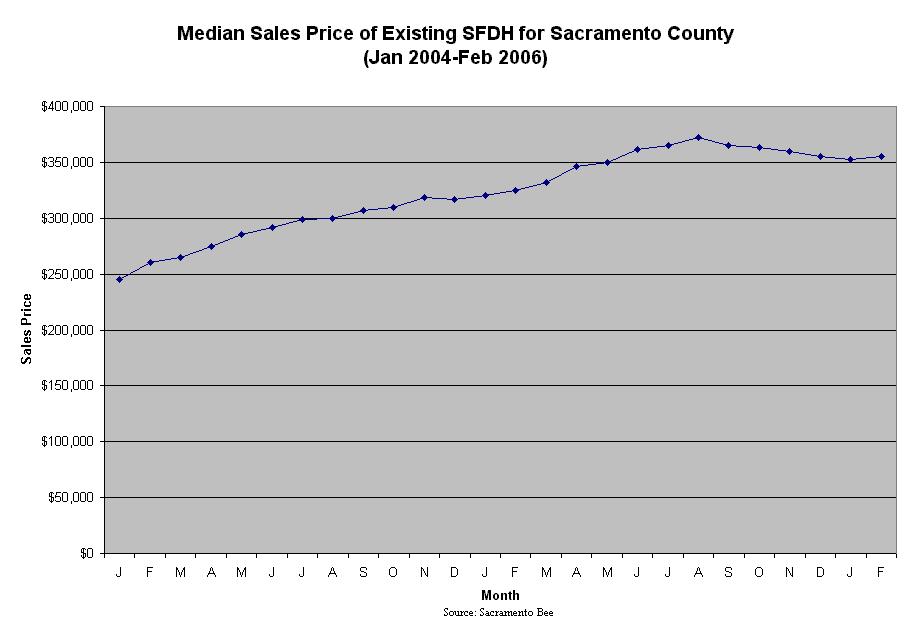
Today, the Sacramento Bee reported on February 2006 DataQuick statistics for resale single-family detached homes. As previously suggested, the median price for Sacramento County rose in February for the first time since August 2005. After five months of decline, the median price for Sacramento County in February was $355,000 (up from January's $352,500, but still down from August's peak of $372,000). This graph shows the median sales price of resale homes since January 2004:


(Click to Enlarge)

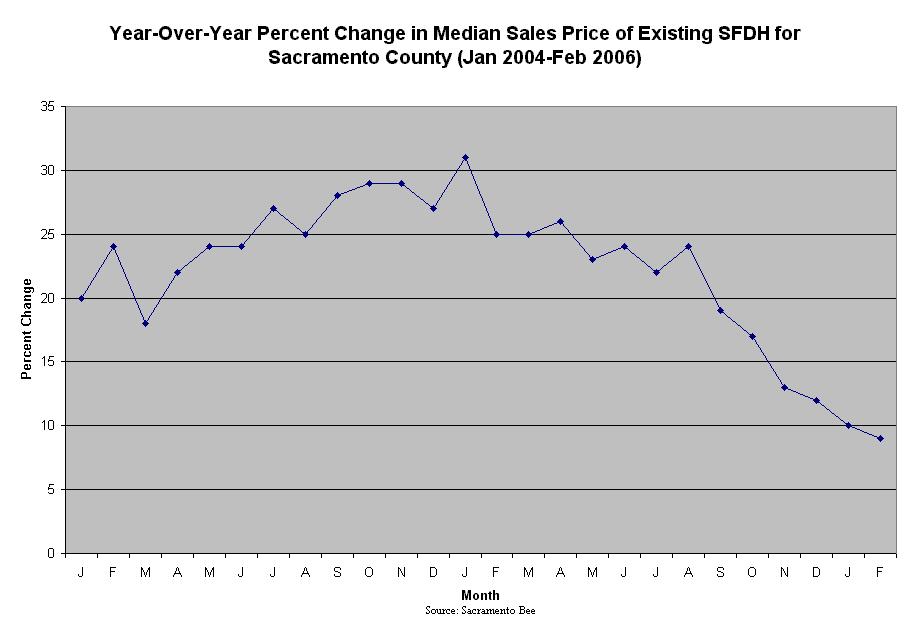
On the other hand, the year-over-year (yoy) median price appreciation rate fell in February into the single-digit range (+9%). You would not know this unless you scrolled to the bottom of the article and looked at the chart.

This is the first dip under 10% in quite some time, probably since the beginning of the boom. (I looked back at the Sacramento Bee's articles for 2003-2005, and the lowest yoy percent change I could find was +16% in October 2003. Reporting of monthly Dataquick statistics in the newspaper is spotty before that point.) This graph shows the rate of year-over-year appreciation since January 2004:


(Click to Enlarge)

Two other counties also slowed to single-digit appreciation: Placer County (+5%) and El Dorado County (+9). Yolo was at +13%.

This rapid decline in appreciation is big news but was not reported in the body of the article. Since monthly prices began to decline in September, the Sacramento Bee has reported the year-over-year appreciation rates in the body of the article, mainly as a counterbalance to the monthly declines. (For example in January the Bee said: "The median sale price fell for the fourth consecutive month....Still, in each of the region's four counties the December median remained 11 to 20 percent higher than a year ago.")

This month, when the monthly number went up, the yoy was ignored. Hmmm. Then again, this month's article was written by a different journalist (Jim Wasserman) than the usual (Andrew LePage).

Thursday, March 16, 2006

"Calm" After the "Frenzy" or Calm Before the Storm?

The Sacramento Bee had this article on their front page today:

Housing frenzy replaced by calm
Prices aren't soaring, buyers have choices: It's business as usual.


From West Sacramento's new suburbs to the association-governed neighborhoods of El Dorado Hills, would-be homebuyers appear to be encountering a long and almost forgotten phenomenon. It's the return of "normal."

In the cooling wake of Sacramento's five-year hot streak, a legendary era when prices skyrocketed and speculators abounded in the furious chase for a place called home, real estate is tilting amid mixed signals back toward the routine, say builders, analysts and agents in Sacramento and across the nation.

Back in vogue for the traditional spring shopping season: old-fashioned wheeling and dealing on prices, an abundance of choices, and even enticements such as plasma TVs, washers and dryers for signing on the dotted line. Gone are waiting lists and buying what's left when builders of new homes call your name on a Saturday morning. Out is the speculative "flipping" and jumping prices that terminated so many home-owning dreams and made first-time buying a panic. Also out is watching neighbors get their asking price the first day, a sensation that eventually placed metropolitan Sacramento among the West's more expensive areas for single-family homes.
On inventory:
Buyers in February could pick from 9,870 single-family homes for sale in Sacramento, Yolo, Placer and El Dorado counties, according to the Sacramento-based data firm, TrendGraphix. That's up from 3,554 a year ago. A year ago, the average home spent 37 days on the market. Last month it was 58 days, TrendGraphix reported.
On price:
According to the Sacramento Association of Realtors, home values in Sacramento County and West Sacramento stopped sliding in February. The association reported a 1.4 percent increase in median prices - where half the homes cost more and half cost less - from January.
On Centex cancellations:
Doug Pautsch, financial officer of the Sacramento division for Dallas-based Centex Homes, said the departure of speculators who backed out when the boom was ending accounts for the change. "It's about half of what it was in the fourth quarter," he said.

Tuesday, March 14, 2006

Has the Sacramento Housing Market "Gotten Ahead of Itself?"

There seems to be a whole industry dedicated to ranking the most overvalued/riskiest housing markets in the country. Once again Sacramento and other Central Valley cities sit prominently on these lists.

Bankrate.com looked at 10 markets that are most likely to experience a decline.

10 bubble busters -- values expected to decline

Sacramento, Calif. We're not quite sure what Sacramento ever did to anyone, but it showed up on just about everyone's list of has-been markets. Winzer's Local Home Value Ratings rates the market as 59 percent overvalued and Burns Housing Cycle Barometer also lists it as overpriced.

"Sacramento, we think, has topped out," says Gollis of The Concord Group. "There is just so much (housing construction) in the pipeline. It's a steady-as-she goes market and has always had consistent growth, but we think the land market has gotten ahead of itself."
Meanwhile, the latest National City Corp./Global Insight study shows that affordability has continued to decline as mortgage rates have increased. Here's a rundown of some of the most overvalued markets in the country (out of 299 markets):
  • #2 Merced: 86.20%
  • #4 Stockton: 79.50%
  • #5 Madera: 77.00%
  • #9 Modesto: 72.30%
  • #12 Fresno: 65.40%
  • #13 Sacramento: 63.80%
  • #15 Bakersfield: 62.40%
  • #16 Chico: 62.10%
  • #19 Redding: 60.30%
  • #30 Visalia: 53.90%
Previous Post: Sacramento Market 61% Overvalued?

Monday, March 13, 2006

Agent: "No Doubt Pricing Has Dropped," 5% to 10% in Some Areas

The largest development in Roseville history is set to hit the housing market this summer/fall, amid rising inventory. The Roseville Press-Tribune reports that in January, Placer County housing inventory shot up 272% compared with the previous year.

Just west of Sun City Roseville, the heavy currency of large-scale grading equipment precedes this summer's arrival of framing crews putting up model homes, followed by eventual houses and people. And with the West Roseville Specific Plan marching forward toward populating the area, city officials say development will bring nearly 21,000 people to Roseville over a 15-year build-out period, in four phases. The 3,162 acres of land will be built out by two companies - WestPark Associations and Signature Properties - and represent the biggest development in the history of the city...

But a real estate market with rising supply and buyers employing growing leverage could mean a changed sales climate.

The WestPark portion - the southern half of the project - will begin building units in July or August when model homes are completed. Expect to see residents begin moving into the first phase by fall, said Bennett. "What's interesting about new communities like this, I don't know of any builders that have set pricing. They don't until just before they open for sales," Bennett said. "That's part of the market, and the other part is the tweaking they continue to do to the home plans..."

Roseville Realtor Craig Seydel said that local builders seem "bullish" on new housing starts despite a local market where buyer power is making a decidedly notable comeback in recent months. According to statistics released by the Placer County Association of Realtors, housing inventory in January 2006 shot up to 562 listings compared 206 to a year before then. Despite a 272 percent increase in inventory, the median sale price had also increased to $432,500 from $406,000, or 6.5 percent. That's decidedly down from previous years.

"There's no doubt pricing has dropped. It's 5 percent in some areas, or even 10 percent," said Seydel of RE/Max Gold. "There's more room for negotiation to be done."

However, Seydel said he isn't too worried about an oversupply because large-scale developers can afford to work off smaller margins in selling new homes. "We've had so much residential growth and we're starting to see commercial growth," Seydel said. "Regardless of what the experts are talking about, we are in a soft landing."

Saturday, March 11, 2006

Centex Sacramento, We Have a Problem

No, this is not a blog about Centex. But Sacramento Centex has a way of popping up all the time. The Sacramento Bee had this piece which quoted the president of Centex's Sacramento division.

Mortgage giant Freddie Mac said Thursday that interest rates for 30-year home loans reached their highest point in 2 1/2 years this week, but Sacramento real estate experts predicted the benchmark would have little effect on home-buyer decisions...

An official of Dallas-based Centex Homes, which expects to sell 800 houses in metropolitan Sacramento during its fiscal year ending March 31, said higher rates aren't dampening sales. "We're not hearing in the sales offices from buyers asking, 'What are your interest rates?' " said Jack Hood, president of Centex's Sacramento division. "I always say, 'Give me 95 percent employment and interest rates in the single digits, and I'll build houses all day long.' That's what we have in this market..."
Hard to tell if higher interest rates are dampening sales when you offer never-ending $50,000-$150,000 sales. It's curious that wasn't mentioned specifically. Has anyone heard of Centex offering such significant discounts for this length of time anywhere else in the country? (If you have, please comment below.) Obviously Centex is experiencing some "difficulties" here in Sacramento given all those cancellations.

Friday, March 10, 2006

To Sell or Not to Sell: That is the Question

A financial advisor recently answered this question in the Sacramento Bee:

Q: We own three homes outright, each with a value of around $400,000. We moved into one of the rentals a year ago. We are fixing it up, and we will sell two years from the date we moved in to avoid the capital gains tax. Once it is sold, we will move into a second home, live in it for two years and sell it. At this time we are property rich, cash poor. My husband has a small IRA, and I make about $16,000 a year working part time, and he is retiring this March with about $1,300 a month Social Security.

Our question is, with the housing market changing, should we rethink selling the home we love and have owned for years instead of waiting one more year to sell our rental home? We are worried that if we wait another year we may be unable to sell one of our local homes.

A: It's impossible to know what the housing market will be like one year from today. Will the market pick back up after a slower winter? Or will inventories continue to rise, causing home prices to stagnate or fall?

The best thing you can do is at this point is to crunch some numbers to see what's at stake. Living in a house as your primary residence for two years can avoid capital gains taxes, but it may or may not be worth it. With federal capital gains taxes at only 15 percent, it wouldn't take much of a decline in home prices to wipe out any benefit of living in your home for another year.

I suggest you sit down with an accountant to determine what your tax bite (including recapture of depreciation, state taxes and the possibility of AMT) would be if you sold your home now vs. one year from now. Once you know the actual cost, you can then make an informed decision on whether waiting a year from now is a risk you want to take.

It's been said a bird in the hand is worth two in the bush. One thing you know is this: You could sell your homes today and have plenty of cash to enjoy a comfortable retirement. A year from now it may be a different story.
Real estate agent Jimmy Castro has this advice about selling in the Sacramento housing market:
The housing market in the Sacramento Region has cooled off considerably! Especially when compared to the last few years...But now, with the current over-supply of investor owned property in the Sacramento area for sale, homes are taking much longer to sell and sellers are forced to lower prices or pull their houses off the market.

There are definite signs of price erosion in the Sacramento Region, and that will affect pricing across the area, especially in the $600,000 and above market. If you are in Sacramento and have a neutral or positive cash flow, I would recommend you HOLD on to your property because I see the long term prospects for the Greater Sacramento area to be good. If you are looking to enter the Sacramento market to invest, I would suggest you look to either Folsom or El Dorado Hills...

Speaking of which, you'll need to settle on an asking price. In doing so, forget what you originally paid for the house, how much you've spent on renovations or remodeling, and even how much money you need to move on to your next home. When it comes to pricing your property, the only thing that matters is what comparable homes are selling for in your neighborhood now -- which may be less than you sank into it.

Thursday, March 09, 2006

Sacramento Market on the Rebound?

This blog often posts links to articles at the Sacramento Real Estate Blog (link also on right). John's posts often give a preview of trends that the Sacramento Bee reports later in the month. For the past few months, John's data has appeared quite negative for the Sacramento housing market, with reports of declining prices, sales, and increased expired to sold ratios. However, John recently reported that February's average sale price for Sacramento County increased by $4,000 and the median sale price increased by $2,500. The expired to sold ratio has also improved since the winter, although it is still up significantly compared with the prior year. On a less positive note, sales volume was down 35.6% from February last year, according to John's data. Inventory supply was at 7.4 months. Is this the start of a spring rebound?

Also upbeat in tone, the Sacramento Magazine had a lengthy article about the Sacramento housing market in its March issue. Some excerpts:

Buyers who haven't been getting much of a break in the past few years may indeed be out looking for bargains this spring. Depending on the price range, they could be in for a disappointment. Homes won't be appreciating at 20 to 25 percent a year as they have for the past three years, but prices aren't likely to plummet, either. In fact, when Mike Lyon, CEO of Lyon Real Estate, looks to the horizon, he sees respectable appreciation levels. "The crazy stuff is done," he says. "That's over. But under $500,000, you'll still get a nice appreciation-better than the stock market." Lyon agrees it's healthy for the market to slow down a bit.

"It's wonderful," he says. "As long as we have positive job growth in the Sacramento region, which compared to the Bay Area is pretty good, we are the game in Northern California. When you have job creation, you've got positive pressure on housing." Using numbers generated by Trendgraphix, which uses state and federal indices, Lyon says in 2006 many homes priced under $600,000 will continue to appreciate.

Above that number, things start to change. "The problem with above $600,000 is our income levels don't support that," Lyon says. "People are using equity to buy, and as rates go up, the equity isn't growing as quickly. So when you get into the upper end in some areas, especially in the foothills, I think those are subject to zero appreciation, and potentially negative as you get near or above $1 million. Between $600,000 and $1 million, it's questionable whether we will see appreciation [in 2006]. Over $1 million, I think there's a possibility of depreciation if we see interest rates get up to 7 percent..."

"I don't mind when people use the word 'bubble,'" says Singley, "but do I think we are in one now? No, I don't. And there are a lot of reasons why I think we are not. When the California Association of Realtors' chief economist, Leslie Appleton-Young, came to Sacramento in November, she gave us information about the market beginning at the national level, and then the state, and then about our own backyard, and she was very definite about the fact that we are not in a bubble. I had heard the term, but it's getting a little old. A soft landing is what [Appleton-Young] told us we would have, and I agree with her 100 percent."

Singley says that to find decreasing home prices, you'd have to look back to the early 1980s and the mid-'90s. "We had a huge drop-off in prices for reasons that don't exist now. We had horrible interest rates in the 1980s-I can remember 14 percent," she says. Singley also points to the job losses that resulted from base closures in the mid-'90s. "We don't have either of those conditions right now, and I don't think we are going to see them again..."

"The market goes up and levels off and then comes back again," he says. "It always bounces back. I think '06 is going to be as good a year as we've ever had. It doesn't look like they're going to do anything with interest rates, which keeps the market going good, and you've got people moving up and other people who are downsizing. And then there are people who are renting homes and looking at the taxes they pay and want to buy a house so they can get those income-tax write-offs. I think a lot of people will be getting out of rentals and buying houses" in 2006. Little does acknowledge that inventory is growing. "Six months ago, the sign hadn't gotten comfortable in the ground before you got your first offer," he says. "Things are taking a little longer now because there's more for buyers to choose from..."

Harry Duncan, president of Vitek Mortgage Group, based in Sacramento, agrees it's hard to make a call about long-term rates, but he's not afraid to say he doesn't see them moving up much this year. In fact, he says they might even come down a little bit during the second half of '06. "I think [activity] will pick up in the spring, and that we are looking at a soft landing," he says, adding that in his view, soaring house prices have been more of a drag on the market than interest rates. "Right now," he says, "I really don't think interest rates are having that much of an impact on the slowdown in the housing market. I believe it's really an issue of affordability." (It might be interesting, for example, to figure out if you could afford to buy a home on your street if you didn't have all that equity built up.)

"The 'Housing Soufflé' is Out of the Oven"

Recently, the Associated Press declared that the "five-year housing boom in the United States is indeed over." Meanwhile, Professor Sean Snaith and the folks at the University of the Pacific's Business Forecasting Center in Stockton are sticking with the soufflé imagery. In their quarterly national forecast, the Center admits that the national "housing soufflé" is now out of the oven, but there is no need to panic. From an article in the Central Valley Business Times.

The housing market is cooling, but not collapsing, according to the report, released Tuesday. "The 'housing soufflé' is out of the oven and house prices will settle as this sector cools off, but the alarmist predictions of a recession due to a collapse in prices will not come to pass," it says.
A section in the complete pdf report reads:
As the soufflé is cooling, the highest peaks inflated by the hot air that lifted the soufflé will be the ones to settle the most as the soufflé cools. The rest of the surface of the soufflé will remain stable as the cooling process takes place. This translates into a bifurcated housing market. The high priced "McMansions" will see a significant price decline as the soufflé cools, but the homes in lower price levels can expect to see fairly stable prices as this process unfolds. The primary cause of this discrepancy is affordability.
Note the use of the phrase "significant price decline," which is in contrast to what Realty Times calls "adjustments in pricing" for higher-end homes.

While the "highest peaks" of the national "soufflé" refers to a market segment, it also seems reasonable to apply this to geographic markets. So how much "hot air" does our local housing market have in comparison with the nation as a whole? According to the Office of Federal Housing Enterprise Oversight, the Central Valley has been at the top of the list for price appreciation.
Central Valley home values appreciated twice as fast as the national average the past five years, just-released federal statistics show. While national home values grew by a healthy 58 percent, Central Valley homes appreciated up to 144 percent since 2000. Valley counties - from Yuba through Kern - top the nation's list for soaring home values.

"I've been marveling at the appreciation rates in Central California," said Andrew Leventis, an economist for the Office of Federal Housing Enterprise Oversight...."The appreciation we've been seeing in your neck of the woods is unsustainable," Leventis said. "At some point, the rates are going to have to go down unless wages start growing at levels we've never seen before."
Here's the breakdown from the Modesto Bee.

Percent Increase in Existing Single-Family Home Values Between 2000 and 2005:
  • Sutter/Yuba: 144%
  • Madera: 144%
  • Merced: 142%
  • Fresno: 142%
  • Stanislaus: 140%
  • Kern: 136%
  • San Joaquin: 123%
  • Sacramento/Yolo/Placer/El Dorado: 122%
  • Tulare: 119%
  • California: 117%
  • Solano: 114%
  • Kings: 111%
  • United States: 58%

Looks like the Central Valley has some of the "highest peaks" in the national "housing soufflé." So will the Central Valley markets "settle the most" as the national housing market cools? Just as the high-end market is expected to suffer because of affordability problems, the Central Valley is at risk for the same reason. Based on PMI ratings, a recent article described Sacramento as the 8th most "treacherous" market in the country, largely stemming from lack of affordabilty.

Meanwhile, the LA Times reports that the vast majority of Americans believe the "housing soufflé" is still in the oven, although some are beginning to fret over their adjustable rate mortgages.
Americans remain largely optimistic that home values will keep rising in the next few years, but some are concerned that they won't be able to keep up with their mortgage payments, according to a Los Angeles Times/Bloomberg poll. More than one-quarter of those who have adjustable-rate mortgages say they aren't sure they'll be able to make their monthly payments if their interest rate goes up. These loans have been particularly popular in California and other states with high housing costs.

"I think the 'bubble' talk is hyped," said Deane Harvey, a 66-year-old retiree in Foster City, Calif., in a follow-up interview after the poll. She and her husband, David, have made a business out of buying and selling houses in the Sacramento and Phoenix areas for the last 2 1/2 years. Harvey said she believed that the market had entered a slowdown, but that demographic trends in the growth of households and the lure of Sun Belt living would shore up prices in the regions where she and her husband had invested in homes.
Phoenix and Sacramento? At the same time? Ouch!

In contrast, home-buying attitudes dropped to their lowest level in 15 years, according to the Index of Consumer Sentiment (Inman News).
Favorable home-buying attitudes fell to their lowest level in 15 years in February due to increased resistance to high home prices and rising mortgage rates. "Complaints about high home prices were voiced by more consumers in February than any other time during the past quarter century," Curtin added.


Tuesday, March 07, 2006

Lodi Agent Debunks Bad Weather Excuse

To what extent does weather influence home sales? Well, agents (and the newspaper) up in Redding keep talking about the rain to explain declining home sales and falling prices. The latest from the Redding Record Searchlight.

Home sales drop off, Weather keeps buyers away during January
Winter continues to cast a chill on single-family home sales in Shasta County. Homes sold in January fell about 42 percent from a year ago, industry tracker DataQuick Information Systems recently reported. Single-family home sales last month in the county also were off -- about 15 percent -- from December, the sixth straight month of decline...

DataQuick reported that 95 single-family-home sales were recorded in Shasta County in January, down from 162 in January 2005 and 111 in December 2005. The median sales price for a home in Shasta County last month was $257,000, up from $228,000 in January 2005 but down from $269,000 in December 2005. The median price that homes in Shasta County fetched last month was nearly $30,000 less than in August 2005, when prices in the county peaked at $285,000...

Real estate agent Brad Garbutt, past president of the Shasta Association of Realtors, said the decline is a combination of the weather and a market that's cooled. Both December and January were wetter than average in the north state. Rain typically dampens the enthusiasm of potential buyers, Garbutt said..."It may take until we get to spring, past the rainy season. It seems like when the rain stops, the buyers come out."

A Lodi agent has a different perspective on the rain. From the Lodi News-Sentinel.
It was a dreary Sunday in Lodi, but more than 20 homes up for sale were hosting open houses. That doesn't count the homes featuring open houses in Galt, Acampo, Lockeford, Woodbridge and Morada.

Potential homebuyers weren't coming in droves Sunday. Two houses had three come in, while another had seven groups of people...Visitors checking out homes on Sunday tended to be quiet while walking through the house...

"The weather is a killer," Century 21 Realtor Surinder Bains said Sunday as he anxiously awaited the opportunity to show a spacious two-bedroom home on LeBec Court, near the Mokelumne River.

But Re/Max Realtor Traci Hicks disagrees. "I've had a lot of people come in today. Six groups of people came," Hicks said Sunday afternoon at a home she was showing in the 600 block of West Daisy Avenue. "People are more likely to go to the mall or the park on a beautiful day. I usually get more on lousy days."

Hicks and Prudential Realtor Tonya Freeman agree that bad weather definitely brings the serious buyer out instead of the browser.
Tip for California real estate agents: you could always try blaming it on the "distractions from the Super Bowl and the Olympics."

Monday, March 06, 2006

Surprise! Centex 28-DAY Sale

When will it stop?

First, there was the Centex 12-hour sale (February 11, 2006).
Save $50,000-150,000!

"Homebuyers who have been considering a new Centex home won't want to wait a minute longer," said Patrick D'Arcangelo, vice president of sales and marketing. "Our 12-hour sale is their one and only opportunity to save up to $150,000 on that new home they have been dreaming about.
Next, came the "extended" Centex weekend sale (February 18-19, 2006).
Save $50,000-150,000!
"Our 12-hour savings event was a huge success," D'Arcangelo said. "Because the response was so great, and we were unable to spend quality time with everyone in the 12-hour period, we are extending the special incentives through Sunday. We still have a good selection of homes available, and we want interested homebuyers to be able to take advantage of the savings."
Now, comes the Centex end of fiscal year sale (March 4-31, 2006).
Save $50,000-150,000!
Beginning today, homebuyers can save $50,000 to $150,000 on specially selected homes that must close escrow by March 31 - subject to availability.

"Homebuyers interested in a quick move-in home won't want to miss out on the opportunity to save up to $150,000," said Patrick D'Arcangelo, vice president of sales and marketing. "These specially priced homes won't last long, so we are encouraging interested homebuyers to visit this weekend."

Any bets on what April will bring?

Saturday, March 04, 2006

Sacramento Cancellations Quadrupled in Q4

So what's with all the new home incentives in Sacramento lately? Well, the Wall Street Journal (via The Housing Bubble blog) informs us that new home cancellations in Sacramento quadrupled in the final quarter of 2005 compared with the prior year. Obviously the shrewd investors knew which way the wind was blowing after prices topped out in August.

With the housing market cooling, a number of people are backing out of their agreements to buy new homes, spawning some opportunities for bargain hunters. Typically, new-home buyers must sign a contract and cough up a hefty deposit. But that isn't stopping them from saying 'no thanks.'

It is particularly noticeable in many California markets and in Washington, D.C.; Phoenix; and Chicago. In Sacramento, Calif., for instance, the number of cancellations quadrupled in last year’s fourth quarter from the year-earlier period. The typical reasons: Buyers can't sell their current home, or they are having trouble getting a mortgage or fear that they may be buying at the top of the market...

In some cases, builders are selling completed homes at prices lower than those charged for units still under construction; in others, they are offering other incentives, such as free upgrades or builder-paid closing costs.

Unless you have a compelling need to move, "it's better to be prudent and wait," says Ivy Zelman, a housing analyst with Credit Suisse. "It seems as if the builders are going to get more aggressive and offer more discounts that will make it more compelling for buyers." In some cases, she notes, buyers who thought they had nabbed a good deal have been surprised to find their builder offering a similar home at a lower price a few months later.

The higher cancellation rates right now are particularly notable because they come at a time when new-home sales are slowing in many of these areas. That is the case in Sacramento, where cancellations have jumped in part because buyers have pulled back from purchasing higher-end homes amid worries that they may be buying at the "top of the market," says Jonathan Dienhart.

Children Vanishing from Elk Grove, Population Growth Stumbles

Are Elk Grove children playing hooky this year? The Sacramento Bee reports on an abrupt slowing of student enrollment in the Elk Grove School District.

For a time, the Elk Grove Unified School District couldn't hire teachers fast enough. Student enrollment was rising by the thousands. Development was flourishing. The district added hundreds of new teachers each year...

But things changed suddenly this school year. Instead of adding 3,000 students as expected, the district grew by only 1,800. For the first time in years, the district didn't meet growth projections - no small matter when a flawed estimate could mean hiring more teachers than the district could afford. After 23 consecutive years of 3 percent growth or more, the district is projecting next year's growth to be 1.26 percent, or about 760 students over its current enrollment of 60,439...

It's difficult to estimate, she said, because its unknown whether this year's numbers are an anomaly or a trend. Some administrators believe the housing market has changed so much in Elk Grove that the period of growth is over. Others think the numbers will rise again. "There are a number of theories," Rosenstein said, noting that she believes some area developments, such as Madeira (Laguna Ridge), are proceeding slower than anticipated.
Or could it be all the unoccupied flipper homes that dot Elk Grove? Or perhaps all those new home cancellations?

Declining enrollment is not confined to Elk Grove. The Davis Enterprise reports a similar phenomenon in Davis.
According to Weber, the Davis district enrolled 8,768 students in 2002-03, the highest number ever. But the district lost 135 students in 2003-04, and another 11 students in 2004-05. Some months back, Weber projected the district would lose another 60 students this year. However, the decline has proved to be even a little steeper. Actual enrollment is down by 122 students, to 8,500.The Davis district is by no means unique in dealing with this problem. Roughly 40 percent of California school districts are experiencing declining enrollment.

The rapid increase of Davis home prices during the last five years is also believed to have made it more difficult for families with young children to buy homes in Davis. But the impact of this factor is difficult to measure.
Meanwhile, the Sacramento Bee reports that people are thinking twice before moving to the Sacramento area.
Lately, Sacramento County can hardly replace residents as fast as it loses them. Last year, the county's population grew at a slow pace not seen since the late 1990s, according to estimates released Thursday by the Demographic Research Unit of the state Department of Finance. The trend hit most surrounding counties and the rest of the state, too.

As of July 1, 2005, 1.38 million people lived in Sacramento County, up 1.6 percent from the previous year. That's the slowest rate of growth since 1998, state figures show. The biggest drop came in domestic migration: The number of people leaving for other parts of the United States almost matched the number who came here. International migration remained steady and births continued to outpace deaths. Even Placer County, which is growing faster than almost every other county in the state, saw its growth rate slip last year...

Wassmer and several other economic and demographic experts agree about the main cause of the trend: rising home prices. Just between 2003 and 2005, the median home sales price in the Sacramento metro area rose from about $250,000 to $375,000, according to the National Association of Realtors.

That means people living in Utah or Texas thinking about moving here might think again after seeing ballooning home prices. "Housing costs have increased. That starts to become a barrier," said Matt Mahood, president and CEO of the Sacramento Metro Chamber...

"This may be the sign of something," said Giovanni Peri, an associate professor of economics at the University of California, Davis. "If a state does not attract people from elsewhere, it could mean that the economy is slowing down. Normally, states that are doing well have been increasing ... their population."

Slower growth can be a good thing or a bad thing, several experts said. On one hand, a quick pace of growth is often a boon to the area's economy. It means more tax revenue and more jobs. "Fast growth means that you are going to be building more housing, retail - things like public infrastructure," said Howard Roth, chief economist at the state Department of Finance. With slow growth, "pretty much the opposite happens."

Fast growth also is good for the housing market. A healthy construction industry, some experts said, has had a lot to do with Sacramento's robust economy. And property owners usually love rising home prices...

No one is sure whether growth rates in the Central Valley and across California will continue to decline or if the trend has hit bottom. Dowell Myers, a professor of policy, planning and development at the University of Southern California, thinks it all depends on housing prices. If they level off and other states start to catch up, more people will relocate here. "It really is the big change," said Myers, referring to home prices.

Friday, March 03, 2006

Central Valley "Bubble Appears to be Bursting"

Just a few days ago, I wondered whether the Central Valley's round soapy things were poised to pop. Well, a Fresno television station seems to think the bursting is already underway.

The Valley housing boom is over, with home prices in some neighborhoods dropping $50,000 in just the past two months. The median price of an existing home in the Central Valley in January of this year was $347,000. That's a 13% jump from the same time last year, when the average price was $307,000. Valley home prices have been going up so fast, your home is still worth more than it was a year ago.

But when Action News broke down the numbers, we found that in the past couple months, the bubble appears to be bursting. To realtors, it's a market adjustment. But to some analysts, it's a full-on correction.

Local housing prices have come tumbling down over the last two months, erasing months of drastic increases. Just two months ago, the median sale price for homes in Clovis' 93611 zip code was $439,000. But in just 60 days, those homes plummeted $51,000, to $388,000. Over the same time frame, Fresno homes were unchanged, while homes in Merced lost a little more than $4,000 in value.

The correction hurts worst for people who flip homes, buying them and selling them again within a matter of months. "You can drive through any brand new subdivision. You will see just as many for sale signs and for rent signs as you see people living in the homes," said Joan Jolly, from the Fresno Association of Realtors.

Thursday, March 02, 2006

Inventory Explosion in Bakersfield, Prices Down 4.8% in One Month

According to the Bakersfield Californian, the "housing market [is] still running strong" despite reporting a 4.8% drop in median home prices in January and an explosion of inventory since June 2005.

Local prices began leveling off last summer and have dipped slightly in recent months. In January, Bakersfield's median house price was $277,591, a 4.8 percent dip from the month before, according to data from local appraiser Gary Crabtree. "It's too early for us to tell if this is a permanent trend or if this is just a typical winter market," he said. Prices generally drop around 2.5 percent in the winter months, Crabtree said, though Bakersfield's housing boom has kept sales buzzing nonstop the past couple of years.

The number of houses on the market has now climbed to nearly 2,800, up from around 800 in June. Some sellers have slashed their asking prices, while others have started offering buyer incentives. Investors hoping to make a quick turnaround for a big gain are also losing interest. Still, Bakersfield is fortunate, said real estate agent Jon Busby. "It's not going to plummet like maybe other areas may," said Busby, of Bakersfield Premier Realty...
Oh yes, I forgot, Bakersfield is different!

Realty Times: Does Sacramento "Have a Fighting Chance?"

You know things are bad for Sacramento when Realty Times places this article on their front page. Are local agents sending out an SOS?

Sacramento has been reported as one of the fastest growing areas in the state of California. But with homes sales on the decline, does this area have a fighting chance?

The National Association of Realtors released this week a report that notes, "Total existing-home sales in the West declined 3.5 percent to a pace of 1.37 million in January, and were 14.4 percent below January 2005. The median existing-home price in the West was $310,000, up 11.5 percent from a year ago." A rise in inventory (now four to six months worth) has haulted the once rapid price appreciation seen early last year. The state of California has seen the number of homes sold statewide drop 27 percent from December (but only 9.5 percent from last January).

Sure, talk about the West & California but conveniently skip over even worse statistics for the Sacramento region. How useful for the consumer. So does the Sacramento housing market have a fighting chance? Of course, says Realty Times:
Despite these factors, Sacramento, California, has been named one the Top 10 most desirable places to live in the United States.
Wow, that convinced me!
Lower priced homes are still selling quickly, but homes over the $450,000 mark are seeing adjustments in pricing. This makes for buyer advantage.
Adjustments in pricing? Translation for normal folks: PRICE DROPS. How low does it have to go for a little straight talk?

Wednesday, March 01, 2006

February Roundup: Inventory Up 6%

Inventory continued to flood the Sacramento housing market in February 2006, according to three tracking blogs. (Note: the three sites use different sources for their numbers. Please see the individual sites for more information on methodology and areas of coverage.)

Sacramento Housing Bubble:
1/31/2006: 10,693
2/28/2006: 11,345
+6.1% in February
+12.8% in 2006

Bubble Markets Inventory Tracking:
1/30/2006: 10,582
2/28/2006: 11,215
+6.0% in February
+11.3% in 2006

Housing Tracker:
02/01/2006: 7,229
03/01/2006: 7,663
+ 6.0% in February
+11.8% in 2006

January Roundup: Inventory Up