Thursday, January 31, 2008

In Come the Government Layoffs

From the Sacramento Bee (hat tip Gwynster):

Sacramento City Manager Ray Kerridge said layoffs and other financial cuts will begin in February as the city scrambles to deal with an estimated $55 million budget shortfall next fiscal year. The Development Services Department, hit hard by the real estate downturn, will lose 16 employees in February. In a Wednesday letter to employees, Kerridge said, "employees in other departments may be affected."
From the Appeal Democrat:
The Sierra Cedar Products sawmill facility in Olivehurst will close March 31 or sooner, leaving more than 60 employees without jobs. Market conditions and log costs were two reasons cited by company representatives.
...
John Fleming, Yuba County's Economic Development coordinator, said Sierra Cedar's closure is not a unique event, especially when the market is in a downturn. "Nobody's immune," Fleming said. "This company represents only one of the many industries in Yuba County that supports construction and is affected by the market." Fleming said business that focuses on the wood industry and residential construction is down 90 percent because of the downturn in the housing market.

"Sierra Cedar Products is the tip of the iceberg," Fleming said. "This is a challenge we are going to face over the next few years."
From the Modesto Bee:
Diablo Grande, the luxury golf resort in the hills of western Stanislaus County, is in financial trouble and is closing both golf courses at the site. The Ranch course closed last month, and golf members were told it would reopen in March. Members found out this week that the Legends course will close Saturday for at least a month. Dwain Sanders, vice president of development at the resort, confirmed today that both golf courses and the club house are closing, due to the downturn in the housing market.
...
"We are in a temporary suspension mode. We don't know how long it will last," he said. "We are feeling the effect of the housing market, just like everyone else. We aren't getting enough revenue to keep them open during the down turn," Sanders said.
...
Oak Valley Bank CEO Ron Martin confirmed that the resort, owned by a partnership headed by pharmaceutical entrepreneur Don Panoz, is in default.
From the Auburn Journal:
Anna Mendez was just one of the more than 300 residents who turned out to a mortgage workshop Tuesday night seeking help from state officials and roughly 21 lenders. "My husband and I just purchased our home in 2006 and we have already seen the value decrease $250,000," Mendez, a resident of Woodland who drove from Yolo County to attend the workshop said. "We bought it thinking we could refinance it at a later time. We had plans. We thought everything would be fine."

Wednesday, January 30, 2008

The Home Builder Implode-O-Meter & More

New to the blogroll:

The Home Builder Implode-O-Meter
The Bank Implode-O-Meter
East Bay Housing Bubble
Arcadia Housing Blog
National Bubble
Housing Fear

Mike Lyon: 'This is Going to Get Ugly'

From the Granite Bay PT:

Michael Lyon, chief executive officer for Lyon Real Estate...told the audience the market has changed drastically. In 2001 about 800 homes were sold throughout Placer County in about a month. "Today there are about 2,460 homes for sale in Placer County and only about 219 are sold each month," he said.

Lyon warned that the market is not expected to get better anytime soon. He predicts more of a downtown by the summer and a second wave of falling prices in the spring of 2009. "This is going to get ugly," he said.
From CBS 13:
Thousands of homes sit empty in Sacramento because of the housing crisis, so it may come as a surprise to learn that Sacramento city leaders want to build 3000 more homes in an area ruled unsafe.
From the Sacramento Bee:
In the fourth quarter, 7.3 percent of the Sacramento region's retail space was vacant, up from 6.3 percent a year earlier. Some of the hardest hit areas – Roseville/Rocklin, Elk Grove and Natomas – were retail hot spots not long ago.
From the Stockton Record:
A total of 3,746 notices of default - the first step in the foreclosure process - were filed countywide in the fourth quarter of 2007, according to the real-estate research firm DataQuick Information Systems of La Jolla. That was a 189.7 percent year-to-year increase, compared with 2,961 default notices in the third quarter, up nearly 230 percent year-to-year.

Jerry Abbott, president and co-owner of Coldwell Banker Grupe, Stockton, said he expects foreclosures to continue streaming in for at least 18 more months, putting enough downward pressure on home prices to shrink prices between 10 percent and 15 percent this year. "We're seeing a steady stream of foreclosure listings," he said. "We're not seeing any let-up in it at all. We've still got a lot in the pipeline. It's going to be a tough two years."
From the Lodi News-Sentinel:
Animal rescue organizations in Lodi have had to deal with animals that have been given up by people whose homes were foreclosed."It's just mind boggling," said Patricia Sherman, president of Lodi Animal Friends Connection. "We've got a lot of them — at least a dozen or so calls in the past two months."
From the Modesto Bee:
Restaurants and furniture stores aren't the only businesses struggling to make a go of it in the Northern San Joaquin Valley these days. The ripple effects from the housing market downturn, credit crunch, inflation jump and unemployment increase are putting the squeeze on consumers of all kinds of goods and services...[I]t's sad to note that Salon DeVille and Day Spa in Modesto has closed its doors...At a time when folks likely are cutting back to save a buck, hair care may be one of the things getting trimmed from family budgets.

Tuesday, January 29, 2008

Central Valley Real Estate's Elephant in the Room: Affordability

From the Modesto Bee:

Northern San Joaquin Valley home prices have plummeted, but they haven't fallen enough to become affordable for most wage earners, a new study shows. Home buyers must earn about $98,000 a year to comfortably afford a median-priced house in Stanislaus County, the Center for Housing Policy reports. But workers in only one of the 64 occupations studied -- construction managers -- earned that much last year. Even two-income couples with good jobs -- such as accountants, police officers, school teachers and firefighters -- barely can cover ownership costs, the report showed.
...
In calculating what's affordable, the study assumed not more than 28 percent of household income should pay the mortgage, property taxes and insurance. It also assumed buyers had a 10 percent down payment with a conventional loan.
...
Houses weren't always hard to afford. Anita Hellam, executive director of Habitat for Humanity for Stanislaus County, remembers during the mid-90s "when the majority of the working families living in Modesto were able to find affordable housing."
Click here to read the study. The amount of income needed to purchase the median-priced home per their methodology:
  • Sacramento: $110,090
  • Stockton: $113,683
  • Modesto: $98,003
  • Yuba City: $86,569
  • Merced: $90,816
From the HomeGuide123.com (hat tip Bay Area Housing Bubble)
Historically, median home prices and median incomes have always shared a close relationship. From the mid-1970s to 2001, the historical ratio of median housing value vs. median household income was consistently between 2.6 and 3.0. What this essentially means is that median home prices were (on average) 2.8x the median household income for the last 30 years. Using this 2.8 formula, it is very easy to estimate what median home prices would be if the most recent bubble never happened.
...
There is no doubt about it. California was hit hardest by the housing bubble. Although prices have always been slightly elevated in the state, they grew by leaps and bounds during the housing boom. The result is that home prices are 61 percent higher than they should be given California's median household income of $56,645.
From the Auburn Journal:
Placer County Association of Realtors statistics for December show a $357,000 median value for the 226 homes sold in December -- down from $366,000 in November, and $439,700 in December 2006. The median value is well off the peak of a red-hot August 2005 real estate market in the county, when it soared to $517,500 and 486 sales were closed.
...
Lyon's report by Trendgraphix showed the average price per square foot in Placer County decreased by three percent during the month of December to $194. El Dorado County's was $204 per square foot and Sacramento County's was $177. The Trendgraphix report's overall totals for the tri-county region of Sacramento, Placer and El Dorado counties mirrored the Placer County numbers. Sales were 22 percent lower than December 2006 sales and the December inventory of 13,181 homes for sale was 28 percent higher than the December 2006 inventory.
...
Joe Newton, Association of Realtors president, said Monday that while the market has been awash with negative industry statistics, the downturn has meant clients buying and selling homes "rely on us even more as trusted advisors."...Placer County will continue to be a destination for people as the market sorts itself out, he said, noting amenities like nearby wildland areas for hunters, rafters and fishermen.
From the car.org:
Home sales decreased 33.4 percent in December in California compared with the same period a year ago, while the median price of an existing home fell 16.5 percent, the California Association of Realtors reported today.
Sacramento Median Price Change: -21.5%
Sacramento Sales Change: -19.0%

CBS13: Squatters Take Advantage Of Foreclosed Homes
News10: Recovery from Foreclosure Takes Time

From the Stockton Record:
New-home sales last year in the United States were in lock step with those in San Joaquin County - both saw annual sales drop by about a fourth from the previous year...[T]he average selling price of a new home in San Joaquin County dropped 12 percent over a year, from $519,350 in the fourth quarter of 2006 to $456,956 in the fourth quarter of last year.

Monday, January 28, 2008

60 Minutes: Stockton's "House of Cards"

From CBS News (video) (hat tip Tyrone):

It sounds complicated, but it's really fairly simple. Banks lent hundreds of billions of dollars to homebuyers who can't pay them back. Wall Street took the risky debt, dressed it up as fancy securities, and sold it around the world as safe investments. It sounds like a shell game or Ponzi scheme; in some ways, it was a house of cards rife with corruption, greed, and negligence.

And as correspondent Steve Kroft reports, it started in places like Stockton, Calif. Stockton is a city of 280,000 people in the Central Valley; 80 miles east of San Francisco and 80 miles north of San Jose. In many ways, this is ground zero for the current financial crisis and a microcosm of everything that went wrong. A few years ago, it was one of the hottest real estate markets in the country; today it is the foreclosure capital of America.
From the CNNMoney:
The risk of foreclosure is on a rapid rise nationally and, with a possible recession at hand, this spike in mortgage-defaults could last for years. A report released Monday by First American Core Logic rates foreclosure risk for 381 metropolitan areas, and found that the risk of foreclosure has jumped 22 percent from January, 2007, and 9 percent from three months ago.
...
The price declines are biting hardest in California, especially the Central Valley cities that had recorded outsized price gains during the boom. Of the top 10 large cities facing the highest risk of foreclosure over the next six months, five are in California. Of the 36 markets nationwide undergoing double-digit price declines, 22 are in California.
...
Top 10 risky cities
The markets facing the highest risk of foreclosure
[Annualized home price appreciation]

#2 Stockton [-18.7%]
#7 Sacramento [-15.1%]
From the Stockton Record:
The telephone began ringing at 6 p.m. Thursday and didn't let up for the next two hours as eight members Financial Planners Association of the San Joaquin Valley offered free financial advice to callers. "This is the busiest we've been," said Teresa Mandella, a financial planner with Ameriprise Financial.
...
Frank Mandella, owner of Meadow Lake Mortage (and Teresa Mandella's husband), handled many calls from people unable to meet rising mortgage payments or worried about falling home prices.

"All the problems I dealt with tonight dealt with option ARMs," he said, referring to adjustable loans in which borrowers are offered a selection of payments, including at interest-only or lower levels...He also spoke to callers worried their home's value had fallen below the mortgage balance, even though they could still afford the payments.
From the Sacramento Bee:
When the economy sours and gold soars, there's one business segment that actually sees more traffic coming in the door. Welcome to the world of pawnbrokers. Amid the economic queasiness surrounding housing, jobs and credit, local pawnshop owners are seeing evidence that more money-strapped customers are dropping off their valuables to get fast loans or unloading their gold for a quick windfall. "The demand for loans is way up, because the economy stinks," said John Appelbaum of Sacramento Loan and Jewelry Inc. on 10th Street in downtown Sacramento.
...
Out in suburban pawnshops near the American River, the flood of pawned construction tools bears evidence of the area's protracted housing slump. "You can usually tell (how) the economy (is doing) by how many tools we get in," said "KC" Carvalho, of Carvalho's Loan in Sacramento's Foothill Farms area. "We now have more tools than we've ever had. Ever." Carvalho has devoted an entire section of his store to tools brought in by idled construction workers, from air compressors to heavy-duty drill sets.
From the Sacramento Business Journal:
Bold moves carried Reynen & Bardis Communities Inc. into the top tier of Sacramento's firms during the housing boom, but the longtime developer's full-throttle approach to buying land has backfired through the bust. The company is accused of missing payments on $34 million in debts tied to land acquired as the housing market slipped. It ceased construction last month at its three divisions -- Sacramento, Reno and Visalia -- and has hired a restructuring and turnaround specialist to increase cash flow and strike new deals with the developer's many lenders, according to sources familiar with the company's financial position.
...
While land brokers declined to discuss Reynen & Bardis directly, they said Sacramento builders are actively seeking partners to stay afloat. "That's what people with excess inventory are doing right now; they're reaching out to the investors," said Randy Grimsman, a land broker with CB Richard Ellis. As for investors, "They're waiting for the bottom before committing. When they feel the deal is right, that's when they're going to move."
From Keep It Real in Sacramento:
[A]fter two plus years of downward real estate trends, there are now industry professionals who have gone in the other direction and seem to pride themselves on how “gloomy” they can make the market appear. I didn’t attend but got a report from a title company sales officer that Mike Lyon of Lyon Real Estate made such a “gloom and doom” forecast yesterday in Roseville. My contact is a sale person; he makes his living selling his company’s service to real estate agents. He told me the Lyon talk was so depressing he had to leave.

Saturday, January 26, 2008

Sacramento Real Estate Market - January 2008 Water Cooler

Post off-topic links, observations, and stories about the Sacramento real estate market here. Please read the comment policy before posting.

Friday, January 25, 2008

Intentional Foreclosure - 'Is it wrong to steal when you're hungry?'

From CBS 13 (video):

This is how it works. Bob paid $420,000 for his home. Then he notices the house across the street, with more upgrades, and is selling for $315,000. So Bob, who has pretty good credit, decides to buy the cheaper house. He can't afford both, so then he walks away from his original home, letting it fall into foreclosure. That will hurt his credit, but he's willing to take the hit for a more affordable home.

"Is it wrong to steal when you're hungry? That's an issue that a lot of people are trying to figure out right now," says Linda.
LA Land has more on this trend here, here, and here.

Meanwhile, News10 (video) is reporting that squatters are now using motion detectors to protect their new digs.

From the Sacramento Bee:
Practically every Sacramento wage earner would get a tax rebate check from the U.S. government under the economic stimulus package unveiled Thursday – $600, $1,200, even more for families with kids. What's uncertain is how much good it will do for an economy in danger of slipping into recession.
...
Also uncertain is the impact of a plan to boost the upper end of the housing market by raising the ceiling on so-called jumbo loans. The plan likely will reduce interest rates in certain high-end metropolitan areas of California but may have limited effect in more affordable areas like Sacramento.
...
At Arden Fair mall, retired truck driver Irwin Hart of Sacramento said the stimulus package won't do enough to revive the economy. "People here are sweating because they can't buy a home, and others are sweating because they can't sell theirs," he said.
From the Sacramento Business Journal:
With home prices falling, retail spending down and fears of a recession looming, Lowe's has dropped plans for a giant home-improvement store at a big-box development in Elk Grove, and Wal-Mart might do the same, real estate sources said.
From the Fresno Bee:
Home prices fell so precipitously in 2007 that five cities in the San Joaquin Valley, including Fresno and Modesto, recorded some of the greatest declines in property values in the country, according to a report released Thursday. Modesto, Merced, Stockton, Fresno and Bakersfield finished in the bottom 10 of 956 regions sampled. The median price of a single-family house in the Fresno area fell 16.73% over the year ending in December, according to the First American CoreLogic Loan Performance HPI, which specializes in residential mortgage data and analysis for the mortgage industry.

Wednesday, January 23, 2008

'You Guys Have Been Slammed'

UPDATE: Here are updated charts for DataQuick's 4th quarter data. Note: The red bars inserted on the left-hand side show the 1990s highs of foreclosures & notices of default.


From the Sacramento Bee:

"We're still climbing to a peak in foreclosure activity in California," said DataQuick analyst Andrew LePage. "We don't even have a sign of the peak."
...
Linda Caoili, a Re/Max Gold agent who works with homeowners struggling to prevent foreclosure, said the decline in prices makes some clients feel their home can't be saved. One Natomas-area client, who bought her home for $420,000, just watched an identical home across the street sell for $315,000 after foreclosure, Caoili said. This client, like others, is nearly ready to give up her home. "They're living on credit cards now. There's no equity left," she said. "I'm seeing people who have been able to hang on (but) are turning around and saying, 'Hey, why am I hanging on? I'm $150,000 upside down.' "
Foreclosures & NODs by County
2006 v. 2007 Chart

From the Modesto Bee:
Final 2007 foreclosure statistics are in and they're brutal. More than 8,000 homes in the Northern San Joaquin Valley were repossessed by lenders last year. That's nearly 10 times more than were lost in 2006...Foreclosures in Stanislaus, San Joaquin and Merced counties are among the highest in the nation. "You guys have been slammed," LePage said. "In some pockets of your region, it's about as bad as it gets."
From a Downey Financial press release:
At December 31, 2007, the allowance for credit losses was $349 million, comprised of $348 million for loan losses and $1 million for unfunded loan commitments which is reported within accounts payable and accrued liabilities. The increase to the allowance this quarter reflected further increases in delinquent loans and declines in the value of underlying home collateral due to the continued weakening and uncertainty relative to the housing market. This has been particularly true in certain geographic areas such as the greater Sacramento, Stockton, Modesto and Monterey areas of Northern California, the Inland Empire and San Diego County.
From the Modesto Bee:
The subprime crisis in the real estate market has been especially harsh in our Central Valley region. Many pundits have quickly jumped on the bandwagon, assigning blame to different players in the home building industry.

Having spent more than 30 years immersed in this industry, in this market, I have a special vantage point to assess just who and what might be to blame for our current sad state of affairs. My conclusion: Everyone in the entire loop was greedy, and the blame spreads across the spectrum. The land seller...the developer...cities, counties and schools...subcontractors and material suppliers...real estate brokers and sales staffs...the mortgage and money industry...and Wall Street.
...
All of the above has been noted and pilloried by the press and by other observers. But I believe that equal blame lies in the lap of the buyers...[H]omeowners bought houses well beyond their means on the belief (or perhaps the hope) that prices would continue to skyrocket. When they did not, the buyers found themselves hopelessly buried.
...
Sad to say, we were all in this together, and to ascribe guilt and blame to any single player is not appropriate. In the end, greed prevailed, and we are all losers for it.

Pawning the Mercedes


From CBS 13 (video):

Our depressed economy is turning out to be a business boom for area pawn shops. They're dealing with business owners, real estate agents, and other people who are parting with valuables to make ends meet...A lot of construction workers have to stay home, and now some are giving up the tools of their trade just to get by.
...
He's also dealing with new customers who probably never imagined they'd walk into a pawn shop. He recently had a real estate agent turn in a $40,000 Mercedes-Benz to get a loan until he closes the deal.

Tuesday, January 22, 2008

Sacramento Foreclosures "Skyrocket" to "Stratospheric Levels"

From DQNews:

The number of mortgage default notices filed against California homeowners jumped last quarter to its highest level in more than fifteen years, a real estate information service reported. Lending institutions sent homeowners 81,550 default notices during the October-to-December period. That was up by 12.4 percent from 72,571 the previous quarter, and up 114.6 percent from 37,994 for fourth-quarter 2006, according to DataQuick Information Systems. Last quarter's number of defaults was the highest in DataQuick's statistics, which go back to 1992...Last quarter's default numbers were a record in 42 of the state's 58 counties.
...
Trustees Deeds recorded, or the actual loss of a home to foreclosure, totaled 31,676 during the fourth quarter. That's the highest since DataQuick began tracking Trustees Deeds in 1988. Last quarter's total rose 30.8 percent from 24,209 in the previous quarter, and jumped 421.2 percent from 6,078 in fourth quarter 2006. In the last real estate cycle, Trustees Deeds peaked at 15,418 in third-quarter 1996.
...
Of the homeowners in default, an estimated 41 percent emerge from the foreclosure process by bringing their payments current, refinancing, or selling the home and paying off what they owe. A year ago it was about 71 percent.
Sacramento County Notices of Default: 5,807, 120.4% YoY

Calculated Risk has some nice historical charts of California foreclosures.

From the Sacramento Bee:
Foreclosures and defaults soared to stratospheric levels in Sacramento and the rest of the state last year...Notices of default in the eight-county Sacramento region, stretching from Amador to Nevada counties, were up 106 percent in the quarter. For all of 2007, foreclosures in greater Sacramento were up an astonishing 496 percent, to 10,049, DataQuick said.
From the KSN.com:
The nationwide foreclosure crisis has forced millions of people to move out of their homes. But the forgotten victims are the dogs and cats left behind. In California alone, thousands of these animas have become pets in peril.

Sydney is a two-year-old Golden Retriever and an animal victim of California’s mortgage meltdown. She currently lives at the Sacramento SPCA along with dozens of other displaced pets. "The reason Sydney is here is she was given up last year from people who were moving. And she's a wonderful dog and we've adopted her," said SPCA Director Rick Johnson.

Sydney is one of the lucky ones, because at this shelter, the number of abandoned pets has doubled in the last four months. SPCA Animal Services Worker Sarah Varanin said, "We had about 33 dogs come in on Saturday alone. So it's just increasing every day."
KCRA (video): Mayor Heather Fargo's take on the Sacramento real estate market and budget mess.

This headline caught my attention:


What they really meant was 14 years:
Only 30 percent of Placer County employers are planning to add employees in the first six months of the year, according to a recent survey by Roseville accounting firm Gallina LLP....[E]mployers were predicting the slowest growth in the 14-year history of the survey. About half as many employers plan to add jobs in the first half of 2008 as did in the first half of 2007...73 percent of those surveyed said the weak housing market was hurting business, compared to 56 percent one year ago.
Then again maybe it was a Freudian slip. From OpEdNews.com:
From an historical prospective, the real estate market has always been a gauge of the greater U.S. economy from nine months to 18 months earlier than the overall economy.
...
The entire U.S. economy is at the brink of not only a recession, but much worse teetering on the brink of a depression...There have been six depressions since 1837 in the U.S...The cause of every major depression has been land speculation. Economist Henry George discovered this fact 120 years ago. However, never before in U.S. economic history has there been as much land speculation than in the past decade. Land from Florida up the eastern seaboard in New York across the nation to California has been purchased by speculators at the highest rate in the nation’s history, much of it with little money down to protect investors interests.
From Roseville & Rocklin Today:
Last week I got sort of embroiled in a debate with some of the regulars at Sacramento Land(ing). I do enjoy reading the blog but have to remember that the diehard fans there believe very strongly that all Realtors are evil and self serving. It always makes me chuckle when you click on one of their names, like “happy renter” or a host of other equally cute monikers and are directed to their blank profiles. Why is it so hard to believe that most Realtors care about their clients and place their needs above making a commission? We understand being a Realtor is relationship business and doing what is right for the client is right for our business.

Monday, January 21, 2008

Sacramento Borrowers Maxed Out

From the Sacramento Bee:

In 24 years as president and chief executive officer of Sacramento's Safe Credit Union, Henry Wirz said he's never seen such "widespread credit problems in the Sacramento region."
...
Q: You've been here since 1984 and seen all the cycles, up and down, good and bad. And this is the worst credit problem you've ever seen in Sacramento?

A: The reason I say that is this is touching not just the people who have traditionally always been a problem, which is people who have lower credit scores. In every crisis, when we first have a downturn, it's the people at the bottom of the economic pyramid who seem to experience the worst outcomes. I think what surprised us was in this downturn we're seeing people who had, at the outset, relatively good credit having negative outcomes.
...
We've seen a lot of the credit cards and home equity lines get fully utilized as people have drawn them down to support their monthly expenses. I think we're now at the end of that rope. There just isn't any more credit card balance available. There isn't any home equity available, and now people are having to confront the ultimate problem, which is how do I keep my house? How do I keep my mortgage intact?
...
Q: You say we're at the front end of this credit crisis? How long might this continue?

A: In almost every kind of lending problem it takes 18 to 24 months to work through it. I hope this one is a problem we can work through that quick. I've heard some others say it might not be.
From the Sacramento Bee:
A flood is still going to hit Sacramento – of red ink drowning city budgets. "We have a really bad budget situation that is getting worse daily, and we don't know when it will bottom out," said Russ Fehr, Sacramento's budget director. "(A building moratorium) in Natomas means recovery will get deferred."

The fact is, Sacramento lives on its property taxes, its sales taxes. The housing market crashed, and city services are poised to be cut, city employees will be laid off. And now we're talking about losing the sales taxes from future development in Natomas when a moratorium kicks in this December? That's an emergency of a different kind.

Saturday, January 19, 2008

Sacramento Land Values Implode

From the Sacramento Bee:

The sheer drop in values the past two years – more than 25 percent for houses and a stunning 80 percent for raw land, according to one estimate – has put the region on national and international investors' radar screens...In the Sacramento suburbs, lots worth $100,000 apiece during the boom would fetch barely $20,000 today,...Jim Radler of Park Place Partners Inc., a Roseville land broker...said. In some parts of greater Sacramento and the Valley, lot prices have reverted to farmland values.

"We are a market that has gotten some notoriety for how quickly and badly we've been hit," said Pete Nixon, a senior vice president and land-sales specialist in the Roseville office of commercial broker CB Richard Ellis. "So this is a market that people are going to look at."
...
But there probably won't be a flood of quick deals. Many landowners, reeling from the sticker shock of collapsed prices, are leery of taking big losses. And potential purchasers see Sacramento as a fixer-upper – a long-term rehabilitation project that will take several years to pay off.
From the Sacramento Bee:
The swoon in the housing market appears to be a boon for renters in the Sacramento region. Average rent for 75,786 apartments surveyed in El Dorado, Placer, Sacramento and Yolo counties – $962 in October, November and December – rose just 1.2 percent during 2007, reported RealFacts, a Novato-based apartment industry tracker. That's one of the lowest increases among large apartment complexes in California.
...
Experts say the capital region remains oversupplied with new homes and conventional apartment complexes. More people also are renting out homes as they're unable to find buyers during a housing slump.
From the Sacramento Bee:
Brace yourself. Sacramento's rocky financial picture is getting worse and cuts in services are now "inevitable," city budget officials said Friday. Each city department is now analyzing how services would be impacted if they cut their bottom line by 10 percent and by 20 percent, said Russ Fehr, the city's finance director.
...
Nearly three-quarters of the city's expenditures are labor. The budget report says, "the primary strategy has been, and will be, a reduction in staffing levels."...If the city were to solve its budget shortfall solely with layoffs, it would have to eliminate 500 to 600 jobs,...Russ Fehr, the city's finance director...said.
From the Sacramento Bee:
"How bad is this housing slump going to get?" said Howard Roth, chief economist at the California Department of Finance. "It's already worse than I expected."
...
At 5.9 percent, Sacramento's unemployment has risen 1.4 percentage points in the past year, with real estate-related industries taking the worst of it. Some 9,600 construction jobs have disappeared from a year ago, a drop of 13.8 percent. The financial sector has lost 3,600 jobs, or 5.5 percent.
From the Stockton Record:
Unemployment in San Joaquin County rose sharply to 9.7 percent in December, leaping from an estimated 7.4 percent rate the year before and the county's highest jobless figure in nearly four years, state officials reported Friday. The unemployment rate, based on a household survey, also rose nearly a full percentage point from 8.8 percent in November. Looking at figures from a separate survey of employer payrolls, a labor market analyst said San Joaquin had lost 1,400 jobs in construction and another 1,000 positions in real estate-related financial activities over the past year.
From the Appeal Democrat:
Builders and developers took out half as many building permits in 2007 than the year before in the rapidly growing areas of Yuba City and Yuba County, indicating that the area's building boom is over. "The real estate boom we had in 2003, 2004, 2005 was unprecedented," said Darin Gale, legislative advocate for the North State Building Industry Association. "We're now below normal. Definitely, that real estate boom is over."

Friday, January 18, 2008

'2008 Is Going To Be A Year To Remember'

From the Sacramento Bee:

Statistics released Thursday showed that median sales prices declined 20 percent during the year in Sacramento County for new and existing homes combined. Property researcher DataQuick Information Systems Inc. declared it the steepest fall for a large urban county in California.
...
"What you're starting to see right now with the foreclosure inventory swelling is the banks are getting aggressive," said Lincoln-based real estate agent Mike Toste. "They're the ones wheeling. If all their competition is bank-owned and they drop prices 30 to 40 percent, then they've got to do the same thing. If they can't sell within 60 to 90 days, they're getting extremely hungry. I think 2008 is going to be a year to remember."
...
[T]he prospects for another tough year have some of 2007's buyers already re-examining their decisions. John Reed moved to Sacramento last year from Portland when he became a computer programmer for the state. He bought a new home in West Sacramento last July. "I have a lot of second thoughts now," Reed said. "I knew the prices were dropping a little, but I didn't expect them to go down so much. They've probably gone down 10 percent in six months."
DataQuick home sales and price trends by zip
DataQuick home sales and price trends by county

From CBS 13:
From October to December of 2006, the median selling price of a home in north highlands was $264,000. In that same quarter of 2007, 63 homes were sold here, and the average price was $153,000. That's a 42.5% decline in home values according to data quick information systems.
...
But, for the Mahans, and the thousands of families like them across the valley, there is hope on the real estate horizon. Suzanne O'Keefe, a Sacramento State professor, says, "All the information I've seen has pointed to hopefully a turnaround by the end of 2008."
From the Sacramento Bee:
The customary real estate experts have had their say about the state of the Sacramento-area housing market for 2008. In last week's column their consensus called for a rough first half of this year, a more stable second half and some sense of a turnaround and recovery in early 2009. But we asked, too, for your take on the market. The responses seemed a little more pessimistic than the authorities we quoted.
...
Dave W. Walker, general building contractor in Citrus Heights: I disagree with all their expert guesses. I have been in the construction field for over 38 years, and this is the worst I have ever seen the housing industry...My personal feeling is that a big problem is only starting.
...
Diana Sanger, partner with RBI Builder Solutions in Loomis: What I think: The Sacramento market will not turn around until mid-2010.
...
Steve Topper of Sacramento, a former banker who writes an online newsletter about marketing and advertising: We are a long way from the bottom. I believe the best guess for the duration of this correction is that it will take as long to deflate the bubble as it took to inflate it. So, assuming the bubble started inflating in 2002 and peaked at the end of 2006, it will take five years to reach equilibrium, which puts it at the end of 2011.
From News10:
Many small business owners admit their profits are on a downward slide due to current economic conditions..."I believe everyone across the board is down," [restaurant owner Carl] Steagall said. "With the housing market kind of settling down quite a bit, disposable income and the entertainment dollars have decreased pretty drastically."
~~~
Even before Christmas, News10 started working on a series of stories about an impending recession. It was clear people were already feeling the pinch of reduced wages, layoffs, and rising gas and food prices.

Still, just mentioning the "R" word gives most economists the jitters. They've been reluctant to name this economic climate as a recession because a significant part of a recession is the public's frame of mind and how it can affect consumer spending. But, UC Davis economist Brad Barber says there's no ignoring the fact that "the indicators of recession are growing stronger, not weaker."
Video: Local Businesses Feel Economic Punch
Video: Has the U.S. Hit a Recession?
Video: Sagging Housing Market Compounds Troubles for Natomas

From the Sacramento Business Journal:
Greater Sacramento lost a net 300 jobs in December and saw annual job growth fall to a puny 0.3 percent as the jobless rate increased in both California and the capital region, the state Employment Development Department reported Friday.
From the Sacramento Bee:
Sacramento's unemployment rose three-tenths of a point to 5.9 percent, the Employment Development Department said Friday. It was the highest unemployment Sacramento has seen since March 2004.
From Central Valley Business Times:
The confidence California workers have in their economic future is at a record low, according to a survey done for Spherion Inc. (NYSE: SFN). Its California Employee Confidence Index dropped 2.5 points to 50.3 in December, the lowest level seen in the history of the survey.
From the Sacramento Bee:
Yuba County voters, do Gary Gallelli a favor on Feb. 5: Vote against his housing development. Never mind that the developer has fought for a decade to build the Yuba Highlands – 5,100 suburban-style homes in the oak-shrouded foothills near Beale Air Force Base. And disregard the thousands of dollars he's poured into newspaper and television ads touting the controversial project as an economic savior.
Gallelli doesn't want to build it anymore. At least not as proposed on the ballot. "If we win in February, we'll have to spend money on something we no longer believe in," the Rocklin developer said in an interview Thursday. "So, yes, we're asking people to vote 'no.' "

Gallelli's emerging campaign against his own campaign is testament to a housing market slump that is hitting the Sacramento area harder than just about anywhere. Gallelli said he'd been pushing so hard for the Highlands, on the ballot as Measure N, that he failed to recognize how sour the market had turned. "You never step back to think of the consequences of what you're doing or ask if this still is a good project," Gallelli said. "I guess you could say we were in the heat of battle."
Weekend reading/viewing:

Thursday, January 17, 2008

DataQuick: Sacramento Home Prices 27.6% Off Peak

From the Sacramento Bee:

Sacramento County's median sales prices slipped to $280,000 during the month, down more than $100,000 and 27.6 percent off their August 2005 peaks. Those prices were the lowest since February 2004, DataQuick reported.
...
The continuing decline in home values prompted Sacramento-based researcher TrendGraphix to declare December the "resurrection of the $200,000 house." The firm reported that 12 percent of the 13,994 homes now for sale in El Dorado, Placer, Sacramento and Yolo counties are priced below $200,000, with the majority being homes repossessed by banks. A year ago just 2 percent of homes for sale in the region were priced below $200,000.
From CNN Money (hat tip siflsockpuppet)
A former real estate appraiser for Washington Mutual is suing the bank, claiming she was blacklisted last year for providing a housing market forecast that was too gloomy. Jeniffer Wertz, who is seeking unspecified damages, says WaMu stopped accepting her appraisals in mid-2007 a month after she reported that her local housing market in California was "declining."

A pessimistic outlook makes it harder to extend outsized, risky mortgages to borrowers whose homes can't support them. But Wertz's assessment shouldn't have been controversial at the time. According to the National Association of Realtors, home prices in her hometown of Sacramento fell $9,000, or 2.5 percent, to $356,500 in the second quarter of 2007. And most economists were already characterizing the housing market as a bubble that was ready to burst.
From Fox40:
Natomas is the city's, let alone the area's biggest area of growth, adding as much as $4billion per year into the economy. But under FEMA's proposals new construction or remodeling must be done above flood levels as high as 20 feet which is not practical. [Sacramento's Director of Development Bill] Thomas says for construction projects that means "within a year's time, we're going to see a significant drop to hundreds of millions to billions dollars will begin shutting down." That on top of a slow housing market is a double blow for a city already on a tight budget. "Everything from best practice cutbacks we'll have to start scaling back in our workforce perhaps"
From News10:
"The [flood] insurance is not too bad but long run it will be a huge cost," said Terry Webber. She said she and her husband would like to move, but know that now the prospect of selling their house in Natomas is even worse than it was before. "Well if nobody wants to buy a house out here, where are the prices gonna go, but down? Demand is what drives the market," said Mike Birdsall, who works in the foreclosure industry. "I think it'll impact the purchasing side which will also impact the value."

Wednesday, January 16, 2008

'Piece of Cake' Housing Downturn Exceeds 90s 'Depression'

They said it wouldn't happen, but it just did.

The decline in Sacramento home prices has surpassed the total decline of the 1990s housing bust. According to the Sacramento Association of Realtors, the December median home price fell to $280,000, a drop of 28.7% from its August 2005 peak of $392,750. That compares to a 24.1% drop between July 1990 and December 1996.


Much of the collapse in Sacramento home prices has occurred over the last year, with the median price plunging 21.1% since last December. It is the first time during this housing bust (and quite possibly the first time in Sacramento's modern history), that the median sale price for existing single family homes decreased by more than 20% year-over-year.

'Price is King'

From the Chicago Daily Herald:

Kimball Hill Inc. today warned it might become the latest Chicago-area victim of the national housing crisis. The Rolling Meadows-based homebuilder said in a filing today it has "substantial doubts about whether we will be able to continue as a going concern."

If it does file bankruptcy it will be the area's second major homebuilder to do so in recent months, following Warrenville-based homebuilder Neumann Homes last fall. Kimball Hill has developments in 12 markets, including in Dallas, Ft. Worth, Houston, Las Vegas, Sacramento and southwest Florida.
From the Sacramento Business Journal:
Sales of previously occupied homes in the four-county Sacramento area fell to 1,179 homes in December, down almost 18 percent compared with the 1,430 homes sold during the same month last year, according to real estate analyst Trendgraphix...Sacramento County's median home price dropped to $282,000, from $300,000 in November.
From the Stockton Record:
Existing-home sales are picking up momentum in San Joaquin County. Pending sales jumped from 392 in November to 459 last month countywide, a 17 percent increase, according to figures from the latest Coldwell Banker Grupe-TrendGraphix sales report, based on Multiple Listing Service data.
...
Meanwhile, the median selling price continued to slip, falling to $293,000, the first time the countywide median has been less than $300,000 since April 2004, when the median selling price stood at $290,000. "Price is king," said Jerry Abbott, president and co-owner of Coldwell Banker Grupe, Stockton. Foreclosures are accounting for about 70 percent of the monthly sales, he said, and investors are accounting for about half the buyers.
From Roseville & Rocklin Today:
[N]o one knows for sure what will happen in the real estate market, here, California and beyond. In the Sacramento area, I believe we still have some pain to go through with the mortgage loan crisis and the general tightening of credit but hopefully most of that will be sorted out by mid-year. There are clearly buyers out there in our market and many of them appear to be watching very closely trying to time their purchase with what they believe is the bottom of the market...If there is any kind of firming of prices and some media coverage about “recovery” we may see a flood of buyers. Unfortunately for sellers that may not happen in 2008.

Tuesday, January 15, 2008

Sacramento Real Estate "A Little Too Rock n' Roll"

From the Central Valley Business Times:

Central Valley cities are among the most likely places in the nation to see home prices decline in the next two years, according to a report Tuesday from the PMI Group Inc. (NYSE: PMI), a Walnut Creek-based writer of mortgage insurance. The most likely place in the country is Naples, Fla., in PMI’s opinion, but Stockton and Merced are tied as the fifth most likely locations for price declines. PMI says the two Valley cities have a 91 percent chance of price declines...[#8] Sacramento was given a risk score of 73, up from 49, by PMI.
From the Central Valley Business Times:
The pace of home foreclosures in the Central Valley and across most of California is quickening, a foreclosure information company says Tuesday. There was a “gargantuan jump” in Notice of Default filings in December and “we’re already observing a record pace of auction sales in January,” says ForeclosureRadar of Discovery Bay...“Many analysts fail to understand the delays inherent in the foreclosure process, and I believe we have yet to see the real impact from the ARM resets that began in earnest last October.”
...
For the Central Valley, ForeclosureRadar’s figures for December’s NODs and sales are:
• Merced County: 373 NODs; 215 sales
• Stanislaus County: 1,033 NODs; 381 sales
• San Joaquin County: 1,402 NODs; 542 sales
• Sacramento County: 2,145 NODs; 972 sales
• Yolo County: 130 NODs; 59 sales
From the Sacramento Bee:
Eight U.S. financial institutions and two California foundations have contributed $4.6 million to help mortgage counseling agencies beef up California staffs increasingly overwhelmed by borrowers trying to avoid foreclosure, a statewide housing group announced Monday.
...
The positions will be spread across California's 80 federally certified nonprofit counseling agencies. Many new staffers are likely to land in Sacramento, said Alan Fisher, the coalition's executive director. "Sacramento is one of the places that has been hit hardest, and we think they could come up large in our effort," said Fisher.
From KCRA:
Kylee Roe bought this Sacramento duplex when the market was red hot...And after years in rock radio, Kylee started working in real estate. Lately, that's been a little too rock n' roll! "My salary's down 40% for the year. So, I've already been behind, and that's enough. So they say I don't qualify.

Kylee says she's now catching up with the help of a chapter 13 bankruptcy agreement. But she's worried about the next jump in her adjustable rate mortgage...due in June. "It's gonna up my payment by about $600 a month, and there's no way I can keep my house."

So Kylee says she tried to talk to her lender, countrywide, about fixing or freezing her interest rate. She says she knew her previous financial problems techically disqualified her, but....
From the Bakersfield Californian:
A developer's bankruptcy case -- one with ties to three projects in Bakersfield -- will be moved to a Sacramento courtroom from New York state, a federal judge ordered Monday. The change of venue is considered good news for a roster of construction companies owed money by subsidiaries of Dunmore Homes Inc., a once-prominent homebuilder from the Sacramento area. A group of construction firms requested the change, saying they had a hard time accessing court proceedings across the country. All of Dunmore's projects are in California.
From the Sacramento Bee:
A building moratorium is likely for Sacramento's fast-growing Natomas basin after federal flood-control officials said Tuesday they will designate the area as having a high risk of devastating flood damage because of inadequate river levees.

Monday, January 14, 2008

Burning Down The Car

From the Stockton Record:

Can't make your auto payment? Light your car on fire, and tell the insurance company you were a victim of theft. That's what a local prosecutor says he's seeing more of these days. But instead of chasing down a phantom arsonist, oftentimes he charges the car owner with insurance fraud.

A symptom of the overall economy - a troubled housing market and high gas prices - auto arsons in San Joaquin County have doubled in the past three years, according to the state Department of Insurance.
...
These days, people in financial straits who torch their cars are often caught in the subprime home loan debacle, and on top of that, they have to pay $3 for a gallon of gas, said Daniel Bale, national director for special investigations at Mercury Insurance Group.
From the LA Times:

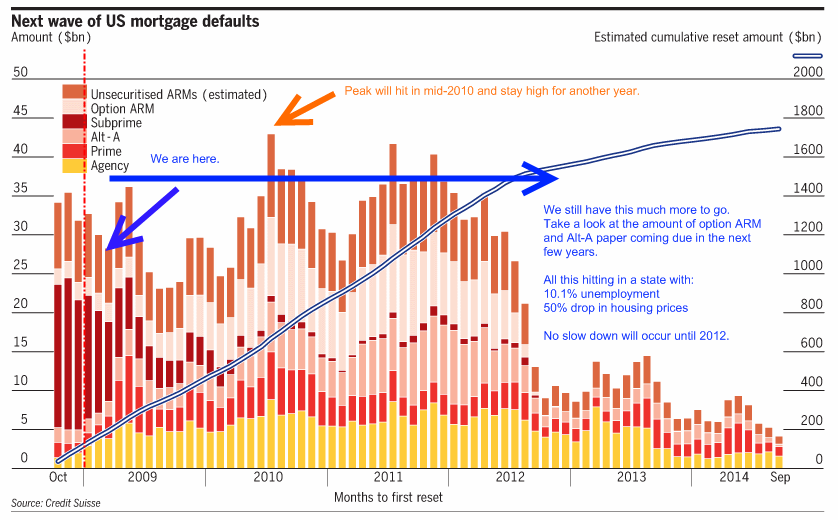
The no-worries lending that inflated the housing bubble is resulting in a flood of soured option-ARM loans, adjustable-rate mortgages that allow borrowers to pay so little every month that their loan balances rise rather than fall, sometimes sharply. Numbers from industry trackers suggest that these borrowers -- most of whom boast respectable and often top-tier credit scores and appear to have substantial incomes and home equity -- are starting to create a second tide of defaults for lenders swamped by the meltdown in sub-prime loans made to people with bad credit or overstretched finances.
...
The percentage of option ARMs with payments behind by at least 60 days in California is in double digits in the Inland Empire, San Diego County, Santa Barbara County, Sacramento, Salinas and Modesto, according to data provided to The Times by mortgage researcher First American Loan Performance...In Yuba City, north of Sacramento, 15% of option ARMs made in 2005 were delinquent at the end of October, the Loan Performance tally showed, and in Stockton-Lodi the delinquency rate on option ARMs from both 2005 and 2006 was over 13%.

"It is astonishing how fast the credit deterioration has occurred," said Paul Miller, an analyst with Friedman, Billings, Ramsey & Co. who follows the savings and loans that specialize in these mortgages. "It took me and everybody else by surprise."
From the Central Valley Business Times:
Two of the nation’s five weakest residential real estate markets this year are in the Central Valley, according to Veros Real Estate Solutions, a Santa Ana-based company that sells enterprise risk management and collateral valuation services. Home prices in the Modesto market are predicted to decline 15 percent and the Sacramento/Roseville market is expected to have a 12 percent drop, Veros says.
Another 2008 price prediction from HousingPredictor.com (hat tip Housing Panic):
  • Sacramento, CA: -10.4%

Friday, January 11, 2008

A Question "We're Almost Afraid To Ask"

From the Sacramento Bee:

Sacramento-area home builders can be excused for cheering the end of 2007. Now their problem is 2008. Statistics released today by the Folsom-based Gregory Group show builders closed 2007 with just 1,320 fourth-quarter sales in El Dorado, Placer, Sacramento, Sutter, Yolo and Yuba counties. It was the lowest quarterly tally since the Gregory Group began counting sales in the fourth quarter of 1999. Sales for the full year were the lowest in a decade.
...
Builders in 2007 sold 7,407 homes in the six-county region, the Gregory Group reported. That was 2,181 fewer than in 2006 and the fewest sales since 1997, when Sacramento was coming out of the 1990s housing downturn.
...
But Gregory Group President Greg Paquin said 2008 may well be the worst of it. "We're still optimistic in Sacramento that a year from now we will have our feet under us," he said.
Q4 Sales chart
Historical sales chart

From the Sacramento Business Journal:
For much of the housing slump that has rocked Sacramento during the past two years, homebuilders failed to heed their own advice about restricting the new-home supply to spur market recovery. But that changed dramatically late last year, according to new-home analyst The Gregory Group of Folsom, which is reporting that builders were forced to shut down 10 percent of the region's new-home projects as sales sank to their lowest levels in years...The Gregory Group found that since June companies have halted sales in 34 of the region's roughly 370 new-home communities, with most of those shutdowns in the fourth quarter.
...
Sales figures show no signs of the slump easing, despite recent inventory reductions. About 1,320 new homes in the six-county area sold during the fourth quarter, a 46 percent decline from last year, the company said.
From the Sacramento Bee:
During this dark winter lull of the real estate season, one question rules, and it's the one we're almost afraid to ask: What are we looking at this year? Is this bottom? Or is that next year? Is this a good time to buy, or is it better to wait? Such are questions buyers and sellers, agents and builders ask in January. We've listed here the 2008 forecasts by some of the industry's experts in Sacramento and other areas of California. They're one slice of the endless speculation of homeowners, bloggers and readers about how far we will go before this downturn levels off.
...
TrendGraphix Prediction: The number of existing home sales in El Dorado, Placer, Sacramento and Yolo counties will rise 2 percent. Home values will fall 10 percent to 15 percent in suburbs farthest from jobs. Desirable older Sacramento neighborhoods will fare better. Downturn is still a long way from finished.
...
California Association of Realtors Prediction: In Sacramento and Central Valley, sales and prices will drop another 8 percent to 12 percent.
...
The Gregory Group Prediction: Builders will sell about 7,700 new homes in El Dorado, Placer, Sacramento, Sutter, Yolo and Yuba counties, about the same or slightly less than in 2007...Foreclosures will rise and peak in first half of the year. The market will find bottom.
From the Sacramento Bee:
Any way you slice it, the new state budget probably won't be kind to the already sluggish economies of California and Sacramento...[T]he governor's proposed 2008-09 budget could be especially troubling for greater Sacramento. Although he's calling for billions in new bonds for infrastructure projects, his short-term budget plan assumes a 10 percent cut in state spending and the elimination of 6,800 jobs in the upcoming fiscal year. The cuts will be spread statewide, but the pain might feel worse to Sacramentans than to other Californians.

That's because state hiring has effectively propped up the area's economy lately. In the past year, state hiring in Sacramento – totaling 4,300 jobs – has accounted for two-thirds of the region's new jobs, blunting the impact of cutbacks in construction, real estate and mortgage lending. Remove the state as a major source of hiring, and the region's economy – already in tough shape – could worsen.
...
The weak housing market is Sacramento's No. 1 problem, but the state's problems "will exacerbate that," said Dean Wehrli, a vice president with Sullivan Group Real Estate Advisors in Elk Grove. "It's obviously going to affect job growth."
From the Modesto Bee:
The valley, with its historically low wages compared with other places, became a breeding ground for subprime mortgages, some of which offered 100 percent financing, unheard of in previous generations. Groans rose from Thursday's audience of several hundred when presenters spoke of stated-income loans, called by some "liar loans." "Which side of the table was lying?" asked John Olson of the Federal Reserve Bank of San Francisco, rhetorically. "Maybe both were. Some people inflated their incomes. Some borrowers were defrauded, with brokers writing in the incomes they wanted."
...
Many economists in recent months have predicted a deepening disaster because of the 1.8 million subprime mortgages expected to reset in coming months. But Olson said the blame is shifting. "We're finding that it's not resets, but it has much more to do with declining home prices that prevent people from refinancing or selling," he said.
...
Olson said maps of foreclosures in some Bay Area cities show distressed clusters, while those in the valley commonly spread across all neighborhoods..."Foreclosure is the freight train that runs over the homeowner," said Jeff Schrager of the No Homeowner Left Behind nonprofit organization based in Fresno. "I submit that we have a local disaster here. People are losing their homes on a daily basis."

Thursday, January 10, 2008

Fire

From KCRA:

Homeowners may see a new fee to cover firefighting costs under a proposal in the new state budget...Homeowners would each see an increase of about $10 to $12 in insurance each year.
...
Even though it's a small fee, some are opposed to another fee for something people are already taxed on. "I don't think increasing any fees in a declining market is a good idea," homeowner Karin Libbee said. "People are struggling to pay their mortgages."
From Fortune:
With the national foreclosure rate zooming and the real estate market in a two-year funk, the insurance industry fears more homeowners will see arson as a way out of their financial woes.
...
Allstate spokesman Mike Siemienas says his company has seen an increase nationally in arsons among homes in foreclosure. In California, the state's insurance division reports that the number of questionable residential fires in 2007 increased 76 percent over 2006.

Tuesday, January 08, 2008

Foreclosures.com: Sacramento County REOs Top 1,000 in December


December 2006 REOs: 283
December 2007 REOs: 1,155
Change: 308.1%

Total 2006 REOs: 1,326
Total 2007 REOs: 8,155
Change: 515.0%

December 2006 Pre-foreclosures: 1,052
December 2007 Pre-foreclosures: 2,380
Change: 126.2%

Total 2006 Pre-foreclosures: 10,505
Total 2007 Pre-foreclosures: 19,453
Change: 85.2%

More statistics at Foreclosures.com

From the Modesto Bee (video):

Monday was a record-breaking day for foreclosures in California. A staggering 5,238 properties were scheduled to be sold in auctions on courthouse steps across the state, including 145 in Stanislaus County. "This is the single largest day ever for foreclosures," said Sean O'Toole, owner of ForeclosureRadar, which tracks mortgage defaults throughout the state. By comparison, 400 to 500 auctions a day were scheduled statewide a year ago, O'Toole said. That average rose to about 2,500 per day by the end of 2007, but he said there's never been nearly as many auctions as happened Monday.
...
In Stanislaus County, for instance, about twice as many properties were scheduled for auction as normal, said David Absher, president of Dual Arch International, which does most of the foreclosure auctions in the county. Absher said that during the past six months, typically 60 to 80 auctions were scheduled a day, but "the volume is mounting."
...
Although an abundance of homes in all price ranges are facing foreclosure in the Northern San Joaquin Valley, fewer and fewer bids are being made at foreclosure auctions, Absher said. "No one wants to buy this stuff because they don't know where the housing market's going," Absher said. "When the prices are continuing to slide down, how do you know you're getting a good deal?"
From the Sacramento Bee:
Lots of developers are putting up "loft" housing in the downtown-midtown area. But Jeff Kraft says his 42-unit condo project at 1600 H St. is the real deal...Now, even though the building looks far from finished, Kraft expects the first units to be ready for occupancy next month. Prices range from $213,000 for a 395-square-foot studio to $699,000 for a two-bedroom, two-bath, 1,249-square-foot unit.

Can Habitat unload them when home sales are tanking and larger high-rise condo projects have flopped? Despite troubles elsewhere, Kraft says midtown is still a residential hot spot. He expects the comparatively low prices for his modest-sized units will bring in buyers. In fact, the project originally was envisioned as a "rent-to-own" complex. Now the emphasis is straight sales. "We just think there's a pent-up demand from people who want to buy," Kraft says.
From the AP via sacbee.com:
Treasury Secretary Henry Paulson said Tuesday the administration was exploring what would be a significant expansion of the program to help at-risk mortgage holders. Paulson, in an interview on CNBC, said the administration was involved in discussions with the mortgage industry to expand a current program to freeze adjustable rate mortgages for five years to include borrowers of loans at prime rates. Currently, the rate freeze only covers a much smaller segment of adjustable rate loans, those made to subprime borrowers. Those are borrowers with weak credit histories. "One thing we will consider with the HOPE NOW alliance is ... maybe expanding this beyond subprime borrowers to other borrowers," Paulson said in the CNBC interview.
From the Federal Reserve Bank of Boston [pdf] (hat tip Paper Economy):
In 2007, residential investment was the laggard among the components of Gross Domestic Product (GDP). Residential investment began declining in the first quarter of 2006, and has continued to decline in each quarter since. It seems all but certain that residential investment also declined in the fourth quarter of 2007 – and many economic forecasts expect residential investment to continue to decline at least through the first half of 2008...Should the forecasts prove to be right, we will have experienced a longer string of back-to-back quarters of declining residential investment than at any other time in the past 50 years...Previous periods where residential investment declined for a year or more were either accompanied by, or closely followed by, an economic downturn.
...
The sharp declines experienced in many regions of the country have occurred despite low real interest rates and, until December, an unemployment rate below 5 percent. This highlights a risk to the housing sector going forward: Since prices have declined substantially even in a relatively benign economic environment, one cannot discount the possibility that they could fall more rapidly should economic performance not remain strong in 2008.

Sunday, January 06, 2008

"Prices Are Still Too High for Potential Buyers" v. Consumer "Mental Disorder"

From the Sacramento Bee:

Dean Wehrli, vice president of the Sullivan Group Real Estate Advisors in Elk Grove: Foreclosures soar; buyers wait; credit tightens. The picture for Sacramento's residential market in 2008 doesn't look good...[P]rices are still too high for potential buyers. Consequently, prices will continue to regress in the second half of this decade to the place they should have been had we not been so frenzied in the first place. If we are waiting for equilibrium – when buyers hold as much "power" as sellers – then we will still be waiting by the end of 2008.
...
David Lyons, labor market consultant at the state Employment Development Department: The economic slowdown will translate into a weak labor market in the Sacramento region, with overall job losses outweighing those sectors still hiring. The regional economy is in for a very slow start to the year. The region generated a net gain in jobs in 2007, but the growth rate slowed to a crawl by year's end. As of November, the region had added just 6,600 net jobs in the past 12 months – a gain of 0.7 percent. It marked the first time the annual growth rate was below 1 percent since 1993. And 2008 is looking bleaker. It's very likely we're going to be in negative territory.
...
Dan Lankford, managing director of Wavepoint Ventures, an early stage investment company with offices in El Dorado Hills and Menlo Park: Most economists agree that the U.S. economy will slow in 2008. The Sacramento region will likely feel a more pronounced tapering off, given the boom of the last several years and the large role that real estate plays in the local economy.
From the Sacramento Business Journal:
Dean Wherli, a vice president with real estate adviser The Sullivan Group, offered a scenario last month during a presentation at an Urban Land Institute event that said if new-home prices around the region had appreciated at a more moderate rate -- say 6 percent instead of the fast-rising prices between 2000 and 2005 -- the price for a newly constructed home at the end of 2007 should have been about $319,000. Instead, the current median price is $385,990. The higher price means that, despite the deep discounts by new-home builders, the region's overall prices are still about 17 percent more than they should have been under the moderate-growth scenario. Wherli said if prices were to hold throughout 2008, by the end of the year they'd still be about 12 percent above the moderate-growth scenario.

Prices, however, seem unlikely to hold. Discounts are drawing a trickle of new buyers, so homebuilders are likely to continue to offer price reductions to lure more buyers.
From the Real Estate News blog:
Our local real estate market has already corrected itself from its past excesses. The median selling price for a county home is $100,000 less than two years ago...Since we all understand the financially successful concept of buying low and selling high, why is it that buyers aren’t?

Consumers are suffering from a mental disorder called media-itice. The affliction resulting from four years of being propagandized by the major media and the economic press about the collapse of the real estate, mortgage and credit markets. Beginning in 2003, consumers have been told that the real estate market was: popping, sinking, bursting, plunging, free-falling, imploding, exploding, collapsing and in total meltdown....Is it any wonder that potential homebuyers are put off from buying a home? Yes, there are some problems but isn’t all the hoopla over a small percentage of troubled homeowners a little too much?

Legislative changes in the mortgage, appraisal and credit industries, insuring market exuberance won’t happen again, will not change consumer immediate attitude toward real estate as a long-term investment and it will do nothing to perk up the county’s housing market. What our current local market needs is a stimulus that will attract homebuyers to El Dorado County.
From the Sacramento Business Journal:
The state's estimated $14.5 billion shortfall could hit Sacramento disproportionately hard if jobs around the Capitol are trimmed. Sacramento's loss of 7,200 construction jobs during the past year was mitigated by 6,000 new hires in government. Given the decline in sales-tax revenue and building fees that have hit all cities and counties, the region can't rely on government for economic growth this year.
...
Sacramento's core jobs are in financial services, construction and government, and none of them look especially strong in the coming year. Housing looks the weakest, with experts predicting further erosion in prices and even fewer sales than the estimated 7,500 new homes built and sold in 2007, down more than 50 percent from the peak years. Sales of existing homes aren't expected to recover this year either, with more foreclosures likely as another wave of adjustable-rate mortgages resets to higher rates. More than 14,000 existing homes were for sale in November 2007, 18 percent higher than a year ago, though down from the record high of 15,302 in September.
From the Sacramento Business Journal:
Sacramento's reliance on government, service, construction and financial service industries for growth in the office market could make for a lean year. With the construction industry taking a huge hit, there has been a ripple into the office market that those in the industry are hoping doesn't build into a wave. That means lease rates are stabilizing and concessions are rising. The region's office vacancy rate inched higher in the third quarter to 15.2 percent for nongovernment buildings larger than 5,000 square feet.
From the Sacramento Business Journal:
A stakeholder in Sacramento's Reynen & Bardis Communities Inc. has accused the builder of making just two monthly payments before defaulting on $19.8 million in obligations it took on this summer. The lawsuit brings the company among the ranks of other local builders struggling through the housing slump who have faced defaults and ended up in court as the market turns against them.

Saturday, January 05, 2008

No "Rush of Would-Be Buyers from San Jose or Los Angeles"

Monterey Village Getting Shredded - photos & video at the Sacramento Real Statistics blog

From the Sacramento Business Journal:

Sacramento County led Northern California counties in mortgage loan defaults in December, with 2,643 homes sliding into foreclosure, according to data released Friday [by Default Research Inc.]
From the Sacramento Bee:
Not so long ago, Sacramento-area home prices were miracles to behold in the eyes of Bay Area and Los Angeles residents. Oh, the wonders here of a sprawling, three-bedroom home for the same price as a tiny, one-bedroom condo there. The allure of lower-priced homes drew plenty of transplants to the Sacramento region earlier this decade. But as housing values began soaring, that affordability began disappearing.

Well, look again. Those days are coming back. The price gap between the capital region and the Bay Area is widening fast. Ditto for Los Angeles...What's going on? Well, it's not rocket science. Prices here have fallen 25 percent since mid-2005 and are still heading down. Prices in the Bay Area and Los Angeles County have held steady until recently – and they're still rising in Santa Clara County.
...
It's not yet clear what this recurring price gap means for the capital's housing market. Many real estate agents say they aren't seeing any rush of would-be buyers from San Jose or Los Angeles.
...
It's going to become tougher in the capital region to qualify for most home loans. Effective Jan. 15, Fannie Mae, the government-sponsored entity that buys mortgages from lenders, wants bigger down payments on loans made in "declining markets" like Sacramento. It means even if a national lender can get you a loan with no money down, Fannie Mae is now demanding a 5 percent down payment for loans in this market. If your loan requires 10 percent down, Fannie Mae will wants 15 percent from the borrower.
From the Modesto Bee:
The Northern San Joaquin Valley's housing market will be one of the very last to turn around in California, a building industry economist predicted Thursday..."It's going to take a very long time for builders to get the confidence to build again" in the Northern San Joaquin Valley, [CBIA's Alan] Nevin said during a telephone news conference.
...
In the San Joaquin Valley, from Bakersfield to Stockton, he projects 17,000 homes will be built in 2008, compared with about 15,000 in 2007. That's less than half the 35,000 houses built in 2005 when the valley's building boom peaked. Joe Anfuso, president of Stockton-based Florsheim Homes, said he doubts San Joaquin Valley builders will sell more homes this year than last year. Anfuso listened in on Thursday's news conference, and he said he agreed with Nevin's verbal predictions about housing markets in Stanislaus, San Joaquin and Merced counties being among the last to recover.

Thursday, January 03, 2008

"The Good Ship Sacramento" Takes on Water

From the Sacramento Bee:

Up until 2007, the good ship Sacramento appeared to be sailing along smoothly, propelled by a pair of seemingly steady winds – state government spending and real estate appreciation.

Yet it was only a matter of time the winds changed. The subprime storm has now arrived. The regional housing market is sinking, dragging down the budgets of state and local governments. Crime is on the rise in some areas. For the first time since the 1990s, the capital region finds itself pressured to cut costs for social services and community policing at a time when people need those programs most.
From the San Diego Union Tribune:
In regions where lots are in good supply, such as Riverside, San Bernardino, the San Joaquin Valley, and the Sacramento area, “there will be a major change in the home building mentality,” [California Building Industry Association's chief economist Alan] Nevin said. “Lots, for the most part, have declined substantially in value. They will be written down to more practical value levels.” That means home builders will be able to build substantially smaller homes and sell them for substantially lower prices, he said.
From CBS 13 (video):
The foreclosure crisis is bad enough for people, but homeowners' pets are suffering as well. A growing number of pets are being left behind in the foreclosed houses they once lived in when their owners move out.
From Sacramento News & Review:
Anyway, if you feel a little un-trendy every now and again, console yourself with the thought that there’s one current trend on which Sacramento has been way out in front: the current housing bust. In that, according to a November article in Forbes magazine, we lead the nation, with prices that have fallen 10.5 percent—outpacing any other city. Be proud, Sacramento, be proud. Or, if that doesn’t seem like a matter of pride, let’s all at least admit that being trendy isn’t everything. Maybe you can’t sell your house, but at least you can console yourself with wine and cupcakes.
From the Modesto Bee:
John Diaz, independent real estate broker in Modesto: Diaz said the market likely will drop further in 2008, as foreclosed homes continue to hit the market. Rising fuel prices have reduced the appeal of Northern San Joaquin Valley homes to Bay Area commuters, he said, and city and county leaders have failed to attract the employers that would keep workers here.

People in real estate differ on when the market will rebound. Some say the sales numbers could rebound in 2008, as reduced prices draw in people who were priced out during the recent boom. Some say 2009 or 2010 is more likely. Diaz said it could take even longer.
From oftwominds.com:
The housing market won't turn around in 2008--or 2009, 2010, 2011, either. The really smart folks will be saving their money for 2012 or maybe 2013, when years of grinding losses will have stripped the assets of everyone who bought real estate with the idea of retiring on the proceeds. At that bottom, everyone will be disgusted with real estate, both residential and commercial, and no one will be dumb enough to sink dead money into an asset class which continues to decline in value year after year. At that point, say Q1 2013, then housing will again become a buy.
...
Exurban burnout and job losses will take a toll. Take two hideously long commutes to distant jobs, a centerless, lifeless suburb in the middle of nowhere, take away one job and presto, you get an empty subdivision of essentially worthless McMansions nobody wants at any price. Add a dash of decay which acts as a catalyst, and you speed up the abandonment of the exurb.
...
Houses built where they should not have been built will be abandoned. Large swaths of known floodplains are now covered with subdivisions in the Sacramento Delta region...Back in the good old days of say, 2007, governments might have reckoned they had the funds to rebuild dikes and other engineering wonders to protect a few thousand new homes. But as the economy sours, governments are suddenly short of funds. And as people leave those distant suburbs, then the stark reality will become apparent: it isn't worth tens of millions of dollars to protect a few thousand homes (many standing empty) which should not have been permitted in the first place.
From The Times:
A small 1950s bungalow in Stockton, California, is up for sale for $169,950. Sitting off a quiet road dotted with American flags, the Funston Avenue home has two bedrooms, one bathroom and a covered porch. It was built as part of President Truman’s Fair Deal, a federal promise to guarantee economic opportunity and housing for America’s servicemen returning from the war.

Sixty years on, however, the American Dream has turned into a nightmare. The bungalow’s value has fallen by $110,000 in two years and the family who live in it have fallen so far behind with their rising mortgage repayments that they have been foreclosed by the bank. This family’s story is a common one in the neighbourhood, which houses the bank workers and civil servants who zoom up Highway 205 to commute for two hours each day to and from the pricier city of San Francisco.

According to David Sousa, the real estate broker who is selling the house, the number of properties up for sale in the area has risen from around 1,800 two years ago to about 8,000 now. Most of those properties are in the process of being repossessed by mortgage lenders. Moreover, there is no sign that the residents of Stockton are past the worst. Their lot seems a far cry from the town’s sunny motto: “Stockton’s Great, Take a Look!”
...
“One of the biggest challenges we face is that the number of foreclosures have left the market saturated with unsold property,” Mr Sousa said. He estimated that prices were falling at “between half and 1 per cent a month” and said that that local mortgage lenders had been so overwhelmed by the number of repossessed homes on their books that they are trying to sell, that real estate brokers – estate agents to you and me – cannot get a decision from them for at least 30 days over whether they will accept an offer price.