Thursday, August 28, 2008

'Beginning of the End of the Sacramento Housing Crash'

From the Sacramento Bee:

After years of gloomy forecasts and despite a still-declining real estate market, something new is creeping into the housing forecasts: Hope. It's a sense that economists can see outlines of an emerging bottom.
...
"We are at the beginning of the end of the Sacramento housing crash," he [Mark Zandi, chief economist of Moody's Economy.com] said late Wednesday..."Prices will resume rising again early in the next decade."...Zandi said another 5 percent to 10 percent declines in home prices will "restore housing affordability" in Sacramento and coax more first-time buyers back into the market.
...
Concerns still exist however, about foreclosures, which still haven't peaked in the Sacramento region. Scott Thompson, a partner at Citrus Heights-based Mortgage Resolution Services, said he thinks a shortage of buyers will begin to show late this year. "I think we are plowing through all the good buyers who are enthusiastically in the market. We're going to get to November and be at the end of the buyer pool," he said.

Wednesday, August 27, 2008

Home Prices Still Higher Than In 2007 2006 2005 2004 2003

Sacramento Bee: Five-year price picture isn't all doom and gloom

The bottom may have fallen out of Sacramento home prices, but most owners are better off than five years ago, says a new federal analysis of the nation's home prices. Home prices remain 22 percent higher in El Dorado, Placer, Sacramento and Yolo counties than in 2003, according to the Office of Federal Housing Enterprise Oversight.
From CNBC:
The economy will never recover if housing doesn’t find its footing first. But when will that happen? Cramer said he expects a bottom by the third quarter of 2009.
...
[E]ven these horrible areas – Bradenton in Florida and the Central Valley in California – are bottoming. The first to fall is usually the first to return, Cramer said.
From Forbes:
Central California is the epicenter. Among the top 10 debt capitals are six of California's major inland urban centers--not a good sign for the state's economic recovery...Housing price declines are the culprit, economists say. In California, prices in Modesto, Merced and Stockton fell between 41% and 45% after peaking in early 2006, the sharpest decline anywhere. The declines "have taken out the economy" in these cities, says Mark Zandi, chief economist at Moody's Investor Services' economy.com.
From the Appeal Democrat:
A West Coast furniture retailer with a long history in Yuba-Sutter announced Tuesday it plans to close after almost nine decades in business. McMahan's Furniture said it will shut all 15 of its stores, including Yuba City, within the next few months.
...
The company, which has been in business for 89 years, cited a slump in the home furnishings business that has been ongoing for two years. "McMahan's has experienced downturns before and always managed to rebound; however, this decline dating back to late 2006 has been considerably longer and deeper than anything (McMahan's) previously experienced," the company said.
From the Voice of San Diego:
"People are saying the reason prices are falling are because of all of the foreclosures, but the foreclosures are happening because the prices are falling," [Chris] Thornberg [founding partner at Beacon Economics] said. "They've got it backwards. The prices are falling because they're too freakin' high."

Tuesday, August 26, 2008

"Fear Is In The Air"

From the Associated Press via Forbes:

U.S. home prices fell 4.8 percent in the second quarter compared with a year ago, easily a new record low, according to a government report.
...
Prices in the weakest markets, he said, have receded to late-2005 levels, plummeting by more than 30 percent in two cities: Merced and Stockton, Calif.
According to the government, Sacramento home prices dropped 17.7% over the last year. That compares to a decline of 14.6% during the entire 1990s housing bust.

From Home Front:
I called Kathryn Boyce of Hanley Wood Market Intelligence, who said [Beezer]...has moved to smaller space on Roseville Parkway. With so many fewer staffers in this greatly-cooled market they didn't need the big building anymore. The office is being run now out of Southern California, she said.
From the SF Chronicle (hat tip Anon1137):
Ken Rosen, chairman of the Fisher Center for Real Estate and Urban Economics at UC Berkeley, had a more bearish take on Monday's numbers. "It doesn't reflect a recovering housing market; it reflects a broken housing market," he said. "It's a reflection of the fact that foreclosed homes are being liquidated at very low prices."
...
Rosen believes that investors, not actual intended occupants, are buying up many if not most of the distressed properties in the hardest hit areas. That will do little to stabilize the markets in those areas, especially if prices fall further and foreclosures continue to climb, he said.
From the LA Times:
State and federal officials are unable to say how many Section 8 renters have been affected by the wave of foreclosures sweeping the country, but local housing authorities say the number is significant -- and growing. Sacramento County had fewer than a dozen people seeking new Section 8 homes in June because of foreclosures. In July, the number was 100.
From the Sacramento Bee:
Not to be too dramatic about it, but fear is in the air. You don't have to lose your home to understand the woes of the housing market. You don't have to get laid off to see the effects of downsizing on your neighbors and friends. In a country busy doing the fear dance, it can be hard not to wallow in worries yourself. So maybe smart folks stay home, conserve gasoline and make do with leftovers and hand-me-downs. They take care of their families and pinch pennies.

In short, they channel our Depression-era forebears – who, it must be noted, are not shopping at the Roseville Hospice Thrift Store in the numbers they used to, either. "A lot of our customer base are people who don't need anything, but they like to come and browse," says Watson. "A lot of them are Depression generation. They've stopped coming in because they don't yet see an end in sight to our economic problems."

Monday, August 25, 2008

'There are only so many houses I can buy in cash'

From the Sacramento Bee (hat tip SMF):

C.C. Myers, the legendary Sacramento-area building contractor, has filed for personal bankruptcy because of losses stemming from his personal investment in an Auburn residential development [Winchester Country Club]..."The market conditions are the worst we've ever seen and we were unable to convince our lenders to work with us to restructure the financing, so I was left with no other options," Myers said in his press release.
From the Sacramento Business Journal:
A St. Louis bank is foreclosing on part of the Sunset Whitney Country Club in Rocklin, creating uncertainty for the 45-year-old private club. Developer John Thomas, founder of Regent Asset Management Group LLC in Sacramento, is being sued by First Banks Inc., which says Thomas is delinquent on a $4 million loan on the golf course he bought in 2004. The club and golf course continue to operate. The bank has already taken the Sheraton Hotel on Stockton’s waterfront from Regent Asset Management.
From the Sacramento Real Estate Blog:
Up until recently, this fairly pricey community seemed immune to the price erosion in the rest of the area. In the last few months, however, we’ve sometimes had to report price drops for East Sac. In July, for example, the average sold price per square foot in East Sac was $324.61, down 12.5% from last July’s average of $370.84...With homes in East Sacramento selling for more than twice the price of homes in surrounding communities, demand for homes in East Sac has slackened from last year, with unit volume down 33.3%.
From the Sacramento Business Journal:
KB Home, the Sacramento region’s third-largest homebuilder in 2008, has merged its Sacramento and Bay Area divisions into a single Northern California division based in Pleasanton. Layoffs, which KB Home would not discuss in detail, included Sacramento division president Barry Grant. The Sacramento office remains open to support several projects still selling in the region.
...
KB Home had been among the builders who were most confident about the Sacramento market during the peak of housing production, in 2004.
From the Sacramento Business Journal:
The Sacramento Bee on Monday offered the cash-strapped newspaper's first broad-based buyouts in its history, inviting a majority of the paper's full-time work force to take a voluntary severance. The Bee continues to experience big declines in advertising revenue brought on by downturns in the economy and housing market, and competition from the Internet and other media.
From the Sacramento Bee:
Bee Publisher and President Cheryl Dell...said another round of layoffs is possible if there aren't enough voluntary buyouts.
...
One ray of hope at The Bee, Dell said, is that the Sacramento area entered the downturn earlier than most markets "and there's a general belief that we'll come out of this earlier."
From the Real Deal:
Margaret Ketwig, for example, is typical of many in Sacramento's middle class. Ketwig, 48, bought her four-bedroom home in 2006 for $590,000. Yet recently she lost her job. She hasn't been able to afford a payment since January. While Ketwig would like to sell, she acknowledges that she may just have to walk away. "There are so many homes on my block that are owned by the bank, that I can't compete with the prices," she said. "I can't even come close to making the house payments. I think I'll be moving in with family and starting from scratch."
...
"I think the hard days are almost over," said Bob Bronswick, president and CEO of Coldwell Banker Sacramento/Tahoe. "Right now I think we've hit bottom, and we're looking at a bounce … I think things are starting to look up."
From the Sacramento Bee:
Millions of dollars in late special property taxes are forcing some cities and districts to threaten delinquent taxpayers with foreclosure...[T]his year the pace of delinquencies is increasing, particularly in California's inland areas, said Tim Seufert, managing director of the San Francisco office of NBS, a firm that does consulting work for special financing districts. "Compared to two years ago, it's up exponentially. There's no question," he said.
...
Delinquency rates also were high during the last real estate downturn in the mid-1990s, but this time individual homeowners are being hit hard. "It is what in the past was considered could never happen," said Oakland attorney Susan Feller, who represents issuers of land-secured bonds. "It was always considered that once property was built and owner-occupied, you would not have delinquencies (in large volume)," she said. "You wouldn't get to these kinds of levels."
From the San Jose Mercury News:
Few if any lenders these days will make loans to those who already have four or more mortgages...Banks' new restrictions on the number of mortgages available to borrowers won't bother typical home buyers. But it's hobbling people...who invest in rental properties, and could even prolong California's housing slump, some observers say. That's because investors are among the most likely buyers for many of the bank-owned foreclosures now lingering on the market in the state's inland valleys.

"If we can't participate, we can't burn through these inventories and help the market correct," said Geraldine Barry, president of the San Jose Real Estate Investment Association....More often lately, she said, "What I'm hearing from our members now is, "I have a deal; I can't get money'.''

Barry and her husband recently bought a foreclosed house in Sacramento for $114,000; the previous owner owed about $250,000 on the property when the bank repossessed it. Even with a 25 percent down payment, they were unable to find a loan because they have more than four outstanding mortgages, so they paid in cash...Geraldine Barry said she wants to buy more bank-owned California properties in coming months, but has yet to figure out exactly how she will finance deals, if lender restrictions remain in place. "There are only so many houses I can buy in cash," she said.
New York Times: In the Central Valley, the Ruins of the Housing Bust
Forbes: Sacramento Second Most "Distressed" Housing Market
CAR: California's Median Home Price Decline Breaches -40% YoY

Saturday, August 23, 2008

Sacramento Real Estate Market - August 2008 Water Cooler

Post off-topic links, observations, and stories about the Sacramento real estate market here. Please read the comment policy before posting.

Thursday, August 21, 2008

'The speed at which this thing fell apart was just unheard of'

From the Press Democrat:

Exchange Bank, one of the most visible companies in Sonoma County, is navigating through turbulent times. The Santa Rosa bank has suffered losses in two of the past three quarters -- its first in at least 50 years, according to bank officials -- and its stock has lost half its value over the past two years.
...
The bank opened its first office outside Sonoma County, a lending branch in Sacramento, as Sonoma County builders moved into the Central Valley and scrambled to develop subdivisions....Bank officials defended their lending standards and the decision to expand into the Sacramento area. "The speed at which this thing fell apart was just unheard of," [Exchange Bank's veteran Chairman C. William] Reinking said.
From Rocklin & Roseville Today:
I personally believe we have not seen the bottom yet in terms of price but increased sales volume and inventory coming down will get us there in the next 18 months. I don’t think declining prices will be very dramatic during that period but we still have a tranche of “loan resets” coming which may spike up foreclosures and unemployment increasing will not help. The key element in stabilizing prices is seeing the supply and demand start to equalize.
...
HousingTracker indicates that there are still 14,721 homes on the market. This is down over 21 percent from the same time last year but the rate of decline has slowed considerably and, in my opinion, it will take an inventory level south of 10,000 to stop the decline in prices.
From the Associated Press (via the Union Tribune - hat tip: Sold in '05):
As if the housing market wasn't scary enough, the record-setting surge in foreclosures could be distorting some of the closely watched housing data used to gauge the market's health. The foreclosure glut is making listings of homes for sale a less reliable indicator, because much of the distressed inventory might be left out.
...
"The wave of foreclosures is unprecedented, making it difficult to analyze, difficult to gauge how large it will get or how bad it will make things," Deutsche Bank analyst Nishu Sood said in an interview. Sood, in a recent report, lays out a case for why the surge in foreclosures isn't being fully reflected in the resale inventory levels, as measured by the real-estate databases known as multiple listing services, or MLS. In nine of the 33 markets Sood examined, distressed inventory is significantly higher than what is found in the MLS listings.

This is most pronounced in what have been deemed “bubble” real estate markets, which saw the biggest gains during the home buying boom and are experiencing the largest declines since the pullback began more than two years ago. For instance, in Sacramento, the foreclosed inventory was 31,219 units, or more than twice the 14,913 units on the MLS listings.
...
Sood attributes that gap largely to bank-owned foreclosed homes that aren't always captured in the MLS listings. He calls that the “shadow inventory,” and says the behind-the-scenes glut of properties wreaks havoc on housing-related statistics.
From the Sacramento Bee:
...[D]istricts, hit hard by the housing market crash and declining student enrollment, will struggle to keep afloat. "We tried to maintain the same programs we had the prior year, that was a strong desire for us, but still it's difficult to cut $2.9 million from a $40 million budget and not have some things felt," said Scott Leaman, superintendent of Western Placer Unified...Staff reductions will be felt in custodial services, kindergarten classes and front offices.
...
In San Juan Unified, four counseling positions have been left vacant, and the equivalent of three full-time vice principal positions have been cut.
From the Sacramento News & Review:
We’re in the third year of a pronounced downturn in the housing market. And not coincidentally, Foothill Theatre Company (one of the region’s few professional theater companies) is in serious financial peril. Other performing-arts groups are also feeling the pinch.
...
It’s probably going to be two (maybe three) years before things get better. So hold on tight, because performing-arts groups—which are linked to the local economy at multiple levels—are going to face some tough sledding before the economic picture starts to improve.
From the Daily Breeze:
Rep. Laura Richardson caught a break on Wednesday when code enforcement officers decided not to bill her for boarding up the garage door on her vacant Sacramento home. The city decided it would be too much trouble to determine who owned the property last month, when code enforcement officers were called out to deal with a "public nuisance."
...
In a statement, Richardson, D-Long Beach, disavowed any responsibility for the current upkeep of the home, because she said it still has not been transferred back to her...Richardson's statement conflicts with available public records, which state that she has had the title to the property since June 2.

Wednesday, August 20, 2008

50% Off Peak For Stockton & Modesto Metros; Merced Down Nearly 60%

From the Modesto Bee:

This spring, median-income families could afford about half the homes sold in Stanislaus, Merced and San Joaquin counties. Compare that with three years ago, when the region's families could afford only about 3 percent of the homes sold. That's the upside of the housing downturn.

The downside is that home prices keep declining: July's median sales price plummeted to $190,000 in Stanislaus County. That's less than half what houses were selling for in December 2005, when prices peaked at $396,000.
...
San Joaquin's median sales price fell to $220,500 in July [down 51.2% from the $451,500 peak]. Merced's median fell to $155,000 [down -59.5% from the $382,750 peak].
From the Sacramento Business Journal:
The sharp fall in median home price in Greater Sacramento has helped drive up affordability....About 55.7 percent of all homes for sale in the four-county metro area were priced so that a family making the median income in the region could afford them, according to the National Association of Home Builders/Wells Fargo Housing Opportunity Index. That was the highest affordability rating among any California market in the study, and was even better than the U.S. figure of 55 percent for the second quarter of 2008.
From the Appeal Democrat:
In Yuba County, sales in July climbed 43.3 percent above a year earlier. The $183,500 median price was down 33 percent from the same period last year. In Sutter County, sales jumped almost 26 percent while prices were off 30 percent from July 2007, at $203,000.
From the Sacramento Bee:
The cosmetic surgery industry is in need of a lift. Soaring unemployment, high gas prices and the mortgage crisis have left consumers with less discretionary income. For plastic surgeons, that means fewer patients are coming in for elective procedures.
...
"Now financing (companies) are becoming more difficult in who they approve," said [Dr. Shahriar] Mabourakh [of the Folsom Plastic Surgery & Laser Center]. The Folsom doctor started seeing a decrease in calls from prospective patients in December.

Tuesday, August 19, 2008

The Scarlet Letter

From the Sacramento Bee:

To some analysts, the region's rising sales – mirroring those elsewhere in inland California – suggested a path toward stability that could set in next year.
...
"I think in the Central Valley we're getting closer to the bottom. I still think it's going to be 2009," added Delores Conway, director of the Casden Forecast at the USC Lusk Center for Real Estate in Los Angeles. "But I think prices are bottoming out in Sacramento, the Inland Empire and some areas around Fresno."

Caution abounds, however. Much rides on unemployment, which is rising in California, availability of credit, resets on a new wave of troubled loans and the pending loss of down payment assistance gift programs, analysts said.
DataQuick data via Home Front:
-By County [doc]
-By Zip [xls]

From the Sacramento Business Journal:
The price-per-square-foot of the average house in Sacramento County dropped to $141 and to $191 in El Dorado County, representing an overall regional decline of 33 percent from a year ago, according to Trendgraphix Inc., a real estate data tracking firm connected with Lyon Real Estate. Michael Lyon, CEO of Lyon Real Estate said bank-owned properties make up 63 percent of all sales and the inventory of those properties inventory continues to grow.
From the Sacramento Bee:
The housing market has collapsed. Growth pressures? Poof! Yet Elk Grove – or at least a large number of its council members – still continues the curious push to balloon the city's boundaries. Elk Grove is seeking to expand its "sphere of influence" over 10,536 acres south of the city, including parts of the Deer Creek and Cosumnes River floodplains.
...
Why this push? Why now? It's hard to say. There's no immediate need for Elk Grove to add rooftops. The city has scores of empty houses. What Elk Grove needs is new jobs, centrally located, so the city can evolve into a real city.
From the Modesto Bee:
The Modesto Bee offered buyouts Monday to all its full-time employees. The announcement comes four days after The McClatchy Company, which owns The Bee and 29 other daily newspapers, announced a companywide one-year wage freeze. "Unfortunately, the economy continues to worsen, and we must reduce expenses further," Publisher Margaret Randazzo said in an e-mail to employees. This is the second buyout The Bee has offered employees this year.
...
These actions follow last month's announcement that The Bee will cease printing in Modesto...That change will cost 33 full-time employees and 127 part-time employees their jobs.
A bit of déjà vu courtesy of InsideBayArea.com:
As the mortgage meltdown forces more homes into foreclosure in the Bay Area, some of these properties are being picked up by investors who are putting them back into the rental market...[A]s investors buy foreclosed homes and rent them out, the number of available rental properties is likely to increase, which could lead to lower rents down the road, observers say.
...
"We are starting to see a trend. Investors are picking up the homes and turning them into the rental market right away. ... We have not seen the foreclosures drive up rents anywhere right now" [said Eric Weigers, deputy director of the California Apartment Association.]...Foreclosure activity involving investors who are turning the homes they buy into rentals is indeed increasing the rental stock, said Steve Edrington, executive director of the state Apartment Association's northern Alameda County chapter..."I think we are in this transitional point where rents are going to slow down and sales of houses are going to pick up a bit because there is less inventory out there," he said. "The (foreclosed) homes are being bought and rented out and not being sold for owner-occupancy."
From the Stockton Record:
Stockton City Council tonight will consider an ordinance that will require vacant homes and other empty buildings to be posted with 24-hour contact information for the owner or local property manager on a street-facing, weather resistant, 4” x 6” sign. “Stockton has become a center for the foreclosure crisis,” says City Manager Gordon Palmer. “Our code enforcement officers have had a significant increase in the number of cases they are handling. This ordinance will help us quickly determine who the property owner or manager is and work with them to resolve problems and concerns before they deteriorate.”

Monday, August 18, 2008

DataQuick on Sacramento: Price Declines Exceed 45% Off Peak

From the Sacramento Bee:

Median sales prices of existing and new homes combined in Sacramento County fell to $210,000, the lowest since June 2002. The number of sales in the county was up 73 percent from last year and was highest since October 2005. Prices have now fallen 45.7 percent from their August 2005 high of $387,000.
...
Bank repos accounted for as much as 80 to 90 percent of July sales in some parts of hard-hit Sacramento County, according to the Sacramento Association of Realtors.
One thing missing from my chart of Sacramento home prices as well as The Bee's interactive chart is a perspective on sales figures. Although not about Sacramento, Peter Viles of the LA Times provides an interesting look at the relationship between sales bottoms and price bottoms.

From the Sacramento Business Journal:
Granite Community Bank is profitable, but its real estate-heavy loan portfolio has bank regulators looking for reassurance. The bank has entered a “formal agreement” with the Office of the Comptroller of the Currency, the regulator of nationally chartered banks, that requires it to create detailed plans as it faces the potential of continued deterioration of real estate loans. The 2002 startup in Granite Bay is well-capitalized and profitable. But the federal regulators want the bank to detail how it will stay that way.
...
Granite Community was started with a real estate focus, and the Sacramento region “is high on the list of areas where regulators have concerns about real estate,” [David] Kaiser [Granite Community's chief executive] said.
From the Sacramento Business Journal:
In a downtown Sacramento market with new office buildings under construction and little demand from tenants for space, AKT Investments Inc. has temporarily suspended its application to build a 24-story tower on K and 15th streets and will consider modifying the project.
...
Office vacancy has been on the rise for the past year, up by as much as 2 percentage points, according to several brokerages, reflecting a downturn in the housing market and the economy in general. There have been fewer company expansions and little growth with firms relocating to Sacramento.
From the Sacramento Business Journal:
Hefty paychecks and higher-valued homes helped Roseville and Elk Grove become two of the nation’s 50 wealthiest communities with at least 100,000 residents, at least before the free fall of the real estate market. Sacramento — which boasts deep pockets in areas such as East Sacramento, the Fabulous 40s and Land Park — finished at No. 88, between Inglewood and Reno, Nev.

Of course, California’s once-booming housing market created some of the wealth factor, with five of the Top 10 cities and 17 of the Top 20, according to a just-released Bizjournals report based on 2006 data, the latest available.
From the Sacramento Bee:
[T]he Sacramento area's unemployment rate jumped last month to 7.3 percent from 6.8 percent in June, the department reported. The half-percentage-point bounce was the highest single-month increase for the region since the state started keeping regional statistics in 1990.
...
"The story behind the job numbers is that the state's economic weakness is spilling outside of real estate," said economist Jeff Michael, director of business forecasting at the University of the Pacific in Stockton. "It's the same theme for Sacramento."..."Some people are still debating whether the nation is in a recession," Michael said. "For California, I think the debate is over."
From the Sacramento Business Journal:
Attorneys say conflicts and lawsuits are up, many from the difficulty in financing deals or carrying land when the economy dips, land prices fall and commercial tenants stop looking for larger offices.
...
“Our construction practice has been very busy,” he [Ed Quinn, managing shareholder of McDonough Holland & Allen PC] said. “Developers are finding it difficult to pay for infrastructure improvements. There’s no question that subdivision and other types of developments are underwater and have come to a grinding halt. Disputes arise as to who ought to be responsible for costs.” He said contractors’ liens are on the rise, as are claims against title insurance policies.
From the Manteca Bulletin:
What is the best flippant way to describe the Manteca housing market in four words? The vultures are feasting. A stratospheric 52 homes went pending in the week ending Aug. 11 for an annual pace - if it holds - of 2,704 homes.

The accelerated sales pace doesn't surprise Florsheim Homes' chief executive officer Joseph Anfuso. "Those who expect homes to fall another 30 percent in value aren't being realistic," Anfuso said Friday at his company's Valley Park neighborhood in southwest Manteca. "Home (values) can not fall below rental value."
...
"Foreclosures are driving everything now," Anfuso said. He had originally expected the foreclosure wave to start subsidizing by the end of the year but now expects it to extend into the first quarter. "The amount of foreclosures has surprised me," Anfuso said.
From Of Two Minds:
"Prices likely won't increase if supply vastly surpasses demand, but they will only fall so far before hitting a natural bottom, he said. California's growth rate, rental rates, construction costs and income levels help determine that level, and O'Toole said he thinks some communities, such as Stockton, which leads the nation in foreclosures, might already be near the bottom."

This is like saying that your injury will stop hurting when the pain goes away. The mantra many others and I have been repeating is that home prices will fall until they are in line with income. But I realized that is, perhaps, a gross miscalculation which I must address. I have new hypothesis: Prices will fall below the level of median income support; they will overshoot to the downside and bottom at "market clearing" prices. The reasons are high inventory, high unemployment, scarcity of credit, scarcity of qualified buyers and poor sentiment.
...
[P]rices will fall to market clearing levels and that level is not singularly tied to incomes. Even in normal markets prices oscillate around the mean. After such a great distortion (bubble) it is somewhat unrealistic to think that prices will fall right back to the mean.

Saturday, August 16, 2008

Hell Freezes Over

"[The city of San Francisco's] median home sale price fell nearly 12 percent between May 2007 and May 2008, according to the city controller." -San Francisco Chronicle


"More foreclosure signs are going up around the Bay Area in places we are not used to seeing. New numbers released Thursday show the picture remains grim. No part of the Bay Area is now immune from the housing crisis. Foreclosures are skyrocketing in the wealthy counties of Marin and San Mateo."-ABC 7

Friday, August 15, 2008

Sacramento Unemployment Breaches 7%


Source: EDD [pdf]

From the Sacramento Business Journal:

The unemployment rate in the four-county Sacramento area hit 7.3 percent in July, up a half-point in just one month and sharply higher than the July 2007 jobless figure of 5.6 percent...The Sacramento metropolitan area last saw a jobless rate this high when it hit 7.4 percent in January 1996, as the region was coming out of a recession.
...
[W]age and salary employment dropped by 9,700 jobs from June to July....[T]he area was also down 1 percent -- 9,100 jobs -- from July 2007 to July 2008, with 5,100 construction jobs disappearing.
From KCRA:
Beefed-up code enforcement of bank-owned homes is leading to more violations and liens being placed on foreclosed properties, officials said. Some of these fines can be up to thousands of dollars.

The problem for taxpayers, KCRA 3 has learned, is that multiple banks -- instead of paying those fees to fix the properties -- are dropping sale prices as much as 50 percent to get the property out of their hands. "What they (code enforcement agencies) are doing is not forcing the bank to fix it up," said Mike Lyon of Lyon Real Estate. "They are forcing the bank to give it away."
From the LA Times:
First Rep. Laura Richardson was having problems making house payments, defaulting six times over eight years. Then after a bank foreclosed on her Sacramento house and sold it at auction in May, the Long Beach Democrat made such a stink that Washington Mutual, in an unusual move, grabbed it back and returned it to her.

This week, in the latest chapter in the housing saga, the Code Enforcement Department in Sacramento declared her home a "public nuisance." The city has threatened to fine her as much as $5,000 a month if she doesn't fix it up.

Neighbors in the upper-middle-class neighborhood complain that the sprinklers are never turned on and the grass and plants are dead or dying. The gate is broken, and windows are covered with brown paper. "I would call it an eyesore," said Peter Thomsen, a retired bank executive who lives nearby.
From Housing Wire:
The nation’s worst-performing counties continue to be centered in hard-hit California, CoreLogic’s data show: Sacramento County has seen prices fall 26.12 percent from June of last year, while Santa Barbara County has seen prices fall 25.54 percent; San Bernardino, 25.41 percent. In the past three months, San Bernardino has seen prices fall 7.46 percent, the second worst such showing nationwide (the worst performer was Calif.’s Sutter County, which saw a 7.87 price decline).
From the Sacramento Bee:
Existing home sales kept climbing in Sacramento County and West Sacramento during July, with homes repossessed by banks accounting for 70 percent of escrow closings, according to the Sacramento Association of Realtors. Prices continued to fall.
From the Stockton Record:
In a hot foreclosure sales market, the latest trend taking shape is investors bundling their cash to buy bundles of homes...Terry Hull Sr., a Stockton real estate developer and co-owner of a family-owned property-management firm, said he is organizing a group of as many as 50 local investors to pool enough money to buy 25 to 30 houses...Twenty investors already have bought in at $25,000 per share, he said.

The buyer of one share is Bob A. Sullivan, a semi-retired owner and broker of a Stockton real estate firm. He said he expects to no less than double or triple his investment. "What I like the best is the timing to buy," he said. "Prices are really depressed right now. In my mind, there's no question that prices will go up again considerably. Whether it's one year or five years, I don't know. I don't see any downside."

Thursday, August 14, 2008

NAR: Sacramento Tops For Price Declines (Again)

Bloomberg reports on the latest numbers from the National Association of Realtors (NAR):

The biggest [second quarter] declines reported by the Realtors today were in Sacramento, the capital of California, with a 36 percent drop, followed by the metropolitan area around Cape Coral and Ft. Myers, Florida, down 33 percent.
The more things change, the more they stay the same (at least at the NAR). The Mess That Greenspan Made takes the NAR to task for its latest propaganda public relations campaign. "It's a great ideal time to buy!"

From Home Front:
It's kind of uncanny how much it [commercial real estate] resembles the path taken by the residential sector. Unbridled faith in the future led to an excess of investment capital, overbuilding and then an inability to stop when all the signs said the party was ending.
...
An estimated 7.6 percent of retail space across the four-county region was vacant at the end of June. That's up from 5.6 percent at the end of last year.
From the Sacramento Bee:
The Sacramento area continues to bleed auto dealerships. The latest to go is Winter Volvo Lincoln Mercury on Florin Road in Sacramento. It will close at the end of the month after 60 years.
...
Winter Volvo Lincoln Mercury will be the sixth area dealership to close in the past five months and the third in the 3800 block of Florin Road.
From the Sacramento Business Journal:
Dale Vaira, president and general manager of the dealership, cited a number of factors that “all happened at once,” which led to the decision to accept the buyout. “The economy is too tough. The real estate bubble has burst. The falling dollar is making prices too high,” consumer confidence is low, and gas prices are high, he said.

Wednesday, August 13, 2008

'The lenders still just have their heads in the sand'

From the Modesto Bee:

A record-breaking 3,000 homes were lost to foreclosure during July in the Northern San Joaquin Valley, pushing the 12-month foreclosure total to more than 20,000 homes. Mortgage defaults on those properties cost lenders about $1.1 billion in July, according to statistics released Tuesday by ForeclosureRadar....

"We're going to see even more foreclosures this month," predicted Sean O'Toole, founder of ForeclosureRadar, which tracks every California foreclosure. "The lenders still just have their heads in the sand." O'Toole said mortgage companies continue to be unrealistic in dealing with borrowers because they haven't accepted how bad the real estate market is in places like the Northern San Joaquin Valley.
From the Appeal Democrat:
Roughly three quarters of Yuba-Sutter homes purchased in the last five years are worth less than their mortgages, said Zillow.com, an Internet home-value provider.

And the last year has continued to be brutal to area homeowners. Zillow.com's median home value estimate for the second quarter sagged by 23.4 percent for the Yuba City metropolitan area compared with a year ago. Nationwide estimates dropped 9.9 percent for the same period.

"Obviously, Yuba City isn't doing that wonderful, comparatively," said Zillow spokeswoman Sarah Mann.
From the Stockton Record:
Sales of existing homes - mostly foreclosures - in San Joaquin County continued to rise in July for the sixth consecutive month. A total of 1,036 single-family home sales closed last month, up nearly fourfold from the previous July, according to figures from the latest Coldwell Banker Grupe-TrendGraphix monthly sales report, based on Multiple Listing Service data.
...
This while the median selling price countywide continued to drop, from $220,000 in June to $215,000 last month. That continuous slippage back to selling prices not seen since spring 2002 is driving sales, real estate brokers said.
From the Financial Times:
Subprime mortgage defaults are soaring in the northern Californian city of Merced and angry local officials are placing much of the blame for the rout on property speculators from the nearby San Francisco bay area..."There should be a special place in hell for those people," James Marshall, Merced city manager, says of the speculators.
From the Merced Sun-Star:
Merced Councilwoman Michele Gabriault-Acosta, a residential Realtor, hadn't read the Financial Times piece, but said such stories could keep people from moving to Merced. "It doesn't help matters," said Gabriault-Acosta. "People look at that and they automatically think negatively of the city." Gabriault-Acosta said her real estate clients routinely mention negative news coverage they've read about Merced.

She likened reports of Merced's housing bust to coverage of the downturn Detroit experienced in the 1980s during the collapse of the American auto industry. "You start to second-guess whether it's somewhere you really want to move to and bring your family to," she said.

Tuesday, August 12, 2008

"The Complete Opposite of the American Dream"

Excellent post by Max over at SacRealStats about Sacramento's shadow inventory.

The Sacramento Bee has a fancy interactive graph of Sacramento home prices back to 1990.

From Home Front:

Four in 10 homeowners who bought houses in El Dorado, Placer, Sacramento and Yolo counties since 2003 now owe more than their homes are worth, according to the online real estate firm Zillow.com.
From Bloomberg:
In four of the state's metropolitan areas -- Stockton, Modesto, Merced and Vallejo-Fairfield -- the number of homeowners whose mortgage debts exceeded the values of their properties topped 90 percent, Zillow said. In five more California areas -- the Inland Empire (Riverside-San Bernardino), Bakersfield, Yuba City, El Centro and Madera -- the percentages were more than 80 percent.
From the CVBT:
Tops in California for foreclosure sales per capita in July [per ForeclosureRadar] was Merced County at one foreclosure for every 409 residents, a jump of 305 percent compared to July 2007. Second is Stanislaus County, with one foreclosed home for every 488 residents, a 287 percent year-over-year increase. San Joaquin County is in third, with one for every 491 residents, an increase of 204 percent...Other Central Valley counties making the top ten for July are Yuba, with one foreclosure action for every 541 residents, an increase of 169 percent, and Sacramento, with one for every 704 residents, a 156 percent year-over-year increase.
From the CVBT:
The Central Valley inland seaport city of Stockton is adrift in an ocean of red ink when it comes to home sales, according to a report from Zillow.com, a Seattle, Wash.-based online real estate information company. While U.S. home values dropped nearly 10 percent in the second quarter compared to the same period a year earlier, home values in Stockton plunged 38.2 percent. Zillow says 63.4 percent of the homes that sold in Stockton in the second quarter sold at a loss.
...
Stockton’s median home value was put at $216,100, down 38.2 percent in a year and down 47.6 percent from the market’s peak, Zillow says.
From the Guardian:
The stellar increase in house prices was inflated first, fastest and furthest in California. So it is not surprising, now that the bubble has burst and the market is in freefall, that places like Stockton are suffering more than most...But the city is far more significant in the big picture of California's troubled economy than many realise. The problems facing this part-old, part-new city are being duplicated all over the state, causing an economic ripple effect that could push America's biggest economy to the brink of collapse.
From the Sacramento Business Journal:
Even a signature project such as the L Street Lofts in midtown Sacramento isn’t immune from the effects of the housing downturn. The top-floor penthouses that overlook the city were snapped up quickly to the delight of developer Sotiris Kolokotronis, including one loft bought by Kings basketball player Kevin Martin. About half of the 92 units, however, are still empty since the lofts opened for sales late last year. Kolokotronis and partner Resmark Equity Partners LLC are now in dispute over the project, according to sources familiar with the situation.
From the Fresno Bee via the Modesto Bee:
Merced-based County Bank's parent company reported Monday that it lost $12 million in the second quarter of 2008 as it increased its provisions for bad loans tied to the region's declining real estate market.
...
Key to the 41-branch bank's increasing loan-loss reserves is its "exposure to real estate declining rather dramatically in the Central Valley," Richard Cupp, the newly appointed chief executive and president of the company, said in a Monday conference call with reporters.
From the Modesto Bee:
City Council members Monday advanced a package of proposals meant to provide relief for cash-strapped builders in a down housing market.
From the Sacramento Bee:
A lot of what I'm seeing is people who were looking to upgrade their homes, and were told by real estate agents, as well as mortgage brokers, they would be able to refinance in a few years. They were told that home prices would go up, that they really didn't need to be too concerned about these adjustable-rate loan issues. And there are a fair number of people who didn't have a financial savvy about them, and believed on an $80,000 income they could afford a half-million-dollar house.

I was an economics major in college. The rule I was taught was multiply your income by three, and that's the most expensive house you can afford. Everybody seems to have ignored that rule, which worked so long for so many people. Not just consumers, but brokers and real estate agents ignored that, as well. They believed multiples of five, six and seven were going to be sustainable.

From Home Front:

This afternoon came a call from Sacramento, a woman looking for help for her sister who lives in Vacaville. Their loan payment went from about $2,000 a month to $3,200 or so, she said. She said the loan was from Washington Mutual, which makes me suspect Option ARM. That's where the payment that most people make doesn't even cover all the interest. The loan gets bigger. She was looking for some kind of phone number for help. I sent her to that HOPE NOW hotline, 888-995- HOPE. It was another sad story of two hard-working people, a Spanish-speaking mom and dad, who got "snookered" by a loan they didn't understand. Now they're having to figure they might end back up in an apartment with the kids. The complete opposite of the American Dream.

Friday, August 08, 2008

'You've Brought a Pistol To a Nuclear War'

From the Sacramento Bee:

The nation's new housing bill will offer a lifeline to an estimated 400,000 struggling borrowers starting Oct. 1, including many in Sacramento...The government will guarantee $300 billion in refinancing funds to get people out of risky adjustable loans and into safer 30-year fixed loans...The bill lets borrowers refinance their homes at what they're worth today – instead of the extreme high price paid during the boom.
...
[S]ome experts said lenders, already taking huge losses when homeowners default, might work with the FHA program. This is a way for the banks to take less of a loss, said Elk Grove foreclosure attorney Jonathan Stein. "I think lenders who already own a lot of real estate are going to be more inclined to follow through on this," he said. In other words, refinancing will be easier than maintaining vacant homes.
From the ForeclosureTruth blog:
[The] Housing and Economic Recovery Act of 2008...gives local governments a total of $4 Billion to purchase and rehabilitate or redevelop foreclosed properties..."$4 billion is kind of a meaningless sum," [ForeclosureRadar's Sean] O'Toole said. "It can't possibly make a difference. You've brought a pistol to a nuclear war."
...
By the time California gets their share, we are talking about enough money to perhaps buy 10 percent of the properties foreclosed upon in ONE MONTH.
...
There is an awful lot in this package, but nothing that strikes me as likely to fundamentally turn the tide. The reality is that housing prices will continue to correct until home prices are once again in line with incomes using traditional financing. The sooner the powers that be accept this and focus on smoothing out the transition while minimizing the affect on taxpayers the better off we will all be. And hopefully next time we'll collectively keep our eye on maintaining home affordability rather than artificially building home equity so that we never have to go through this again.
From the Sacramento Business Journal:
Sacramento has the 18th highest mortgage closing costs in the country, according to a new study by publicly traded Bankrate Inc...Sacramento’s average closing cost is $3,179.
From CBS News:
The promise of the suburban dream is what brought Nichole Cinaglia and her daughters to a neighborhood more than 30 miles outside of Sacramento, California.
...
Nichole can't afford the $800 in gas she burned each month commuting to her job, so she's selling her house for less than half what she paid for it...Nichole Cinaglia plans to rent near her job. But she still thinks about the life she used to have. "I don't miss the commute, but I miss the idea," she says. "I miss that it was mine." A dream abandoned miles away now is beginning to fade.

Thursday, August 07, 2008

Stockton's "Butterfly Effect"

From Home Front:

Like many in real estate...Jeff Johnson, who runs the Citrus Heights branch of a national mortgage lender, Platinum Home Mortgage...says that the elimination of down payment assistance...will keep thousands of would-be buyers out of the market. He believes that just as the sales here have started to rise, this federal decision is going to slow them down again..."We're really going to be in trouble."
One reader's response:
Mr. Johnson's comment "We're really going to be in trouble" shows his narcissistic view of the real estate market--it's all about me. If buyers can't get free money or bad loans, I'm not going to make $500,000 this year like I did last year. What people need is low home prices, not gimmicks to get into an expensive home. The market shouldn't be about people in the business making lots of money, it should be about people not in the business being able to afford a home. It's the mentality of people in the business thinking they need to make more that leads to less people owning homes. How about if we prohibit investment in single family homes, support more use of the Internet and less use of real estate agents and mortgage brokers, require a reasonable down payment to ensure buyer commitment, and let the market work in a sensible way, then maybe people who are responsible would be able to own a home.
From the Sacramento Bee:
On paper, the Silvertip Estates development in Orangevale may seem like a great deal for home buyers. The 32 single-family homes on a four-acre lot near the corner of Greenback Lane and Almond Avenue range from about 1,700 to 2,000 square feet and start in the low $400,000s, according to the development's Web site. Homes were slated to be available this spring, it said.

But call the number listed and you'll find it has been disconnected. Drive by the project site, and all you'll find is weeds. Silvertip Estates is one of several developments planned by Fair Oaks-based developer Sixells LLC that has become a casualty of the housing downturn...[T]he once prominent development company now finds itself sputtering along in a dismal economic climate.
...
[Sixwell project manager Jim] Franklin denied recent reports that the company was going out of business. "There's no plan to shut the doors and no plan for filing for bankruptcy," he said. But without any work to do, he wondered if – by default – it already was. "When you're not doing any business, are you out of business?" he asked.
From the Sacramento Bee (hat tip Jeff):
Increased costs prompted Lowe's Home Improvement Warehouse to pull out of a proposed store in Rocklin, according to a spokeswoman. Property owner and developer Paul Petrovich, however, said architectural details added by the Planning Commission killed the deal. "The amount of money that was added onto their building as a result of the Planning Commission busted the budget, in addition to the tougher economy," Petrovich said.
From the Appeal Democrat:
People still have to eat. But whether they will leave their homes and workplaces to do so is a question that puts local restaurant owners on edge...According to the 2008 Restaurant Growth Index, calculated by Restaurant Business Magazine, Yuba-Sutter residents didn't get out much for eats last year and are doing so even less this year. Scoring, based on local restaurant sucess and demographic measures, pegs the national average at 100. Yuba-Sutter scored 11 in 2008, down from 31 in 2007.
...
Steve Brammer, chief of operations at the Economic Development Corp. in Yuba City, says the restaurant business — like many other types of businesses — is inextricably linked to the housing market. With fewer and fewer residents able to pay their mortgages, the idea of eating out seems more and more extravagant.
The Average Buyer blog notes substantial declines in local airport activity.

From The Independent:
American Dream Realty – Reduced Price! The estate agent hammering the "for sale" placard into the yellowing lawn of a family home in the Weston Ranch district of Stockton, California, this week could hardly have been optimistic. Almost every second home had a similar sign. This suburb, created from nothing 15 years ago, had promised so much to the low-income families who streamed in during the building boom, a roof of their own at last for people deemed "sub-prime borrowers" and – perhaps – a nice profit if house prices continued to defy gravity, as they seemed they would a few years ago.

When the crash came, when the US housing market ran out of sun seekers migrating from the North and speculators hoping to flip their purchases for a quick buck, the surge in foreclosures blighted neighbourhoods. In Stockton, foreclosure capital of the US last year, the lowering of tone has been tangible, in an unpleasant way: residents became alarmed at the number of abandoned swimming pools lying uncleaned, magnets for mosquitoes and disease. Such things don't show up in the statistics, but they are as telling an indicator as the 25 per cent drop in American house prices over the last year alone.

In Weston Ranch as elsewhere, egged on by brokers on fat commissions, during the boom, residents had taken on mortgages they could not afford. Of all the bits of jargon, it is the "Ninja" loan that will stand out as the abiding symbol of the US real estate bubble – "no income, no job, no assets". Now that their cheap "teaser"-rate loans have run out and they can't find credit, they're giving up. Meals lie half finished on dining tables as families bolt the moment the sheriffs arrive to repossess the property. In many cases, owners simply post the keys through the letterbox and walk away rather than continue to pay for a home that is slumping in value.

Even now, it is impossible to know what, precisely, triggered the credit crunch. In the familiar story that is always used to explain chaos theory, the flap of a butterfly's wings in the Amazon rainforest can provoke a tornado on the other side of the globe, because even the tiniest chance alteration in a weather system can be amplified into the most dramatic of outcomes. Nature has always been global; now the globalisation of finance has made similar phenomena possible in economics. In the case of the credit crunch, the butterfly's wings might have been the crack of a real estate auctioneer's gavel a couple of years ago, heard in some corner of California, as a former dream home in Stockton went for a knockdown price as a foreclosure special. Or some casual gossip in a bar that prompted a buyer to pull out of a deal. Or a family break-up that forced a distressed sale. At some point, the momentum behind America's property boom ran out, the moment where reality caught up with the debt delusion. The credit crunch would follow, a trillion-dollar ($1,000,000,000,000) meltdown of banking losses that has left the world's financial system so feeble that banks are too scared even to lend to each other, for fear they will never be repaid.
Related posts:
Loans to Sacramento Trailer-Home Buyers...Trigger a Global Credit Crisis
California's New Canary in the Coal Mine
Placer Pops - YoY Depreciation Era Begins?

I guess Stockton and Sacramento were special after all!

Wednesday, August 06, 2008

Forbes: Central Valley's Incredible Shrinking Home Equity

From Forbes:

Cities in California are particularly hard-hit. In Modesto, Sacramento, Riverside, Vallejo, San Diego and Stockton, homeowners have lost 50% or more of their home equity in the last year. Price declines--most significantly in Modesto, where prices are down 38% from last year--combined with second mortgages and low down-payment loans have tapped home equity.
...
In California's Central Valley, one of the nation's foreclosure epicenters, it seems that the only real estate brokerage business with potential buyers to spare is Repo Home Tours, a bus operator that takes weekly jaunts through the hard-hit neighborhoods of cities like Modesto, Calif., showing passengers hundreds of potential bargains in one afternoon.
...
[B]ased on current homeowner equity figures, it's unlikely these tour operators will go out of business anytime soon. Prices are down 38% from last year, based on Trulia.com data from California's multiple listing services, and the state of the housing market has had a formidable effect on homeowners' net worths: with home equity at just 19% of home value, it's the most depressed housing market in the country. At this time last year, homeowners had 57% of their home's value in equity.

U.S. Households Losing Home Equity Fastest:
#1 Modesto
#2 Sacramento
#8 Stockton
#13 Merced

America's Most In-Debt Households:
#1 Modesto
#7 Sacramento
BBC Radio: Stocktonians on the housing bailout

From the Manteca Bulletin:
The housing gods must be crazy. Now - in some cases- it is substantially cheaper to buy a home in Manteca than to rent an apartment.
...
Realtor Tom Wilson noted that the current Manteca housing markets driven by foreclosures is shaping up more and more as "an opportunity of a lifetime" for first-time buyers as well as investors. "First-time home buyers who are taking baby steps like their mom and dad did are doing quite well in the market," Wilson said. "I imagine those who bought baby McMansions a few years ago as their first home are wishing they hadn't.

Tuesday, August 05, 2008

Monday, August 04, 2008

'I don't think any of us are guaranteed anything anymore'

Recently foreclosed homes made up 61.4% of all resales in Sacramento County during the second quarter. That was the 6th highest rate in California, according to DataQuick (via Jon Lansner's blog). The usual suspects: Merced, San Joaquin, and Stanislaus captured the first three spots, with Yuba at #4.

Sacramento Bee housing reporter Jim Wasserman appeared on CNBC.

From the Sacramento Bee:

Unlike an elite city like San Francisco, Sacramento's growth has been fueled by an influx of educated, family-oriented residents – the populations that have been fleeing such high-priced places where the housing supply is constrained.
...
The fact Sacramento has fared far better than these cities over the past 15 years suggests the region's recent problems lie not in a lack of downtown condos and nightlife, but with a housing market that, as in much of California, has been totally out of whack. Once a consistently affordable locale, by the mid-1990s Sacramento's housing prices jumped almost nine times income growth, an unsustainable pace seen in a few areas such as Riverside, Miami and Los Angeles.

As a result, the refugees from the coastal counties who had been coming to Sacramento for affordable housing stopped arriving. Net migration to the region, more than 36,000 in 2001, fell to less than 1,000 in 2006.
From the Sacramento Business Journal:
“In the past 12 months, I have seen builders slash their staffs by more than 50 percent and consolidate operations in one office,” said Angel Ahumada, founder of recruiting firm Integrity International. “Before the builders had offices everywhere — Sacramento, Central Valley and the Bay Area. The current trend is to have one office run all three.”
From the Sacramento Bee:
Californians – spooked by negative economic news and the tens of billions of dollars they've lost to rising gas prices and disappearing home equity – are ratcheting down their spending. It's true even for those who've avoided foreclosure or a pink slip. Tim Einer, a software trainer in Lincoln, considers himself upper middle class but has seen his home equity fall by $225,000. He traded his Jaguar for a fuel-efficient Chevy, scrapped a European vacation and stocks up at Target whenever possible. "I have worries all the time – you just see how the economy is," Einer said. "I don't think any of us are guaranteed anything anymore."
...
The falling real estate market has been doubly burdensome for Meredith Wharton, a Folsom real estate agent. Not only is she "working twice as hard for half the reward," she and her husband, Mark, have had to adjust to the decline in their own home equity. Because they both live mainly on commission income, they frequently use their home equity line of credit to smooth out fluctuations in their paychecks. But their available credit was recently cut in half, to $50,000, reducing their financial cushion.
From the New York Times:
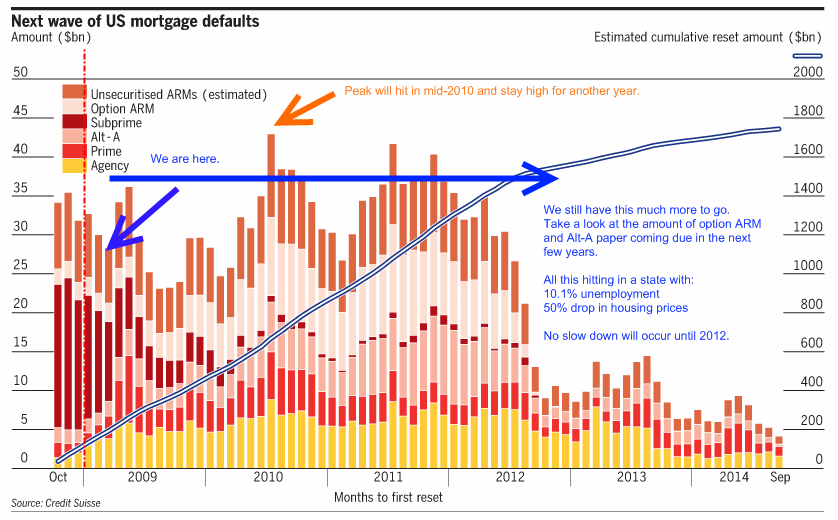
The first wave of Americans to default on their home mortgages appears to be cresting, but a second, far larger one is quickly building. Homeowners with good credit are falling behind on their payments in growing numbers, even as the problems with mortgages made to people with weak, or subprime, credit are showing their first, tentative signs of leveling off after two years of spiraling defaults.
...
“Subprime was the tip of the iceberg,” said Thomas H. Atteberry, president of First Pacific Advisors, a investment firm in Los Angeles that trades mortgage securities. “Prime will be far bigger in its impact.”
From the Sacramento Business Journal:
Aggressive belt-tightening efforts by lenders and a dismal economy put the squeeze on the commercial investment property market in the Sacramento region during the past year. Investors plowed almost $5 billion into Sacramento office buildings, shopping centers, apartment buildings and warehouses in June 2006 to June 2007, fueled by a seemingly endless supply of “cheap” money. But in the past 12 months, investment has declined to about $2.1 billion, a 58 percent drop from the peak, according to figures from brokerage CB Richard Ellis.

“It’s a weird time right now,” said Jon Wilcox, a senior associate at CB Richard Ellis who exclusively represents investors looking to purchase income-producing property. “Nobody can find a price point yet. ... (Investors) can sense blood in the water. They’re going in and offering 10 (percent) to 15 percent lower than the asking price.” He said foreclosures that have driven housing prices down might start hitting investment property soon.

Sunday, August 03, 2008

Rejected Transplants

From the Sacramento Bee:

Three years ago this month, median sales prices peaked in Sacramento County. The result: The end of the housing boom. Across three years, the damage has piled up. In 2006, the spring rebound that area real estate agents were predicting failed to materialize...A discussion at year's end with some real estate professionals had a common thread: Foreclosures probably wouldn't get out of control.
Attached to this article is a nice chart showing the decline from peak in eight area counties.

From Bloomberg:
Home prices fell in 23 of 25 U.S. metropolitan areas in May from a year earlier [according to Radar Logic]...Sacramento had the biggest price drop, falling 31 percent from May 2007....The number of transactions rose 27.7 percent in Sacramento and 13 percent in San Diego from a year earlier and fell in the 23 other areas surveyed.
From the Sacramento Business Journal:
National homebuilder Ryland Homes will end more than 20 years of building in Northern California and gradually wind down operations in the region, including Sacramento.
From the Modesto Bee:
Could real estate woes persuade residents to abandon the Northern San Joaquin Valley? Bay Area transplants -- nicknamed BATs -- swooped into the valley en masse during the 2000-to-2005 building boom...At least one industry analyst suspects the valley's foreclosed families are headed back to the Bay Area, especially those who had been commuters.
...
"We saw similar (population shifts) happen in the 1990s, but nothing close to this level," [Steve] Dutra [VP for John Burns Real Estate Consulting based in Sacramento] said...."The data won't show it yet, but we know (the population is shifting) from our clients' reports," Dutra said. He noted that his clients are builders who monitor where people who are shopping for housing are coming from.
...
Another indicator of population movement is public school enrollment. This is summer vacation for most schools, but some Stanislaus County districts already are noticing shrinking enrollments.
From the Sacramento Bee
28 percent of Sacramento households earn more than $75,000 (the higher income range); 54 percent earn less than $50,000 a year (the lower income range); and 18 percent earn $50,000 to $74,999 (the middle income range).

The market is not providing housing affordable to folks in the lower and middle income ranges. The city's most recent housing update estimates that only 15 percent of households in 2007 could afford the median-priced home of $300,000. Home prices are dropping as the real estate bubble has burst, but even home prices of $220,000 remain unaffordable for the bulk of Sacramento households.

This mismatch between housing prices and incomes is a relatively new development for the Sacramento market. In 1997, 65 percent of Sacramento area households could afford a median-priced home.
From the Sacramento Bee
In another marker on the economic misery scale, a 1.1 million-square-foot mall on tap for southern Sacramento County has stalled, officials confirmed Thursday. The Elk Grove Promenade, an open-air regional mall that repeatedly has pushed back an opening date, is among a number of retail projects nationally that General Growth Properties Inc. of Chicago will delay, several City Council members said.
...
City Councilwoman Sophia Scherman...expressed fear that conditions would deteriorate at the mall, where parking lots are poured and future retail spaces are rising. "I don't care how it's done," Scherman said. "I want security there. I don't want it to become a blight."
...
Mayor Gary Davis...said, Elk Grove's economic climate will rally. "It's just a matter of timing. It's going to turn back around," Davis said. "It's not like in this downturn the place is going to hell in a handbasket. … That's not happening."
From Sacramento Bee:
Already burdened with its worst unemployment in 12 years, the Sacramento area figures to suffer even more following Gov. Arnold Schwarzenegger's decision Thursday to lay off 10,300 temporary and part-time employees and cut most full-time workers' salaries to minimum wage. Though the cutbacks are expected to be temporary, the news sent a chill through a metro area that has one of the worst foreclosure rates in the country.
...
With the real estate market just starting to get healthy, John Arvanitis, president of Sunrise Vista Mortgage Corp. in Citrus Heights, said lenders may think twice about approving a mortgage for a state worker affected by the governor's order. "If you're an underwriter and you see someone who's listed as one of those casualties who's gotten laid off or had their salary reduced indefinitely, that's going to be significant," Arvanitis said.