Saturday, September 30, 2006

Bad Hangover for Merced

One Merced home seller is probably not too pleased by this article in the Merced Sun-Star:

At the height of Merced's real estate frenzy last year, Bay Area Realtors drove vanloads of clients through town on the hunt for investment properties. They poured over the Altamont Pass, lured by the promise of cheap houses guaranteed to swell in value when the new University of California campus opened. Now the out-of-town speculators are gone, leaving behind streets lined with For Sale signs and new subdivisions filled with freshly built houses standing empty...

Clearly the real estate party is over -- and in Merced the hangover is bad. "I knew it was going to soften, but I didn't know it was going to slide this quickly," said Mike Salvadori of Century 21 Salvadori Realty...

The frenzy lasted five long years, the longest boom broker Loren Gonella has seen in his 29 years in the business. It peaked in August 2005, when a record 652 houses sold in Merced. Since then the number of sales has dwindled by almost half, with just 369 houses sold in August 2006, according to DataQuick News.

The boom was fueled mostly by the out-of-town investors, creating what Realtor Kay Flanagan calls a "false market" that made selling houses as easy as filling orders at a factory...

Now, the market is shifting back to reality. It's time for what people in the real estate industry optimistically refer to as a "correction..."

Usually it takes about three and a half years for prices to return to a reasonable level after reaching an artificially high peak, said Richard DeKaser, chief economist with National City Corporation, which studies real estate busts...Merced's market, which was one of the most overvalued in the country, could see prices decline by about 35 percent, said DeKaser.


Friday, September 29, 2006

In the Red

"Reflecting a national trend, home sales slowed and prices fell in Shasta County in August, according to DataQuick. Last month, 161 home sales were recorded, down from 173 sales in July and 250 sales in August 2005. The median sales price in August was $245,000, compared with $269,000 in July and $285,000 a year ago, DataQuick reported."

"For the first time in 15 years, the price of a home in Tracy fell from one year to the next. And with 'For Sale' signs spinging up all over the valley, buyers are feeling the market shift in their favor. For the first time in 15 years, prices for single-family homes in Tracy and around the Central Valley have dipped, putting the breaks on a supercharged market that left many first-time homebuyers in the dust."

"September figures show the median price for a single-family home in Tracy during the last six months has retreated from $546,000 to $538,000, and at least one real estate professional thinks prices could drop even further..."

"'Negative press about housing prices, along with the fact that buyers are much more educated today, have contributed to a bubble burst,' he said."

"After nearly a decade of booming home prices and fast selling times in Yolo County, the market has quickly slowed down. An increase in housing options and steady home prices have caused the tables to turn in the real estate industry..."

"[Don] Sharp [owner of RE/MAX in Woodland] said people started to notice a change within the market and modified their buying behavior, which further emphasized the trend. The reason the switch occurred mainly has to do with an increase of housing options, Sharp said. Currently, there are 356 houses available in Woodland - that's more than three times the amount in 2004."

"'Some people come in and say: 'I need to bury St. Joseph to sell my house!' And I say, no, you need to pray!'"

Thursday, September 28, 2006

Too Many Signs: Bad for Business?

From the Auburn Journal:

Balance sought for real estate signs as houses for sale grow

Real estate signs are reflecting a recent market that has sellers chasing buyers. The number of houses on the market in Placer County, excluding the Tahoe area, in August had increased to 3,101 from 1,684 the same month a year earlier...

County Assistant Planning Director Melanie Heckel said real estate brokers have been among the people expressing concerns about the number of signs. They felt that it created the impression that a neighborhood was undesirable and the presence of too many was bad for business, she said.

Fred Eichenhofer, broker-owner of Sierra Pacific Real Estate, said real estate signs are a sign of the times. "Things were moving relatively rapidly and signs were up for a short time," Eichehofer said. "With properties on the market longer, it's more of an issue."

'Most Pummeled' Award Goes to Sacramento

The San Diego Union-Tribune reports on UCLA's Anderson Forecast:

Edward Leamer, director of the forecast, said the state is only in the beginning stage of the price decline. A decline in the housing market generally begins with a slowdown in sales – which is what has happened over the past year, Leamer said. It often takes a year or two after a sales slowdown for prices to decline, he said. Prices have already declined in some regions of the state, led by San Diego and the Sacramento area.

"San Diego gets all the bad press, but Sacramento is the story that nobody knows about," Ratcliff said. "Sacramento has gotten the most pummeled over the last year." Ratcliff said that regions that have added the most new homes – either from new construction, such as in Sacramento, or condo conversions, such as in San Diego – will be the areas that suffer the sharpest and fastest declines.

Hat tip: Ben Jones

Wednesday, September 27, 2006

The Housing Bubble is Not Bursting, Now Buy My Property!


Having trouble selling your home? Well, here's a new sales tactic. Write a letter to the editor proclaiming there is no busting housing bubble, then announce that you're trying to sell your property and that you're "ready to deal." Hey, everybody knows your name in Merced, right? Submitted to the Merced Sun-Star:

Editor: For over a year now we have heard and read stories about the real estate bubble being in danger of bursting. The facts are that the real estate business in Merced has been pretty slow for over a year now.

Anyone who has studied real estate trends knows that there is no bubble to burst and what we are seeing now is nothing unusual. It is the nature of the real estate business to have up swings and down swings and the down side are often referred to as adjustments.

In the last 12 months or so there have been adjustments that have moved the market from a sellers market to a buyers market. Many properties have been reduced in price 15 percent or more since a year ago. What was a seller's market has turned into a buyer's market.

The economy is healthy with the Dow over 11,000 for quite some time. The Federal Reserve has not raised the prime interest rate for the last few sessions. Real estate loan rates are extremely low and the lenders have lots of ways to do creative financing.

Merced is a growing community and there is no reason not to invest in real estate. I have been buying real estate since I used my first VA loan in 1968 and I have always made money. The payments that sound expensive today will be a bargain in 10 years.

Real estate is an important industry in Merced. There are plenty of wonderful properties for sale and lots of Realtors and lenders to chose from. Don't wait for some mythical bubble to burst. The market is right for buyers right now.

No, I am not a Realtor or lender. I am a seller who has a prime property and I am ready to deal. I believe in the value of Merced property and I hope you do too.

Tuesday, September 26, 2006

'Perplexed' by the "Slowdown"

From the Stockton Record:

Cheryl McFall, broker and manager of the Manteca office of Remax Executive, said the Manteca market had a slower than usual summer, with prices dropping between 5 percent and 10 percent this year. "So, I don't see that we're turning a corner this year," she said. "I'm hoping for next spring."

The main competition for the existing-home market is new homes, because builders are not only offering incentives of between $80,000 and $100,000, they're also offering sales commissions to real estate agents, she said. "It hurts the real estate market, because you can't compete with that new-home smell."

McFall said many would-be buyers seem to be hesitating because they're watching prices, but this slowdown boggles her mind. During the last slowdown, interest rates were running at between 13 percent and 14 percent, and there were not nearly the variety of today's loan products designed to get people into homes, she said. Interest rates are in the 6 percent to 7 percent range, and the economy is good, she said. "I'm perplexed in a way as to why we're going through this."
Why are we going through this? Columnist Eric Grunder provides some answers:
Last year, as the real estate market reached the apex of its nuttiness, more than 40 percent of mortgages in San Joaquin County were interest-only, according to Loan-Performance, a San Francisco mortgage-research firm.

When home prices are increasing by double digits every year and the Fed isn't boosting interest rates every other month, you can get away with such things. But home prices have flattened - a word that may be way too charitable about what's going on in the real estate market - and interest rates are climbing, the Fed's temporary hiatus last week notwithstanding. (Mortgage rates last week did dip to their lowest level in six months.)

Homeowners servicing an adjustable-rate mortgage are likely in for a shock as rates on those loans are adjusted. We're probably not where we were in the early '90s when some homeowners got upside down on their mortgage - owed more than the house was worth - but the latest foreclosure figures show a troubling pattern.

In the first quarter, the latest reporting period, foreclosure notices statewide jumped more than 23 percent from the same period in 2005. In San Joaquin County, they jumped by 30 percent. And those figures are from the January-March period. Since then, the county's homes-for-sale inventory has skyrocketed, buyers have become at once more choosy and more nervous, and home prices have softened. Do you want to be servicing a funny-paper mortgage in that situation?

Monday, September 25, 2006

California Sales Drop Largest Since 1982, Sacramento Leads the Way

From the C.A.R. Press Release:

Home sales decreased 30.1 percent in August in California compared with the same period a year ago, while the median price of an existing home increased 1.6 percent, the California Association of Realtors (C.A.R.) reported today.

"We experienced the greatest year-to-year sales decline last month since August 1982, when sales fell 30.4 percent," said C.A.R. President Vince Malta. "This is another indication that we’re in the initial stages of a long-anticipated adjustment in the market."
The Sacramento region suffered the greatest year-over-year sales decline in the state, dropping 42.2%. C.A.R. also reported that the median price of an existing home in the Sacramento region fell 4.1% (y-o-y) in August.

Nation Goes Negative

From the LA Times:

The national median home price last month suffered its first year-over-year decline in more than a decade as the housing market showed more signs of erosion from its boom years, according to figures released today.

The median sale price for all existing houses fell to $225,000 in August, a 1.7% drop from the same month last year, according to the National Assn. of Realtors. The median price is where half the homes sold for more and half sold for less.

It was the first such year-over-year decline since 1995 and the largest since 1993, according to economist Steven Wood of Insight Economics.
From the Wall Street Journal:
Last month marked the first year-to-year median price decline since April 1995, and it was the second biggest in the survey's 38-year history. Inventories of unsold homes rose to 3.92 million, a 7.5-month supply at the August sales pace, the most since April 1993.

Sunday, September 24, 2006

Ben Jones and the Bee

From the Sacramento Bee:

Eleven months ago as the Sacramento-area real estate market stood at the beginning of a downturn, the National Association of Realtors said there was only one thing that could make the region's home prices fall 5 percent.

That would be a simultaneous combination of 25,000 job losses and 7.8 percent interest rates, events the NAR called extreme and unlikely. The headquarters arm of a million real estate agents across the United States pronounced Sacramento's housing market in "excellent shape with a potential for significant equity gains." Within months, area median sales prices fell 5 percent, proving how wrong experts can be.

In fact, home prices have managed to sink in Sacramento even as interest rates fell -- to an average of 6.4 percent last week. Prices have dropped even as the region celebrates some of the state's strongest job growth. The real estate industry publicly professes this an "excellent time to buy," yet a sense of paralysis grips the market. And one question seems paramount for those with a roof over their head and their money on the line: Where is this real estate market headed?

"Have you in the last 20 years ridden a roller coaster?" asks Scott Syphax, president and chief executive officer of the Sacramento-based housing firm Nehemiah Corp. of America. "They take you to the top of the ride and before they fall, they pause for a second to assure maximum terror. We're at that pause point."

At such a dramatic moment, guessing how far this ride will fall has become a major sport of bloggers, economists, home builders, buyers, renters and an army of armchair experts...

Arizona-based Ben Jones, who runs a nationally known "housing bubble" blog (thehousingbubble.blogspot.com), agrees wishful thinking can't overcome what he sees as negative fundamentals in Sacramento. "Those home prices are out of whack with local incomes and rents," he says. "There's a lot of exotic lending going on. You add those together and that's been the formula driving a lot of markets down. I don't think you need much more than that."

Jones says his beliefs are grounded in seeing thousands lose their homes during the 1980s Texas oil bust. Noting the dominance of investors in the Sacramento market -- buyers of 25 percent of area homes during the boom's 2004 peak -- he says, "If you have significant numbers of those folks fold, you could see a lot of defaults and lenders fold. That's when stuff snowballs. That's what we saw in Texas. It was worse and worse for five years."

Saturday, September 23, 2006

Digging Deeper into their "Bag of Tricks"

From the LA Times:

Stopping short of installing glue traps to ensure that prospective buyers can't get away, sellers, builders and real estate agents have been reaching deeper into their bag of tricks in their efforts to move the ever-increasing homes-for-sale inventory...

Greg Paquin of the Gregory Group of Folsom, which provides market research and consulting services to the new-home industry, has seen builders in the Sacramento area offer free trips to Las Vegas, home-entertainment systems, gift certificates to local furniture stores and an annual membership in the golf club...

Cars, TVs, free vacations -- does it really make sense to do business this way? Not from a buyer's property-tax perspective. If the value of the car being given away is $40,000, why not just lower the price of the home by that much and be done with it? After all, the new buyer will be paying property taxes based on the purchase price of the home. The lower the purchase price, the lower the annual tax bill.

Thursday, September 21, 2006

Sacramento Region Median Prices - August 2006

DataQuick's dqnews.com just posted their August numbers for California. Placer County again leads the way down with a double-digit decline.

  • El Dorado: -0.21%
  • Placer: -14.40%
  • Sacramento: -4.41%
  • Yolo: -12.81%


This graph shows the percent change in median home prices for the Sacramento region's four counties. This includes resale single family residences and condos as well as new homes.

SN&R: "Has the bubble burst?"

Sacramento News & Review looks at the aftermath of Sacramento's housing bubble.

In mid-2004, John and Karen Philbrook bought a home in Sacramento's North Highlands neighborhood, when buying a house seemed like a sure ticket to security. They opted for an interest-only, adjustable-rate mortgage and counted on the value of their house continuing to rise as a way to build up equity.

Now, as the pillars upon which the real-estate boom rested--low interest rates, easy credit and ever-rising house prices--begin to crumble, the Philbrooks, like countless others, are finding their piece of the American Dream increasingly hard to keep a hold of...

...[E]arlier this summer, a note from the Philbrooks' mortgage broker arrived in the mail. Overnight, the note informed them, their monthly payment was increasing by close to $500. And the Philbrooks, who had about $900 saved up for their daughter’s future, a few hundred more for emergencies and nothing in reserve beyond that, realized their entire dream now stood ready to fall...

Over the past year, as interest rates have risen and for-sale houses have sat unsold for months, much has been written on various aspects of the housing market.

Journalists and analysts--not to mention homeowners or potential buyers--want to know: Is the current slowdown just a blip in an otherwise vibrant market, or is it the end of a decade-plus bubble? Will national trends be magnified in Sacramento’s suburbs, which have seen startling appreciation in house values in the recent past? Will the air in the bubble gradually leak out, giving people time to adjust their expectations and their financial planning, or will it burst spectacularly? Will interest rates continue edging upward? If so, will the real-estate market collapse, when it becomes impossible for new buyers to make offers that are acceptable to sellers who bought homes when rates were low and prices were high?

Much of the ink spilled on this has examined these issues as a series of isolated problems. It's becoming clear, however, that the problems are interlocking. Indeed, there's a fear voiced in real-estate circles that some parts of the country, including Sacramento, might be facing a perfect storm in which the true losers are families who borrowed cavalierly without adequately crunching the numbers. Families like the Philbrooks--who, at the urgings of sometimes-unscrupulous mortgage brokers, seriously over-extended themselves at the height of the housing boom--now will pay a high price for reaching toward the American Dream...

How are Sacramentans paying for this?

"You're seeing people who were living off the equity in their house. It worked real good for three or four years," said attorney Scott Coben, a bankruptcy specialist who works out of an airy office, built around an inner, roofed atrium decorated with palms and tropical plants, in downtown Sacramento. Seeing their houses keep appreciating, Coben explained, homeowners borrowed against the increased paper value of their property, essentially living off the promise of an eternally rosy real-estate environment. "But now the gravy train is coming to an end. They've got the credit cards, crazy loans, 40-year mortgages, and they’ve done refinancing. A lot of them are going to lose their homes.

"People were just totally unrealistic about real estate--refinancing to sustain their lifestyles, or people who got in the game late took out horrible loans to get real estate," Coben said. "They're getting killed now."

Capital Public Radio: "Bubble Burst?"

Listen to the archived program.

Wednesday, September 20, 2006

Dying on the Vine

The Sacramento Business Journal reports on the death of two downtown condo projects.

Two downtown condo-tower plans die, D.R. Horton cancels plans as market falls

Two planned downtown high-rise condominium projects fell through this week when builder D.R. Horton canceled its plans. The company's decision is a setback for downtown's revitalization, which many believe depends on bringing residents into the mostly commercial area.

But D.R. Horton's move is not surprising. Homebuilders have been backing out of deals to buy land because new-home sales have declined 42 percent in the six-county Sacramento region this year. Industry insiders wonder if D.R. Horton might only be the first to walk away from downtown development in the next few years.

D.R. Horton division president Tom Harding declined comment, but public officials confirmed the company has backed away from plans to buy a half of a block owned by Sacramento County and build a 21-story condominium tower, said Paul Hahn, the county's Economic Development Director. D.R. Horton has "notified us that as a result of the downturn in the market nationwide, D.R. Horton has been instructed not to put deposits on land for now," he said...

D.R. Horton has also dropped plans to develop a high-rise condo with 203 units along the Sacramento River just north of Old Sacramento, said John Dangberg, the assistant Sacramento city manager overseeing economic development.
Meanwhile, a Rocklin condo development has apparently been abandoned.
The Atlantis Rocklin Condominiums appear to be under water. The phone in the Rocklin office of the developer, Avant Garde Development LLC of Artesia, is no longer in service. The phone number at the sales office goes to a scratchy answering machine that is no longer taking messages. And the phone at the construction company, CDS Builders of Santa Fe Springs, rings and rings and then disconnects...

No work has been done on the project since May. So far, about 55 townhomes have been built but not completed. They have walls, exterior stucco, roofs, doors and windows. The interiors aren't completed, and many of the exterior doors don't stay closed in the breeze...

What was to be a 250-unit condominium townhouse project in two phases was started four years ago by Avant Garde. It is one of the first major projects to turn into a problem locally for a lender in some time. "It may be the first, but it's not going to be the last," said Dave Alford, local bank consultant. The recent dramatic slowdown in real estate likely will catch some developers off guard, and eventually banks will be taking back properties in various states of completion, he said...

When the sales office opened for the Atlantis condominiums last September, they were priced from $345,000 to $375,000, and there were said to be more than 100 sales reservations. At that time, the Sacramento housing market was still strong. The market has since cooled off dramatically.

Analyst: Sacramento Proving Price Declines Possible Without Severe Job Losses

The Sacramento Bee has Dataquick's August numbers. For the third month, Sacramento suffered a year-over-year median price decline.

Median sales prices for all homes and condominiums rose slightly in five of eight Sacramento-area counties from July to August, according to figures released Tuesday by DataQuick Information Systems of La Jolla. The company reported price increases in Amador, El Dorado, Sacramento, Sutter and Yuba counties, ranging from 0.3 percent in Sacramento to 10.5 percent in Amador. Prices fell in Nevada [-1.9], Placer [-4.3%] and Yolo [-5%] counties...

But though nearly 3,700 buyers took the plunge in August, the region's median sales prices largely continued their downward drift compared with a year ago, sometimes sharply. At $448,000, the median sales price -- the point at which half the homes sell for more and half for less -- was 12 percent lower in Placer County than August 2005. The Yolo County price of $419,000 was 8 percent lower than the same time last year, and the $362,000 median sales price in Sacramento County was 6 percent lower. Prices were also down in Sutter, Yuba and Nevada counties. Prices were higher in Amador and El Dorado counties.

DataQuick analyst Andrew LePage said those drops lead California's major urban counties. "Sacramento is proving you can have some kind of correction absent severe job losses," he said. The summerlong price declines played out against a 4.2 percent unemployment rate and the addition of 18,100 jobs during the past year.

Tuesday, September 19, 2006

Sacramento Leapfrogs to #2 Spot on PMI's Risk Index

In June, Sacramento was ranked #5 (out of 50 major metros) on PMI's Market Risk Index. That was the first time Sacramento had landed on the top 5 list. Now, in the latest PMI Risk Index, the Sacramento housing market jumps to second place behind San Diego:

Fall 2006 PMI U.S. Market Risk Index

San Diego-Carlsbad-San Marcos, CA 603
Sacramento-Arden-Arcade-Roseville, CA 601
Oakland-Fremont-Hayward, CA 600
Santa Ana-Anaheim-Irvine, CA 599
Nassau-Suffolk, NY 598
According to the report (pdf), the Sacramento housing market is cooling at the quickest rate in the nation.
Last quarter, 34 MSAs experienced deceleration, and this time a year ago only seven MSAs saw the rate of appreciation slow. The five areas with the highest rates of deceleration were all in the West. Sacramento led the trend with a 17 percentage point drop in year-over-year appreciation, to 6.3 percent compared to 23.31 percent a year earlier...
Next up: #1?

Monday, September 18, 2006

Lincoln BackLogs

A reader sent in an article from the Sacramento Business Journal:

The small city of Lincoln has become the stage for a battle between homebuilders for the dwindling number of homebuyers in the Sacramento region. Five years ago, few builders would look at the city. Today, it has an oversupply of subdivisions -- more than any other city in the six counties...

Today in Lincoln, 16 homebuilders hold 36 subdivisions with more than 2,000 lots -- more new-home communities than any other submarket in the region, said Greg Paquin, owner of The Gregory Group, a Folsom firm that studies the market...

Now Lincoln's builders are pulling out the stops. Their incentives for homebuyers average $24,016 -- more than any submarket but West Sacramento, which averages $31,000 for its 21 projects, Paquin said. Elk Grove's average incentive is $12,851. Besides gifts, builders also have lowered prices, sometimes dramatically. JTS Communities has this year offered homes for $500,000 that had been priced at $650,000 to more than $700,000, said Ian Craig, general counsel for JTS.
From the Tri-Valley Herald:

With older homes in established neighborhoods sitting on the market for upwards of a year, new home builders don't see the lines of buyers waiting for a lottery to purchase homes. So they're getting creative.

Pulte Homes, with subdivisions in Brentwood, Oakley, Mountain House and Tracy, is offering $99,000 in incentives -- from a free pool to no payments for six months to free upgrades -- to entice buyers. They're even offering each home buyer a vacation for two with a destination of choice for closing before Christmas this year...

Ryland Homes is offering 40 percent off mortgage payments for the first year (to commemorate it's 40th anniversary), while another developer had been offering a free Mercedes-Benz with the purchase of a home.

From the Wall Street Journal:
Home builders have a new trick to try to sell you a new home: They will help you get rid of your old one. Faced with falling sales, some builders are helping would-be buyers spruce up their current home by bringing in professionals who advise them on what furniture to get rid of and tell them whether they should rip off the wallpaper... For instance, Pulte Homes Inc. recently started pairing its customers with professional "stagers" who sweep in and do things like remove window coverings and touch up the paint, and covering up to $2,000 of the cost of the service. The program is available in about a dozen markets, including Detroit, Indianapolis, Sacramento, Calif., Tampa, Fla., and Washington, D.C.
Hat tip - Northern New Jersey Real Estate Bubble blog

Buyers are "Like a Deer Caught in Headlights"

From Inman News:

Marketing homes may have been a breeze in some quick-sell markets during the real estate boom, but agents in slowing markets say it now can take more time and work to close deals. Properties must look pristine and be priced well to sell, they say, and sellers should cater to buyers if they want more bites. Home-price appreciation is slowing in much of the country and even reversing in some formerly hot markets, sales have fallen off dramatically, and inventory is building up...

Tamara Dawn, a real estate broker in Sacramento, Calif., said there is a lot of uncertainty and apprehension among buyers about market conditions. "A lot of people are just in limbo. My mentor used to tell me that the competition was inertia." A lot of headlines seem to suggest that the "sky is falling" for the real estate market, she said...

"I do a lot of staging of properties. I buy a lot of my own furniture and accessories," she said. As homes are now sitting on the market longer, Dawn said that she has purchased a larger personal inventory of furnishings. It's more important these days to stage homes, as there are more homes on the market competing for the same prospective buyer.

"Before, people got caught up in the frenzy -- 'If I don't get this one the next one will be more expensive.' People weren't looking at the same degree (of detail). They were overlooking flaws," she said. Nowadays, homes have "got to be pretty stunning. It's like a job interview. (Staging) is incredibly important."

It's better to list a home at the best possible price upfront, she said, rather than starting higher and dropping the price down when the home isn't selling. Also, Dawn said she encourages sellers to take care of inspections ahead of time to attract a larger audience of buyers. Buyers today are "like a deer caught in headlights," she said, and if the seller can ease these tensions then all the better.

While Dawn, a real estate professional since 1980, traditionally works with more buyers than sellers, she said the ratio of buyers to sellers that she works with has changed from 6-to-1 to 2-to-1 as the market has changed -- the rising inventory means a lot of sellers and not as many buyers. As sales get leaner, Dawn said she can rely on business from past clients.

Saturday, September 16, 2006

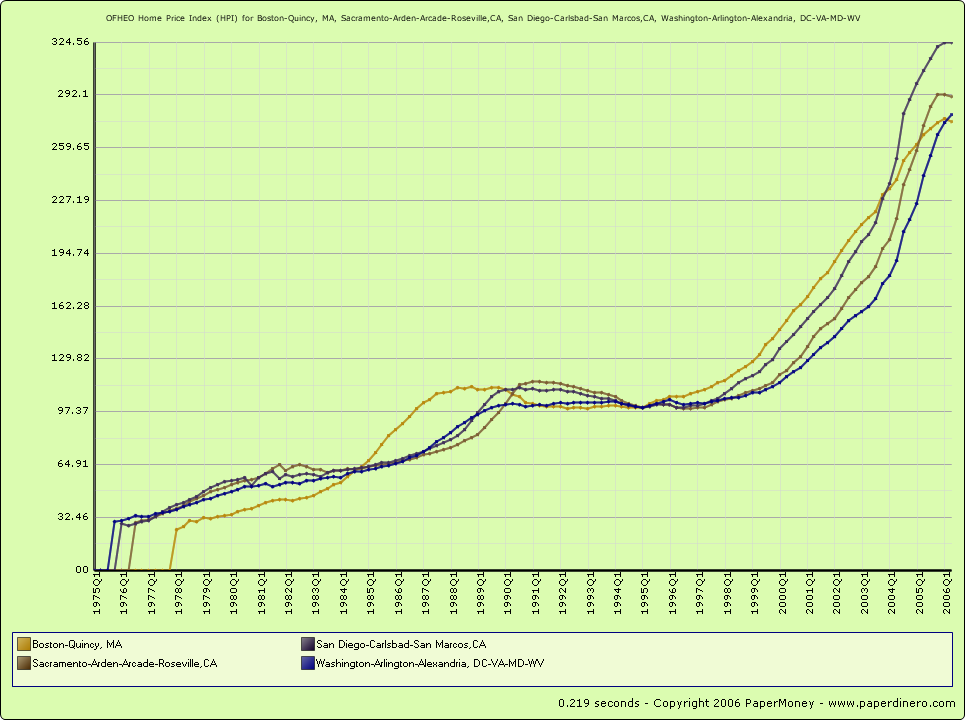
Sacramento v. San Diego v. Boston v. DC Smackdown

The Paper Money blog has an interesting new tool for all you housing nerds out there. The tool allows you to compare the Office of Federal Housing Enterprise Oversight's House Price Index for multiple markets on a single graph. Here's the result for Sacramento, San Diego, Boston, and Washington D.C.


Click to enlarge

Anyone notice which market peaked first this time around?

Friday, September 15, 2006

San Joaquin County Goes Negative, Median Price Down 4.6%

From the Stockton Record:

The median sales price dipped to $395,000 countywide last month, down from $424,000 the previous month, according to sales figures from the Coldwell Banker Grupe-TrendGraphix monthly sales report, based on Multiple Listing Service data. The median sales prices in Stockton slipped from $360,000 in July to $355,000 last month. This also is the first month that the median sales prices throughout San Joaquin County went in the red year-to-year...

...[M]edian sales prices were down across the board, from the Manteca/Lathrop/Ripon/Escalon area, down 3.4 percent year-to-year from $445,000 in August 2005 to $428,000 last month, to Stockton, down 5.3 percent year-to-year from $375,000 in August last year to $355,000 last month...

[See Chart-- Lodi: -3.8%, Tracy: -3.7%, County: -4.6%]

Art Godi of Art Godi Realtors in Stockton said price drops are the result of a summer of real estate brokers and agents "educating" sellers that the days of aggressive pricing are over in a very competitive market.

Not only are Bay Area buyers not in the market the way they used to be, he said, but home builders are offering so many incentives that new homes actually are competing with existing homes these days.

World Domination Plot Unveiled

Q: Who put the ramen in Sac"ramen"to?


A: Marinite.

Thursday, September 14, 2006

Equity Locust Invasion Wanes

From the Sacramento Bee:

Investors Ron Rael of Novato and Kirk McKinney of Pacifica had a ride of their lives during Sacramento's housing boom. They bought houses low and watched the values go sky-high while renting them out. In hindsight, Sacramento's fast rise from a relatively inexpensive market to one of the priciest in the West could make almost any investor appear like a genius.

No more. The investors' game has moved to Texas, New Mexico and Oklahoma, they say. Neither Rael, McKinney nor any of their Bay Area investor colleagues much care now for Sacramento's languid market...

Much diminished, too, amid the still-expensive price tags of 2006 is the rush of Bay Area residents toward Sacramento's home prices. "You got more bang for your buck a couple of years ago than you do today," said Poppy Stercl, a mortgage broker who lives in Rocklin. She said people who once came with $300,000 in equity to buy houses for cash now find they can't do it when the prices top $500,000...

"The prices aren't competitive anymore. They're just lousy California high," said Stephen Levy, director of the Palo Alto-based Center for the Continuing Study of the California Economy. "For eight, nine or 10 years, the Sacramento median price was near the national average and now it's more than double the national average..."

Collectively, these sentiments have become key factors in Sacramento's flat or falling prices and its record pileup of more than 15,000 homes for sale as summer's big buying season comes to an end. The wave of investors and Bay Area arrivals who helped drive the region's real estate market to what many believe were unreasonable heights has primed it now for an aftermath that no one can yet measure. Adding to the uncertainty is the continuing inability of many locals to afford even today's weakened prices as the market slowdown enters its second year.

"You had something that other counties didn't, a big influx of buyers from other areas," said John Karevoll, analyst for the La Jolla-based research firm DataQuick Information Systems. "Now the market is going back to core activity where local demand is self-generated."

Even as high-flying real estate markets from San Diego to Boston are coming back to earth, some believe Sacramento is particularly vulnerable because outside forces that propelled it skyward have dissipated.

Oh. Sacramento is special after all.
In the first quarter of 2004, more than one in four houses sold in Sacramento County were to investors and second-home buyers. But at last count this summer it was closer to one in six, according to DataQuick...

Altogether, investors bought more than 73,000 homes in Amador, El Dorado, Nevada, Placer, Sacramento, Sutter, Yolo and Yuba counties between 2000 and June 2006, DataQuick reported. More than 22,000 of them were from buyers with Bay Area addresses. But those numbers are now falling greatly.

Similarly, the percentage of "flippers" buying in the Sacramento region fell by half between March 2005 and last June, according to HomeSmartReports.com, a San Juan Capistrano real estate Web site. In early 2005, nearly 6 percent of the region's home sales were properties owned less than half a year. None could be considered part of the region's "core housing market of putting roofs over their heads," said Mike Ela of HomeSmartReports.com.

Then, the Sacramento region ranked second statewide for "flipping," the business of buying a house and quickly reselling it for profit. Only San Joaquin County had more, with its rapid home appreciation also fueled by Bay Area migration. But by early this summer, "flipping" represented only 2.4 percent of sales in the capital region -- while 28 percent of investor-sellers reported losing money on their deals, Ela reported...

Wednesday, September 13, 2006

California Foreclosures Skyrocket 160%

From CNNMoney:

With real estate markets slowing and mortgage rates well above levels of recent years, times are getting tougher for homeowners - the number of homes entering into some stage of foreclosure is surging, according to a survey released Wednesday...

Some of the bellwether real estate market states are among the leading foreclosure markets. Florida, had more than 16,533 properties in foreclosure in August. That led all states and was 50 percent higher than in July and 62 percent higher than in August 2005.

California foreclosures are increasing at an even faster annual rate, up 160 percent since last year to 12,506. And the formerly red-hot Nevada market recorded a spike of 24 percent compared with July and a whopping 255 percent increase from August 2005.

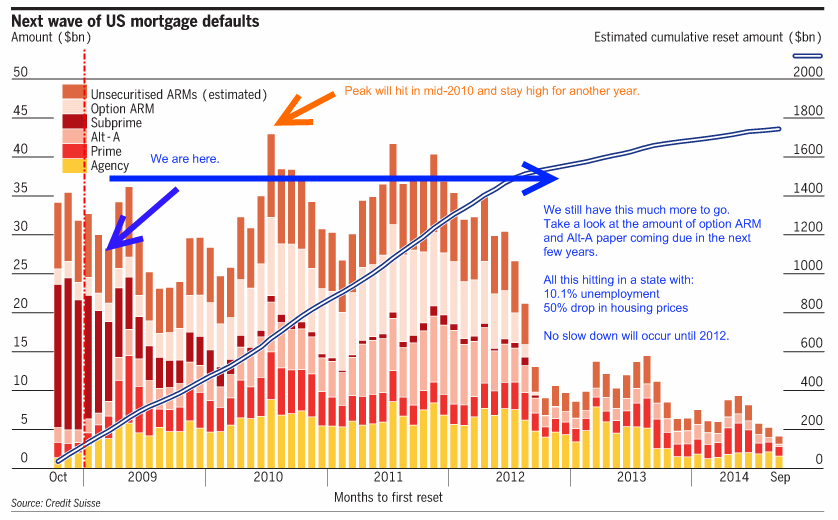
Rick Sharga, RealtyTrac's vice president of marketing, says the rising foreclosure numbers are in part the result of rising monthly payments on adjustable-rate mortgages, which have a low introductory interest rate that heads higher after an initial period. "Usually, foreclosures are a lagging [market] indicator," he says. "But we've never had a situation like this with adjustable-rate mortgages amounting to $400 billion to $500 billion coming up for adjustment over the rest of the year."
From the Sacramento Business Journal:
Foreclosures in California increased 25 percent from July to August, according to a report released by RealtyTrac. The state ranked 12th in the nation for foreclosure rates, and had 12,506 properties enter into some stage of foreclosure, the report said.

'Still in the Early Innings of a Hard Landing'

From the Wall Street Journal:

Ivy Zelman, a housing analyst at Credit Suisse Group in Cleveland, estimates that prices of newly built homes in San Diego, Sacramento, Calif., Phoenix, northern Virginia and southwest Florida already are down as much as 10% to 15% from a year ago. That estimate includes "concessions" from builders, such as upgraded kitchens or help with closing costs, which are disguised price cuts. But Ms. Zelman still sees more price declines ahead. "We believe that the housing market is still in the early innings of a hard landing that will likely take several years to develop," she says.

Tuesday, September 12, 2006

Folsom Intel Update

"Another 61 employees at Intel Corp.'s Folsom campus will receive layoff notices between now and Sept. 24, bringing the total number of jobs cut here this summer to 191." More from the Sacramento Business Journal.

Straight Talk v. No Talk

Code of silence:

We're seeing that no home builders are really talking about what they're doing, laying people off on a national basis. But they are," said Gregory Gieber, a St. Louis analyst who tracks publicly traded home builders for A.G. Edwards & Sons Inc...

The North State Building Industry declined comment on specific cuts by member companies, but a spokesman said they're consistent with "new market reality..."

Richmond American's Pleasanton division referred calls to Denver corporate offices. In Denver, spokeswoman Alison Schuller said she had no information; she did not return follow-up calls...

Schleimer also said there were layoffs at D.R. Horton, Inc., the region's biggest builder with 740 sales this year. The company did not return several telephone calls to its Fort Worth, Texas, headquarters.
Some straight talk, courtesy of Bob Shallit:

Plain talk: Some people in real estate never utter a discouraging word about their industry. As if ignoring a market downturn will make it disappear.

Give Bill Parker credit for being a straight shooter. The master developer of the award-winning Serrano community in El Dorado Hills is optimistic about his industry long term. He's also bluntly honest about some of the hard times he sees ahead.

Of the current slowdown in sales, he says: "I'm planning on it being longer and deeper than most of the experts are predicting."

Why? His experience is that market lows tend to be mirror opposites of the highs they follow. The last real estate boom was unusually strong and unusually long -- partly because of Fed interest rate cuts, which, he says, "created a false economy the last four or five years."

Now, he says, "I think we have to pay for it."

Monday, September 11, 2006

More Waves Hit Sacramento

The shakeout continues for Sacramento home builders. From the Sacramento Bee:

Ax falls at home builders
Firms shed executives, field staff in wake of slowdown.


After months of sales cancellations, production slowdowns and costly incentives to win customers, Sacramento-area home builders have turned to staff reductions and consolidations to help improve bottom lines, analysts and some executives say.

Several public and private home builders have shed executive and field staff in recent weeks, industry officials acknowledge. At least one builder has consolidated offices and another, Colorado-based Richmond American Homes, reportedly shifted its local operations base to Pleasanton after laying off approximately 25 to 30 staffers...

Schleimer, owner of Market Perspectives, said Richmond American made a sizable reduction in its regional work force in recent weeks. One of those laid off said the publicly traded Denver builder cut 20 to 25 management positions. The reduction followed five earlier position cuts, said the former staffer, who requested anonymity because final paychecks have yet to be received...

Among reductions confirmed:
  • Los Angeles-based KB Homes, Inc., the region's No. 2 builder this year, cut 10 percent of its work force through reductions and attrition about 90 days ago. The job losses totaled "in the teens," said Barry Grant, the builder's Sacramento-based North Bay territory president...

  • Dallas-based Centex Homes cut 10 people in June, Pautsch said. "It wasn't dramatic, but it was the first one we've ever done," he said. The firm has since hired field and sales staffers to open new neighborhoods, he said...

  • Michigan-based Pulte Homes consolidated its northern and southern regional divisions last month into one office, said spokeswoman Judy Bennett. Though staffs were trimmed to reduce overlap, she said some have transferred elsewhere in the company...

Schleimer also said there were layoffs at D.R. Horton, Inc., the region's biggest builder with 740 sales this year...Horton's action also was confirmed by Lee Terry, a San Mateo executive recruiter for the building industry. "Horton laid off all through California and Sacramento," she said...

Builders have sold 6,265 new residences the first seven months of 2006 in El Dorado, Placer, Sacramento, Sutter, Yolo and Yuba counties -- 4,655 fewer than during the same months last year, according to Hanley Wood Market Intelligence, an industry tracker based in Costa Mesa. The firm reports that builders also are enduring higher rates of buyers backing out of contracts -- from 23 percent of sales in Sacramento County to 30 percent in El Dorado County.

Prior post on this subject.

Sunday, September 10, 2006

Fresno's "Go-Go Days Are Gone-Gone"

The Fresno Bee reports on the rapidly changing Fresno housing market.

During the go-go days, home sellers put their houses up for sale and sat back as would-be buyers jacked the price up with every bid. Those go-go days are gone-gone. With home sales in Fresno County off from last year by a third, sellers and real estate agents are more willing to negotiate...

Some people have been surprised at how quickly the real estate market softened because, unlike previous declines, this downturn is not accompanied by higher unemployment or a fundamental change in the economy.

Saturday, September 09, 2006

Alms for the Towers

The Sacramento Bee has an update on The Towers at Capitol Mall condo project.

Condo high-rise seeks subsidy

With work already well under way on his twin 54-story condominium and hotel towers, developer John Saca is still wrapping up important financial details, including obtaining an $11 million subsidy from the city and closing on his construction loan.

Caught between rising construction costs and a slumping housing market, Saca has seen the budget for his $500 million project, which would be the tallest residential structure on the West Coast, tighten. A few months ago, Saca began negotiating with the city for a subsidy, something he said he had previously viewed as "a last resort."

"We absolutely need it," he said. "What's happened is our construction costs for the project have gone up well over $100 million from last year."

The money would be used to help pay for furnishings and fixtures in the luxury InterContinental Hotel slated to occupy the lower 18 floors in one of the two towers at Third Street and Capitol Mall...

Condominium owners will have access to a spa, room service, a concierge and other hotel-style amenities in return for homeowners' dues of $500 a month, far less than those charged in many new high-rise condo projects.

"This is the first high-rise residential project to be built downtown," Saca said. "To compel people to move out of their homes in east Sacramento or wherever, you've got to give them amenities."

Another piece of the financial puzzle that Saca has yet to complete is the closing of his $375 million construction loan with Germany's Deutsche Bank. The developer said he needs to obtain "less than a hundred" more non-refundable deposits before he meets the requirements for closing the loan.

So far, Saca said, he has collected non-refundable deposits on about 400 units at prices ranging from the high $300,000s to $4 million. "We are really close to hitting the number we need for our lender," he said. "It's not a concern for us now."

Friday, September 08, 2006

gNARled

The Florida - Paradise Lost blog has a great chronology of the NAR's incredible shrinking sales forecast for 2006.

Hat tip: Bubble Meter

Some more weekend reading:

Different in Davis?

This appeared in the Davis Enterprise. Read the full column at Gwyn's blog.

Davis is relatively well protected from large price drops due to its slow growth policies. Most likely, very few new homes will be built in Davis from 2006 to 2008 and prices will steady by 2008. While elsewhere, the housing bubble will slowly slide to find a bottom in 2008, Davis may well escape the worst of the slide. With a vibrant employer, UC Davis, we can expect a flow of new employees to Davis over the next several years.

UC Davis also can help cushion the fall of prices by canceling or delaying the construction of new private homes in the West Village neighborhood project on the west side of Highway 113. Without the construction of these 475 units, we may be able to avoid a sharp drop in Davis housing prices...

Over the past three years, there has been a debate about private housing to be built in UC Davis' West Village and Covell Village in North Davis. If both these projects are delayed for a few years until 2009, Davis residents may find they have escaped the housing price decline and be gratefully ready for new, slow-growth housing plans starting in 2009.

Wednesday, September 06, 2006

Sacramento Sales Decline Breaks Through 50% Barrier

The Sacramento Real Estate Blog reports that sales of existing homes in Sacramento County fell 52.5% in August. Find more MLS stats for August here.

So with record inventory, price depreciation and sales declines reportedly over 50%, some Sacramento real estate agents still want to describe this as a "normal" market. After perusing Realty Times "Market Conditions" for Sacramento, one agent had this to say in Rocklin & Roseville Today:

It is no wonder that so many of the bubble blogs point to Realtors as sugar coating what is going on in the market. This is not a normal market, is not moving slightly in favor of buyers and I don't know many who would describe our market as great. Maybe just saying how many homes sold last month is telling it like it is.

Placer Upside Down

From the Roseville Press Tribune:

The prospect of people losing their homes has increased in Placer County as mortgage default notices have more than doubled. According to the latest report issued by DataQuick Information Systems earlier this month, the amount of default notices in the county - the first step in the foreclosure process - for the second quarter has increased 126.2 percent compared to numbers from the same time last year. Placer County had the second largest percentage increase in the state behind Sutter, which had a jump of 229.4 percent...

"What I'm seeing from clients I had a year ago, and especially the people that bought homes with 100 percent financing, they're now upside down," said Tom Urbani, branch manager for Jim Leonard's Mortgage Connection in Auburn. "Those people who did 100 percent financing are seeing the home values drop anywhere from $10,000 to $30,000."

With home values dropping, those homeowners that have "aggressive" financing are not able to refinance because the value of their home is not high enough to make it profitable. "For some clients we've suggested that they sell their homes," said Mike Ferguson, owner of Windsor Fina-ncial Services in Granite Bay. "They're at their maximum debt ratio and the value is not going up so, unless they sell it, their credit is going to erode and they're going to be heading into a foreclosure situation down the road."

Tuesday, September 05, 2006

Folsom Deep Impact?

The Sacramento Bee reports on Intel's planned layoffs:

Intel Corp. announced a major restructuring Tuesday that will pare about 10 percent of the company's work force over the next year. While details were sketchy, the cuts could hit the 7,000-employee Folsom campus particularly hard. In a press release, Intel said it will layoff of about 10,500 employees out of a workforce of roughly 100,000 over the next year...

The company said the bulk of the cuts to its work force will come from marketing, management and information technology workers. Because Folsom is headquarters for Intel's IT department, employing up to 1,800 workers to manage the company's internal computer networks worldwide, the cuts could hit particularly hard in the Sacramento region. It also has a large contingent of marketing staff.

SacBee Update:
If hundreds of well-paid Intel employees find themselves without jobs over the next several months, it could be a blow to an already shaky real estate market, but the area's economy should be able to absorb the shock, experts said. "We've seen things like this happen before, and we will probably be able to ride it out," said David Lyons, a labor market analyst with the California Employment Development Department. He said people with the skills needed to work at Intel generally are in demand in the region. "All these people are highly skilled and will be very marketable," Lyons said.

Though it was painful for the individuals involved, the economy absorbed at least 2,500 job losses at Hewlett-Packard Co. in Roseville over the past several years, said Barbara Hayes, executive director of the Sacramento Area Commerce and Trade Organization. "Anytime there are layoffs, it's a major blow," Hayes said. "But 10 or 15 years ago this would have had a much more significant impact....(Now) we have the diversity and strength in our base economy to withstand something like this."

The home market, already reeling from a glut of sellers and a shortage of buyers, could be hit hard if a significant number of Intel workers put their homes on the market, said Fred Wilcox, a real estate agent with Remax Gold in Folsom. "Right now the market is pretty loaded with listings," Wilcox said. If motivated sellers unload another passel of homes on the market, it will drive down prices, he said.

OFHEO Report: Sacramento Falling

OFHEO 2nd Quarter 2006 HPI (pdf)

Percent change in Sacramento house prices:

  • Quarterly: -0.38%
  • 1-year: 6.51% (Ranking: #154 out of 275 markets)
  • 5-year: 102.96%
By comparison, here are the figures from the 1st quarter of 2006:
  • Quarterly: -0.24%
  • 1-year: 13.18% (Ranking: #95 out of 275 markets)
  • 5-year: 112.23%
Graphs here.

Friday, September 01, 2006

Elk Grove's "Pot House" Bubble

There is an excellent post over at the SacRealStats blog that maps out the pot-farm-in-a-house phenomenon plaguing the flipper neighborhoods of suburban Elk Grove.