Friday, June 30, 2006

Sacramento Leads, Central Valley Follows

More "we're not as bad as Sacramento" talk, this time from the Fresno Bee:

Values of new and used homes in the central San Joaquin Valley in May were still considerably higher than a year previously, which was a sharp contrast to some other regions of the state, data released Tuesday show...

Property in the Valley appears to be holding its value better than some other parts of the state, especially around the capital. Prices in parts of Sacramento and Placer counties fell from a year previously. The median price in Placer County declined 2% from May 2005, with Auburn showing the sharpest drop -- 8% to $439,000. In nearby Fair Oaks, values fell almost 16%.
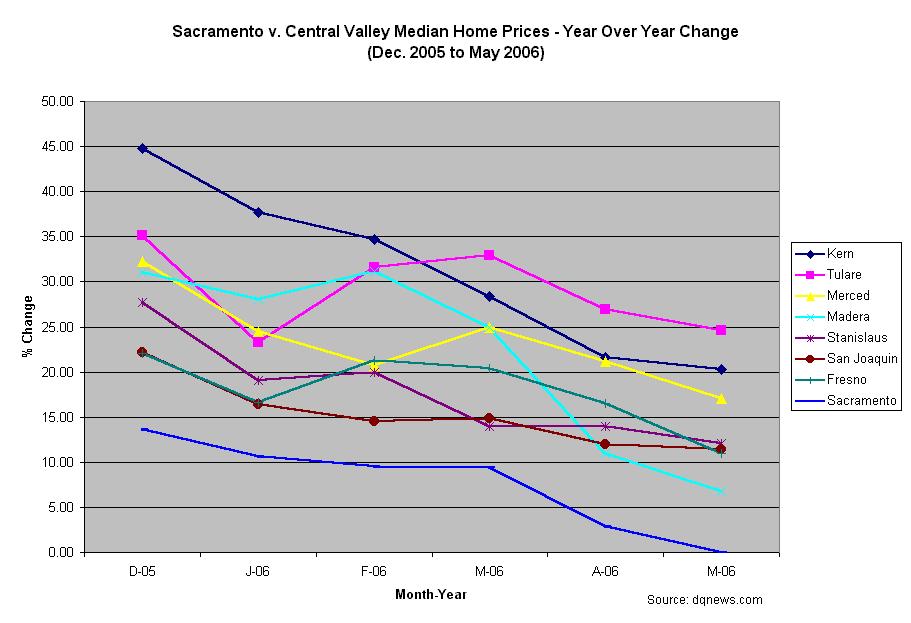
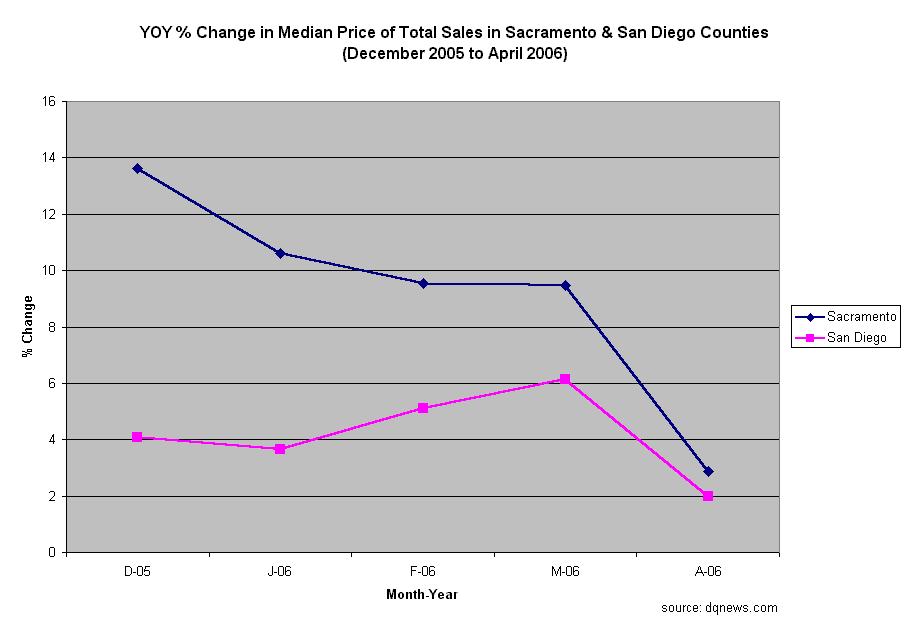
Hat tip: Ben Jones. While Sacramento may be ahead of the pack, that doesn't mean the rest of the Central Valley is immune from the current downturn. A look at the DataQuick numbers shows that appreciation has cooled even in the "hottest" areas over the last six months.

Based on all sales (SFHs, condos, and new homes)

Wednesday, June 28, 2006

'Orderly Slowdown' in Sacramento?

**Thursday: updated article**

For the first time, Sacramento has cracked the top 5 riskiest markets list, but there's nothing to worry about since the market is experiencing an "orderly slowdown," says PMI's chief risk officer.

Home prices in El Dorado, Placer, Sacramento and Yolo counties have a 58.5 percent chance of declining during the next two years, said Walnut Creek-based PMI Mortgage Insurance Co. That's up from 41.8 percent at the same time last year, PMI reported.

[O]fficials at PMI, which provides mortgage insurance to home buyers who make less than 20 percent down payments, said the Sacramento area is unlikely to experience a regional crisis or real estate crash. "The offset to those risks is the economy. It remains really strong in Sacramento," said PMI's chief risk officer, Mark Milner. "Job growth is strong and unemployment is slightly below average. "What we're seeing in Sacramento right now is really an orderly slowdown in the market," he said. "Prices have gone up so much faster than incomes and incomes will have to catch up."
Mr. Milner also is recommending 40 & 50-year mortgages.
"We continue to believe traditional mortgages are the best option for homeowners to protect their financial stability and home equity," Mr. Milner says. "But with increasing affordability challenges exacerbated by rising interest rates, many families cannot buy a home without an affordability product. Forty- and 50-year mortgages help families get into homes now and offer a safer alternative to interest only loans and payment option adjustable rate mortgages by eliminating the risks related to payment shock that are built into some products. While you build equity more slowly, you still build it."
More from the updated article:
The study adds to the increasingly widespread notion among housing experts that the Sacramento-area market shot up too far and is among regions in line for a correction. Earlier this month, a study by Massachusetts-based Global Insight and Ohio-based mortgage provider National City Corp. declared the Sacramento market to be 53.6 percent overvalued.

Though the new PMI analysis backs traditional economic arguments that area home prices will likely see a "soft landing," thanks to strong job growth, the top five ranking brings fresh jitters to the region's already uncertain real estate market. "In my discussions with folks in the real estate industry there is a lot of nervousness about a continuing sluggishness in the market right now," said Scott Syphax, president and chief executive officer of Sacramento-based Nehemiah Corp. of America, which provides down payment assistance and runs other affordable housing programs. "They're not seeing evidence of a late-spring, early-summer pickup they would have expected after such a slow first quarter," Syphax said.

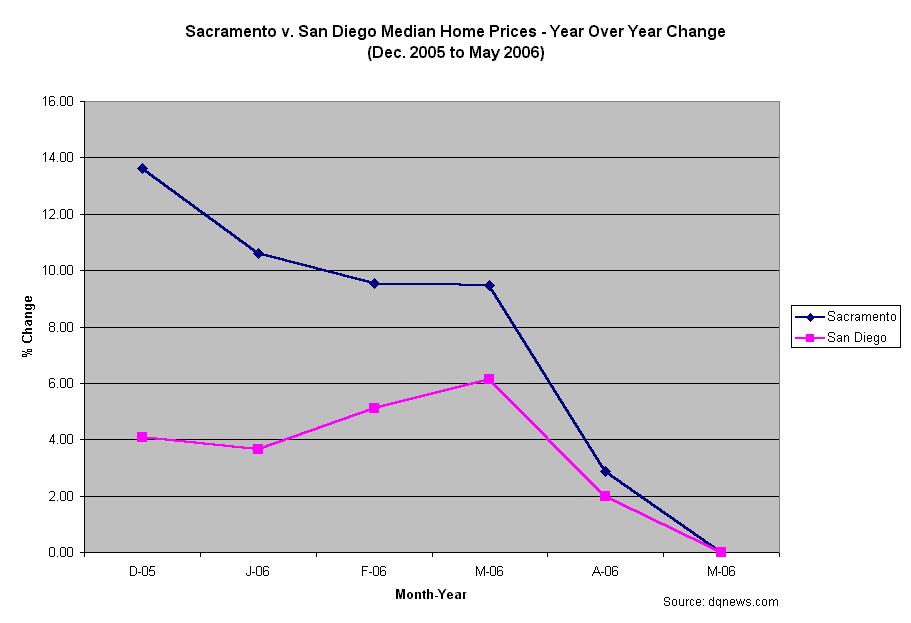
California Canary Showdown: It's a Tie


May 2006
Sacramento County: 0.00%
San Diego County: 0.00%

'People Wanted to Believe' in a 'False Economy'

The return of common sense:

"You just can't have a median income of $58,000 to $60,000 and live in a $400,000 house," said David Levin, a Delray Beach real estate consultant. "It just doesn't work. You don't need a Ph.D. to understand that $2 will not allow you to afford $3." But, he added, "people wanted to believe."

Approval of Kern County's 2006-2007 budget is still two months away, but county departments are already filling out their wish lists...Supervisor Jon McQuiston said he doesn't want to spend any money on ongoing costs. Tax money is coming in from new development, he said, but he doesn't trust that money to keep coming in. "We've seen tremendous growth in the real estate market that is somewhat softening," he said. He called the temporary revenue from that market a "false economy."

Tuesday, June 27, 2006

Sacramento Breaks into PMI's Top Five Highest Risk Markets for the First Time

PMI Press Release (pdf report):

The U.S. Market Risk Index shows 13 MSAs continue to have risk scores above 500, meaning they face a 50 percent or greater risk of home price declines in the next two years..."We'd reached a point where prices had gotten too far away from economic fundamentals," Milner explained. "A return to a more normalized appreciation climate is a natural outcome." While appreciation is slowing in many markets, it is still positive in all of the nation's 50 largest markets.

Risk remains concentrated along the coasts. Of the 13 highest risk MSAs, eight are located in California and five are in the Northeast. San Diego, CA remains the riskiest area with a score of 599, or a 59.9 percent chance prices will decline within two years. Sacramento, CA joined the top five for the first time with a score of 585.
  1. San Diego-Carlsbad-San Marcos, CA 599
  2. Nassau-Suffolk, NY (MSAD) 589
  3. Boston-Quincy, MA (MSAD) 588
  4. Santa Ana-Anaheim-Irvine, CA (MSAD) 588
  5. Sacramento-Arden-Arcade-Roseville, CA 585
Hat tip: John Lansner.

Monday, June 26, 2006

Sacramento Region Median Home Prices


This graph shows the percent change in median home prices for the Sacramento region's four counties. This includes single-family homes, condos, and new home sales. May was significant as none of the counties experienced price appreciation on a yearly basis.

Still Weak

Lennar has again identified Sacramento as a weak market.

Lennar plans to cut land costs, production costs and selling, general and administrative expenses to try to partially offset the increased incentives, Miller said in a statement. The current uncertainty in the new homes market was "primarily the result of speculators exiting the market and changing homebuyer sentiment," Miller said, but he also reserved a positive long-range outlook.

"Although current market conditions have softened, we believe favorable demographic trends and high employment levels bode well for long-term homebuilding fundamentals," he said. Some weaker markets were Sacramento, San Diego and Washington, while Florida and New York remained strong. Miller said speculators who are exiting the market have contributed to inventory and potential buyers are waiting to see how the market performs...

The health of the economy and its impact on consumers and employment, which could result in a "sharp slowdown" in housing demand, poses a risk for Lennar, UBS analyst Margaret Whelan said in a research note.

Sunday, June 25, 2006

'It's Scary'

Sellers are getting burned as builders attempt to lure away the dwindling pool of buyers. From the Stockton Record:

There's a new kind of dropout showing up in the home-sales market within the last couple of months: Buyers who get a loan and open escrow only to drop the deal before the transaction closes so they can buy new. These buyers are lured by deals such as sales packages or incentives. Incentives can include decorating allowances, tens of thousands of dollars worth of upgrades and even backyard landscaping or model furniture - any or all added at no additional purchase cost.

"They're very aggressive," said Jerry Abbott, president and co-owner of the Coldwell Banker Grupe real estate firm. "They're more motivated than (existing-home) sellers. Every day costs them money because they've got money tied up in (a) vacant home." In the last two months, his firm, one of the largest real-estate agencies in the area, has lost eight existing-home purchases pulled out of escrow because the buyers decided that new-home purchases were sweeter, he said...

Builders say they intend to be competitive in the home-sales marketplace, if not through piling on incentives to lure buyers, then by holding prices down. Shane Hart, vice president in charge of acquisitions, development planning and marketing for the Stockton-based Grupe Co., said business is down by about half from a year ago. "It's scary," he said. "The quality of the buyer we're getting is better. The people walking through the sales office are much more inclined to buy, but there are just fewer of them."

In one Sacramento project, the company has offered up to $135,000 worth of incentives to sell homes in the $600,000 range, he said. In that slower market, Hart said, some builders are offering such purchase perks as buying down the interest rates for first three years of a loan, making mortgage payments for a buyer the first six months and even throwing in a swimming pool...

Hart said he had heard that the new-home market was competing strongly with the resale market, with some builders offering sales commissions to real-estate agents of up to 6 percent. "What we found is that resale home prices are much stickier going down than new home prices," he said. "Builders just want to sell off the inventory they have. We'll slash prices or offer incentives to do that. With homeowners, this is their life savings, and they are much less apt to decrease prices as quickly as we would."

That does have one repercussion for builders, Hart said: Some who sign to buy a new home may end up not being able to complete the deal because they're having trouble selling their existing home. "That has caused for us to have a lot of cancellations in the new-home projects," he said. Abbott said builders are barraging his office with e-mails about sales specials and commission offers...

For sellers - and the numbers have been jumping every month in San Joaquin County since last spring - this means added competition from new homes that typically sit in their own market niche and added pressure to keep prices down to try to lure buyers. For example, the number of existing houses for sale throughout the county has steadily jumped each month from 777 in February 2005 to 3,957 last month - a more than fivefold increase over 16 months...

Tom Doucette, president of Stockton-based Frontiers Community Builders, said builders are motivated to move their homes quickly while home owners have an emotional attachment to their own homes that make it more difficult for them to compete on pricing.

Also, builders react more quickly to market changes and change their products and pricing accordingly, Doucette said. Frontiers is nearing the opening of its 800-home development in the 680-acre Westlake Village, the second residential phase of Spanos Park West, at Interstate 5 and Eight Mile Road. "We know we have to include value to the nth degree and price it competitively," Doucette said. The company isn't planning to offer incentives to lure buyers to the new project, he said, but will adjust basic pricing instead...

Dale Gray, chief executive officer of the Central Valley Association of Realtors, said there are fewer buyers while there are lots of resale homes for sale and builders are still building. "The builders are committed to keeping their contractors busy and completing the projects on line," he said. "They may have another one on the books that they have to start."

Friday, June 23, 2006

Sacramento Land(ed) at 0.00%, Yolo Pops: Double-Digit Depreciation Era Begins?

The housing Eagle has landed. According to just-released DataQuick figures, Sacramento County experienced no appreciation in May 2006, as compared to May 2005. The median price for all homes (single family homes, condos, and new homes) in Sacramento County was $367,000 for both May 2005 and May 2006.

In fact, according to DataQuick, no county in the Sacramento region saw price appreciation in May, with the three other counties suffering price depreciation:

  • Sacramento: 0.00%
  • Placer: -2.02%
  • El Dorado: -3.89%
  • Yolo: -11.14%

Did you notice the double-digit decline in Yolo County? In February, I noted that Placer County was the only listed California county to suffer depreciation in January. Now it appears that Yolo County is the only (and perhaps first) listed county to suffer double-digit depreciation. The same caveat applies: Yolo is a small county and the monthly numbers are much more erratic than those of more populated counties like Sacramento. But even so, when was the last time a California county found itself with double digit depreciation?

Last time I asked whether the era of depreciation had begun. Now that the Sacramento housing boom is officially over, is the double digit depreciation era about to commence? Will the Eagle take flight back into the air, roll along the surface, or sink into the quicksand? Stay tuned...

We interrupt this program...

...for a special announcement:

Housing inventory in the Phoenix housing market just surpassed 50,000, according to the Bubble Markets Inventory Tracking blog.

Follow the Phoenix market at the all-new Housing Doom Housing Bubble Blog.

Now back to our regularly scheduled program...

Thursday, June 22, 2006

Sign: 'It is a house.'

For all you bargain hunters out there:

A sliver of vacant land accompanied a triplex that John Johnston bought six years ago in South Land Park. Over the years, that land had been written off as useless.
Johnston didn't see it that way. He saw the long and skinny plot as the perfect spot for something unusual in Sacramento.

Today, a two-story house stands on the lot, waiting for a buyer. From the front, the home looks like something one might see in France, with narrow windows and a tiny balcony above an ornate and narrow front door. From the side, well...The two-bedroom home is 8-feet deep at the south end, but don't judge the residence by that, Johnston said. "Everyone judges the house by one side, the south side," he said. "On the north side of the house, I have a 12-by-19-foot living room that is full of light. You can put a sofa on any of the four walls. I think this house is a wonderful house..."

Johnston has received varied reactions while his South Land Park home has taken shape. "People kept asking, 'What is it? What is it? What is it?' They were going inside and stopping the workmen, and they couldn't get any work done," Johnston said. "So I finally put up a sign that said, 'It is a house.' "

Johnston said the house was initially going to be his own, but he found the stairs were too rough on his aching leg joints. The home has 1,029 square feet and has been on the market for more than four months, he said. The price has dropped from $479,000 to $399,000. Johnston blames the cooling real estate market. "If I could have had it done six months earlier, I think it would have sold right away," he said. "But, c'est la vie."

Wednesday, June 21, 2006

Sacramento Market Loses Its Sparkle

At least it's not as bad as the Sacramento housing market...

[Broker Denise] Aquila said that the Bay Area won't get the kind of price drops seen in areas like Sacramento that have a lot of land and new construction.

UCLA Anderson Report (pdf): The HPI [Home Price Index] also gives some insight into the Central Valley, where the Sacramento region is slowing significantly while other markets are still showing double-digit appreciation. In spite of these ambiguities related to measuring price appreciation, all the data show a major slowdown underway in California real estate markets, with a significant drop in sales and a very sharp deceleration of price appreciation in 2006...

While Southern California and the Bay Area have seen construction employment plateau and fall a little, the Central Valley has lost about 3,000 jobs (-3%) since the end of 2005, mostly in the Sacramento area.

Southern California's housing and job markets generally have fared better than Northern California's, the study says. In particular, the Sacramento area has been hit hard.

The slowdown has tarnished even markets that once sparkled. The Sacramento area saw a 1 percent annual decline in home prices in the first quarter of 2006 after rising 12 percent in the fourth quarter.

Tuesday, June 20, 2006

SacBee/Real Estate Pundits: Don't Worry, Be Happy!

Care for a drink?


I suppose its progress (from a skeptic's point of view) when the current market is being compared to the last housing bust. We're no longer in a "housing boom," Toto.
No panic on housing slowdown
The conditions are much more favorable for a rebound than in the 1990s bust, experts say.


In October 1990, local real estate leader Michael Lyon heard a sound he has never forgotten. It was the silence of phones that had abruptly stopped ringing. Sacramento's sizzling 1980s housing boom was over, and the 1990s bust had begun. When it finally ended, it set records for the number of homes for sale, and flattened prices in Sacramento and Yolo counties for eight years. "It was ugly," said Lyon, head of Lyon Real Estate.

The region's housing market is stalling again. After an even more remarkable seven-year housing boom, the slowdown is driving up resale inventory and triggering speculation about an uncertain future. But this sagging market isn't much like the 1990s version.
Absolutely correct. Some say it is has the potential to be much worse given that this recent boom was "more remarkable" than the 80's one.
Some analysts say the reasons help explain why the present downturn may be shorter and less severe. The differences between that market and this one? "We are having job growth. We are having population growth. We're still having in-migration from the Bay Area," said John Schleimer, a Roseville-based consultant for the home-building industry.

But there's one big problem. "The prices got too high," he said. "When we cracked $500,000 for the median, we outstripped the ability of peoples' incomes to pay." Sacramento's 1990s real estate bust was marked not by impossible prices but by a lethal convergence of negatives: a statewide recession, local military base closings, job losses and higher costs of borrowing...

The result: From June 1991 to October 1997, the collective median price for existing homes in El Dorado, Placer, Sacramento and Yolo counties bounced up and down before resuming steady, dependable appreciation. The story was worse in individual counties. Sacramento County's $132,000 median home value in 1991 slid to $111,250 by 1997, then crept up to $131,000 in mid-1999, according to La Jolla-based property researcher DataQuick. Likewise, Yolo County's median value of $159,500 in 1991 took until 1999 to reach $160,000. Median is the point where half cost more and half less.
Wait. I thought real estate prices never go down.
"I bought in '95. Boy am I glad," said David Lyons, who analyzes the Sacramento job market for the California Employment Development Department. "I never fathomed we'd see the prices we see now." Wassmer also bought an east Sacramento home in 1995, "at the (price) trough," as he recalls it. He remembers the owner owed money to the bank after selling. "To get rid of his house he had to pay money. That's how it was then," Wassmer said.

Amid the capital region's job losses and the stagnation in its home values and population growth, the number of "For Sale" signs peaked at 13,507 in April 1992, a record that still stands. At the time it totaled about 2.5 percent of the region's residential units.

That same percentage today would mean 19,000 homes for sale, when adjusted for the 210,000 new dwelling units built since 1992, according to the Construction Industry Research Board. At last count, slightly more than 13,000 "For Sale" signs graced the region, according to TrendGraphix, a division of Lyon Real Estate based in Sacramento.

Even with so many homes for sale, the publicly traded home builders that now dominate the Sacramento market say their industry reacts faster to oversupply than a decade ago. "In the 1990s the market was driven by private builders, and they took longer to correct," said Doug Pautsch, president of the Sacramento division for Dallas-based Centex Homes.

The region's jobless picture also is different. March 1993 unemployment ranged from 7.8 percent in Sacramento County to 8.9 percent in El Dorado County. Last month it was 4.2 percent in the four-county region, according to figures released last week by the state EDD.

Senior economist Christopher Thornberg of the UCLA Anderson Forecast said it's not unusual for a strong economy to coexist with a weak housing market. Indeed, he said a strong economy signals home values could hold steady without rising "for five or six years."

That's contrary to the quicker turnaround many are predicting for Sacramento.

"People don't move when the economy is growing," Thornberg said. "They hunker down and pay their mortgage so you see fewer transactions...As long as people stay in their homes, it takes longer to work off the inventory and longer for prices to converge with the fundamental price."

But in a critical difference from the 1990s, a sizable majority of borrowers now use riskier adjustable rate mortgages. In March, nearly 68 percent of home buyers used financing where monthly payments can rise with hikes in interest rates. Statistics show that more people are falling behind on payments, the first step in having their homes repossessed. Many believe that's Sacramento's weak spot -- its potential for a wave of foreclosure sales that could flood the market and depress property values regionwide.

Yet economists like Wassmer and consultants like Schleimer say they doubt Sacramento will see a 1990s-level slowdown. Even as a new report by Global Insight and National City Corp. suggests the market remains 53 percent overvalued, their counterpoint is the region's strong economic fundamentals.

"We have two, if not four, slow quarters ahead, then we'll start to see some improvements in the market," Schleimer said. "We've seen the market soften on price, but that was bound to happen," added the EDD's Lyons. "I'm not convinced we're going to see anything more than a correction in the market."

San Joaquin market is like a candy shop...

...with a lot of overpriced candies to choose from. From the Stockton Record:

Sales of existing homes in San Joaquin County were up in May from the month before, but the median sales price slipped somewhat, holding to a pattern of home valuations that have wiggled up and down month to month and held basically flat since last summer.

The median sales price of an existing home in the county sank from $420,000 in April to $415,000 last month, according to figures from the latest Coldwell Banker Grupe-TrendGraphix monthly sales report, based on Multiple Listing Service data...

Meanwhile, the number of homes on the market continued to climb, increasing the competition among sellers and putting pressure on prices. Last month, 3,957 houses were listed for sale, up from 3,462 in April. That compares with 1,173 houses on the market in May 2005. The escalation in listings is cited as the biggest reason why prices have flattened or sagged since last summer.

"That is the killer," said Mike Collins, of Century 21 Collins. "There are so many homes for sale right now, for buyers it's like going to a candy shop - there's too much to choose from." He estimated that business is off by about half from a year ago.

Collins said that although there have been price reductions, typically they aren't sharp ones, and sellers have been reluctant to slash prices, even with the growing competition. For the first time in recent years, he is starting to see some purchase offers as low as 10 percent below asking prices.

Monday, June 19, 2006

Downtown Delay

A sign that the housing downturn is being felt in downtown Sacramento? From the Sacramento Business Journal via MSNBC:

The developer of the downtown Sacramento railyard, rather than cut back its plans for the mall's worth of retail it proposed in March -- as some competing interests had once hoped -- is now saying it will build most of that space in the first three years of the 15-year project. Thomas Enterprises Inc. this week amended plans it presented to the city three months ago, and now says it will delay building most of the housing units until after the sixth year...

Thomas reduced the maximum number of homes slightly, to 10,676 from 11,085 in March, said Nedzlene Ferrario, project manager with the city's Development Services Department...The company does not foresee starting the project with a great deal of housing. During the first three years, only 983 units would be developed. And during the second phase -- years four to six -- only 846 more homes would be built. Not until the third three-year phase would a larger crop of homes be built -- 2,495 units.

Ault said this is logical, because the rail-yard would need to have retail, parks, streets and other amenities to draw larger numbers of homebuyers. And given the drop in sales during the past year or so, it makes sense to start with fewer units, said Greg Paquin, owner of The Gregory Group, a local company that studies the market.

"Hungry" Fresno Agents Get "Creative"

An update on the Fresno housing market from the Fresno Bee:

Real estate agent Mel Kilner knows how to attract a crowd. Kilner held six open houses last week, all at one time, and he used a free dinner as a reward to make sure people would stop at each home. More than 200 people went through at least one home. Free dinners, target marketing and cash bonuses are all being used by hungry real estate agents eager for buyers in a cooling housing market.

The number of resale homes sold in Fresno County slid from 848 in March to 799 in April, while the median price fell slightly from $275,000 to $270,000, according to DataQuick information services. "This is what we like to call the adjusting phase in real estate right now," said Joan Jolly, president of the Fresno Association of Realtors. "There are buyers out there, but they are on the sidelines waiting to see what happens to the market..."

Jolly believes home-buying seminars may also be coming back. The seminars are organized by real estate agents and lenders as a way to prequalify potential homeowners and educate them about the home-buying process...

While Kilner targets older home buyers, agents like Kristine Sorrells, with Guarantee Real Estate in Fresno are going after renters and younger buyers. Sorrells, 24, hits apartment complexes with direct mailers introducing herself as an agent and networks with people younger than 30, another segment of the market she is trying to target. "I know a lot of people who are renting and who are interested in buying a home," said Sorrells. "I don't see the market slowing down; I think it is a good market. We are just having to work a little harder..."

And it isn't just agents who are eager for home buyers; the lenders are also searching for new clients. Joni Davis, of Royal Charter Mortgage in Fresno, has started advertising on bags used by pharmacies in two of Save Mart's Fresno-area stores. "It is just a way to put the thought in someone's mind," said Davis, a mortgage loan officer for 20 years. "It has become a buyer's market and it hasn't been that way for some time, so it is important to educate people about the possibility of buying a home."

Sunday, June 18, 2006

May 2006 Median Price

These graphs measure the median sales price of existing single family detached homes in Sacramento County only. Click on any graph to enlarge it.

The first graph shows the percent change in price over the prior year. The time period is from January 2004 to May 2006. Appreciation for May was 3%, up from 2% in April. As recently as January 2005, appreciation was at 31%.


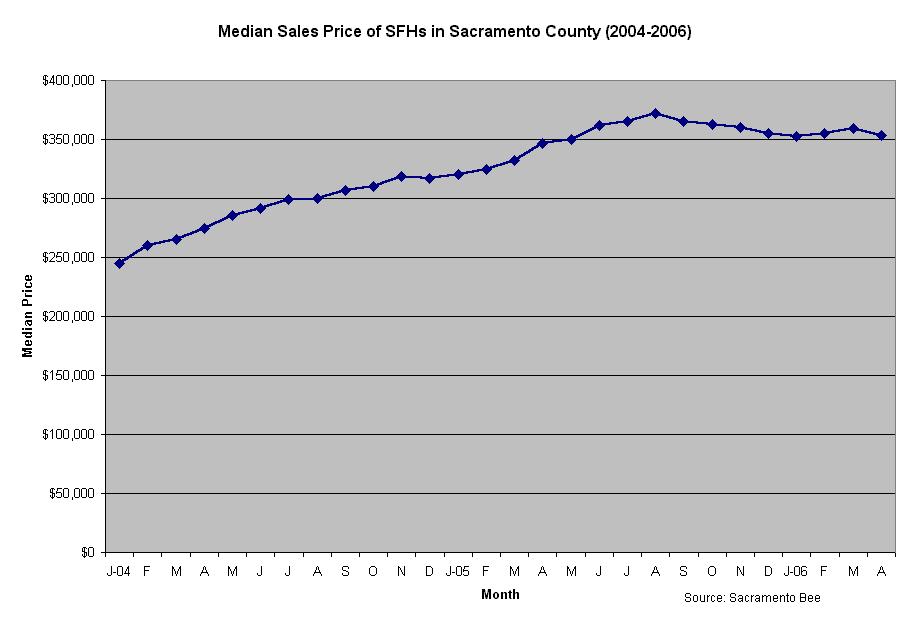
The second graph shows prices between January 2004 and May 2006. The May median price is down $12,000 or -3.2% from the August 2005 peak.


Saturday, June 17, 2006

May 2006 Sales

The following three graphs show sales of existing single-family detached homes in Sacramento County only. Click on any graph to enlarge it.

The first graph shows the year-over-year percent change in the number of homes sold. May marked the 14th straight month in which sales were less compared with the same month of the prior year.


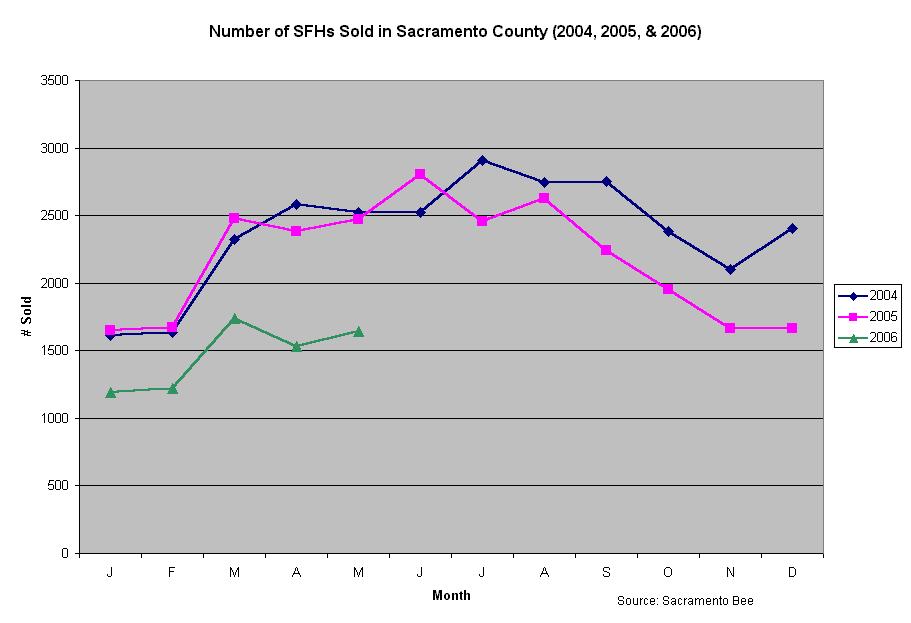
The second graph compares the number of monthly home sales in 2004, 2005, and 2006.


The last graph shows the number of homes sold between January 2004 and May 2006.

Friday, June 16, 2006

"Teetering" Merced

From the Merced Sun-Star:

Merced's housing market is significantly overvalued and teetering on the edge of a downturn, according to a new study. Housing prices have soared to 77 percent above where they should be, which means Merced is "at risk for a price correction," according to the study released earlier this week by financial services company National City and economic information company Global Insight.

"Even though I can't tell you where prices are going soon, I can say that the risk of prices declining within the next three years is very high," said National City Chief Economist Richard DeKaser. When prices dip, they'll probably sink about 35 percent to 40 percent over a period of three years, said DeKaser.

Local real estate leaders say that decline is already under way. "It's already been happening, definitely," said Ray Rodriguez, president of the Merced County Association of Realtors. Rodriguez said he first saw prices going down last fall, but he thinks the market should turn around soon..."We're not as overpriced as people say we are."

Buyers seem to disagree. Developers and real estate agents alike have been forced to slash prices lately. Ranchwood Homes dropped the base price on new homes at its Summit Meadow subdivision in Beachwood this week from $324,900 to $314,900, said sales representative Patty Camacho. "Almost every [listing] that I have has been reduced," said real estate agent Mary Gamel with London Properties. Gamel said she recently reduced the asking price on a McSwain house from $795,000 to $759,000 and dropped a Brimmer Road house from $355,000 to $345,000. That's bad news for out-of-town investors who flocked to Merced looking to buy and then "flip" houses for a quick return. "To those people, I would strongly caution against buying at this time," said DeKaser.

Thursday, June 15, 2006

We're #1 (Again)


Sacramento edged out Phoenix to reclaim its crown of housing market with the highest precentage of price reductions, according to the Bubble Markets Inventory Tracking blog.

We now see almost 4 out of 10 listings in Sacramento with price reductions, and remember, this is not counting the ones that reduce their price when they re-list following a 60-90 days sales contract...Looks like Sacramento is taking the gold this time for being the most bubblicious region.

Sacramento Metro:1/30: 30.5%---> 6/13: 39.7%

'Chico is a Special Place'

After reading one too many real estate articles over the past year, I've come to the conclusion that everyplace is special and land is scarce everywhere. From the Chico Enterprise Record:

Despite a national study that concluded Chico homes are "extremely overvalued," members of the real estate industry here see a buyers' market. A valuation analysis released Monday by National City Corp. and Global Insight found that homes in Chico are priced nearly 61 percent higher than they should be...

Brewster Beattie, a Realtor with Coldwell Banker in Chico, said calling the market overvalued is subjective. People still gladly move up here from more expensive areas of the state, he said. "I think it's all a little bit relative," he said. Beattie questioned income levels used in the study.

"That's skewed down, I think, because of the student situation," he said, referring to Chico State University. "That's someone in New Jersey that doesn't know the Chico real state market." Even so, the high prices have plateaued, Beattie said, and there is an increasing number of homes on the market. In May 2005, there were 163 homes up for sale in Chico. Now, there are 492. "I think right now the inventory is escalated because people are putting homes on the market too high," he said. "They're not selling. It has turned into a buyers' market."

Carlee Shannon of Preferred Agents Real Estate said the market in Orland is showing a similar trend. There are now more than 90 homes up for sale, whereas a year ago there were only 20 to 25. "I think it's because our prices are too high. I believe it's softening and becoming a buyers' market," Shannon said. "There are so few buyers at this time and so many listings out there, so it influences the seller to be motivated. We're seeing price reductions..."

Steve Bertagna, a Chico city councilor and Chico Valley Mortgage loan specialist, said studies of home values often don't take into account quality of life issues, such as climate and recreational activities that make an area attractive to prospective residents. "Chico is a special place and people know about it," he said. "These things directly or indirectly contribute to home values." He cited a scarcity of land available for development as a cause of high prices here.

'A Ton of Overpriced Homes'

The Sacramento Bee has DataQuick and inventory numbers for May.

The standoff between thousands of Sacramento-area homeowners and buyers sharpened in May, as 1,800 new listings added to a mounting inventory of homes for sale in El Dorado, Placer, Sacramento and Yolo counties, real estate researcher TrendGraphix reported Wednesday. The newest influx of "for sale" signs contributed to a near-record pileup of 13,146 homes on the market at month's end...

Altogether, there were 4,621 more homes for sale at the end of May than there were on New Year's Day, according to figures from TrendGraphix. The record number of "for sale" signs in the region was 13,507 in April 1992. That happened amid local military base closings, a statewide recession and unemployment numbers almost double the region's most recent jobless rate of 4.6 percent in April. Then, approximately 2.5 percent of the region's residential units were for sale. Since, builders have added approximately 210,000 new single-family homes, condos and apartments to the four-county region's housing supply, according to the Construction Industry Research Board. The number of homes for sale today would have to swell to almost 19,000 to equal the impact of the 13,507 for sale in 1992...

The most-watched indicator among local real estate agents is the supply of existing homes on the market. "That's the big thing affecting our market more than anything -- inventory, (along with) interest rates," said Richard Swayne, vice president of Sacramento-based Dunnigan Realtors. Or put another way: "What we have is a lack of inventory priced right," added Michael Lyon, head of Lyon Real Estate. "We have absolutely a ton of overpriced homes."

As the "for sale" signs pile up, buyers like John Daniels of Sacramento and Alison Munro of Vacaville are holding back, waiting for lower prices. They're key players in what experts now call a "buyer's market." "We're probably going to wait longer than three months just to see," said Daniels, a supervisor for Select Carrier Group, a Sacramento shipper. Daniels is looking at homes in Sacramento's Natomas area.

Munro, a Fairfield teacher considering a move back to her Sacramento hometown, said, "We are looking actively, but I'm kind of watching the prices come down...We're just waiting it out a little bit longer." El Dorado Hills-based real estate agent Mark Macarow said buyers are not as much in a rush. Often that means sellers must adjust expectations...

Here is a closer look at the four-county region:

Sacramento County's median sales price jumped $6,250 in May to $360,000 after falling in April. May's price remained $12,000 below the county's August 2005 peak of $372,000. Prices were still 2.9 percent higher than May 2005.

Yolo County, which in April posted the four-county area's only median sales price gain, reversed course and posted the region's only median price decline in May. Yolo's median price was $419,500, just $500 below the April median. That price remained $17,000 below its high of $436,500 in November 2005. But it was 2.3 percent higher than a year ago May, according to DataQuick.

El Dorado County saw its May median sales price rise by $1,000 to $450,000 after falling slightly in April. The county's May median price remains $25,000 below its September 2005 high of $475,000. Prices are 1.1 percent higher than May 2005.

Placer County's median sales price climbed $8,627 to $481,127 after falling in April. Sales prices remain $20,873 below their August peak of $502,000. May prices remained 5.7 percent higher than May 2005.

Wednesday, June 14, 2006

Surrounded by "Repartments"

The Sacramento Bee has this article about condo conversions gone bad.

A national housing trend called "repartments" has hit the Sacramento area, leaving people like Violet Vernon wondering if she'll ever be able to sell her home. The 1,100-square-foot Folsom condominium she bought in January for $318,000 is surrounded by what the Wall Street Journal dubbed repartments.

The owner of the 324-unit Waterford Place, on Natoma Station Drive, sold about 40 units as condominiums and then reverted the rest back to rentals. "The prices in Folsom were out of my range and this represented an opportunity for me to gain home ownership," Vernon said. "My concern now is that I may not be able to sell or refinance. I don't know that I can find a buyer."

Real estate experts report slowing sales this year of single-family homes and condominiums...Three years ago, new condominiums and apartments converted to condos were a bare 2.2 percent of new-housing sales in the six-county Sacramento region -- El Dorado, Placer, Sacramento, Sutter, Yolo and Yuba counties. In 2005, they reached 18 percent, according to Costa Mesa-based housing analyst Hanley Wood Market Intelligence...

Waterford Place, formerly called Lakeridge, was the first, with units going on sale July 16, 2005. When sales slowed to a trickle, the sales office closed in May. Waterford Place executives said they understand residents' concerns and never intended to have rental units in the complex, but that the slowing condominium market prevented them from following through on sales...

Moss said his company is researching what problems, if any, owners may have with refinancing or selling their units. Ross said the challenge is not finding a lender but that the value of the unit often decreases if it is surrounded by rental properties.

Vernon has contacted Prometheus numerous times to no avail. She said the owners should have foreseen a slowdown in condominium sales when they purchased the complex in 2005. "They can always get another investor. I can't," Vernon said. "I don't know if I can rebound from this."

Easy to Buy, Hard to Keep

CBS 13 reports on the rising tide of foreclosures in Sacramento & San Joaquin.

The number of California homeowners having difficulty paying their mortgage is going up. New statistics show the specifics: the number of foreclosures is clearly on the rise. In California there are more than 2,500 homes in foreclosure. There are nearly 85,000 pre-foreclosures. Those are homeowners who are on the verge of losing their homes.

In Sacramento there are 165 current foreclosures, more than 4,500 homes are in pre-foreclosure. In San Joaquin County there are 76 foreclosures and more than 2,800 pre-foreclosures.
Don't forget to watch the video clip on the upper right side.

You can find weekly updates on Sacramento County foreclosures at the Sacramento Housing Bubble blog.

Tuesday, June 13, 2006

Prices Drop, Sacramento a Little Less "Extremely Overvalued"

Sacramento is now 54% overvalued according to the latest National City Corp./Global Insight report (pdf). At last check in March, the Sacramento market was considered 64% overvalued. Why the decrease? Well, it may be because "price corrections" or "price drops" are no longer theoretical for Sacramento.

CNN Money:

The most overvalued housing markets in the United States recorded much higher price increases during the first quarter of 2006 than the least overvalued markets, according to the latest analysis by National City Corp, a financial holding company, and Global Insight, a financial information provider.

In the 50 most overvalued markets, prices increased 2.5 percent from the fourth quarter to the first, an annualized rate of 10.1 percent. In the 50 least overvalued markets, prices increased just 0.7 percent, an annualized rate of 2.7 percent...

Some places, of course, bucked this national trend. Salinas, Santa Barbara and Sacramento, all in California, are all among the top 50 overvalued cities where prices dropped.

Markets with valuation premiums above 34 percent were judged to be severely overpriced and at risk for price corrections. DeKaser did find some evidence that prices may be ripe for a correction. A year ago prices in overvalued markets were going up even quicker than they are today, indicating they are pointing to a change of direction. That doesn't mean that a normal, balanced market is right at hand. "We've got a long way to go before we're out of this market," says DeKaser.
Marketwatch:
When prices do fall from overvalued levels, they typically fall by about half the overvaluation, DeKaser said. The correction usually takes three and a half years.

It's a Soaring Balloon, Not a Bubble

The real estate blog of the New York Times noticed the billboard photo that I posted recently.

Remember the idea that the real estate market is not a bubble, but a balloon? Check out this billboard that has appeared around California, where home sales are not soaring.
Here's another blogger's interpretation of that soaring balloon.

Monday, June 12, 2006

May Day, May Day!

The real estate industry speaks.

An agent gives some May results at Realty Times:

The Median Price is the Same as April of this year and May of Last year...The number of Re-sales during the May was dramatically lower (40%) in comparison with the May of 2005 and 2004....
Another agent at Realty Times had this to say about the Sacramento housing market:

The market is down because there are so many houses for sale.. and there are a lot of investors who bought houses to remodel and now need to get them out of inventory. The market was HOT for the last 5 or so years with the price of homes going up 112% for an average of aproximately 23% a year. When the interest rates started going up in July 2005 and the newspapers started talking about a price bubble, a lot of people put their house on the market to take advantage of the high prices before the bubble burst. This created a glut of homes for sale at a time when the number of buyers was going down because of the higher interest rates. As a result, to sell their homes, sellers are being forced to be more competative. Thus, lower prices and a buyers market.
Riva in West Sacramento says it's a great time to buy during the 'price and incentive war:'
"There's no better time to buy a new home than when there's a price and incentive war going on," said Scott Bolli, director of sales for development company Pacific West Cos. "While most people buy when everyone else is lined up to buy, the best deals can be found in a buyer's market. The people that buy at Riva today will stand a much better chance at a bigger return on investment, especially with our prices being so low and huge credits for closing."
An agent in Modesto sees 'panic pricing' and tells sellers to calm down:
In addition to price reductions, today's buyers are also seeing a lot of new inventory, according to Larry McDonald, a Realtor with Keller Williams Realty in Modesto. "After the massive rainy season, a lot of houses are just coming on the market," he says. "There are all of these homes that have flooded the market."

McDonald won't speculate on whether the market has turned. But he has seen some "panic pricing," sellers getting nervous and pricing their homes too low. To calm his clients' fears, McDonald reminds them that current mortgage rates are still quite attractive by historical standards and won't keep buyers away. "I can remember when rates were at 13 to 18 percent," he says. "We have been blessed with a good market."
A Redding agent thought a $70,000 discount was a mistake:
Has the north state real estate market tipped in the buyers' favor? Two new homes in the Land Park subdivision in northwest Redding were discounted $70,000 this week, slashing the list price to $409,900. The reduction so surprised real estate agent Brad Garbutt that he initially thought it was a mistake.

"They have scaled back prices to what they could have gotten nine months ago," said Garbutt, a member of the Shasta Association Realtors board. "There are probably going to be some starving real estate agents around."
Finally, this agent in Visalia was 'shocked' when he looked at the numbers:
Two reports detailing the health of the local real estate market are painting a picture of a rising inventory of both new and existing homes in Visalia and in the Tulare/Visalia MLS. The Tulare County Association of Realtors reports as of June 1 the inventory of existing homes for sale reached 1690, up from 1541 in early May of 2006. These numbers compare to just under 400 homes for sale this time last year.

A second more detailed report done by Icenhower Real Estate of Visalia focuses on both new home builders in the Visalia area as well as the market conditions for existing homes. "We needed to get a handle on what was going on," says Brian Icenhower who worked on the report along with Cyril Thompson and others in the firm. "We found there is an excess of 70 subdivisions being marketed in the Visalia area alone," says Icenhower and the competition in new homes and volume of product "has driven down prices for both new houses and existing homes."

The pace of building has not let up in Visalia, the city reports, with an expected 1400 to 1550 new homes likely to built this year. The Icenhower report details that of the 845 existing homes for sale in Visalia, 283 or one third of them are vacant. Icenhower says that's due largely to the fact so many homes in recent years were purchased by investors...

A key measure of how sales of existing homes are doing is the average number of days on the market. In May of 2005 the average market time was 31 days for homes to sell, a trend that continued until about February of this year when the MLS reports the market time jumped to 58 days. MLS figures for June show pending sales are about 50% of what they were last June signaling slower sales even as the home selection grows for both new and existing homes. Last year the supply of existing homes on the market amounted to enough for just one month. As of June 2006 we have a six month supply, says the report.

The report shows new home subdivisions by price around Visalia with the busiest part of town in the city being the rapidly growing northeast where there are over 20 active subdivisions. Icenhower says the "the numbers kind of shocked me" especially when you add in the amount of residential land and lots already available in the city detailed in a new city report.

More Bubbles

Recently added links:

Saturday, June 10, 2006

The Sacramento Real Estate Market Has "Flipped"

The Sacramento Bee has an update on the incentives frenzy that has gripped the Sacramento housing market.

They'll give you refrigerators, pay your first year's homeowner association dues and cover your closing costs -- all to get new houses off their books. As Sacramento's housing slowdown continues and more existing homes sprout "For Sale" signs, home builders are ramping up the deals. What started late last year with free granite countertops now has escalated at places like Antelope's Winncrest Homes, where upgraded carpets, kitchen cabinets and lighting are in the offing.

Beazer Homes is promising $20,000 to $65,000 off. Some Centex Homes buyers can get a $125,000 price break. KB Homes has run ads offering $1,000 gift cards for buying in Yuba City, Natomas and Woodland. Pacific West Cos. hands out $10 gas cards for touring condos in Elk Grove and West Sacramento. "We're going to look at every objection and we're going to overcome that objection," said Vince Brennan, vice president of sales and marketing at D.R. Horton's Sacramento division. "No secrets," he said, "it's a buyer's market..."

What a difference a year makes. A short time ago, before the capital region's five-year housing boom ran out of steam last summer, builders were quickly selling whatever they built. There were waiting lists, near-weekly price hikes and even lotteries for desperate buyers.

Now the market has flipped. Avant Garde Development LLC recently wooed buyers to its Rocklin townhomes with 37-inch plasma TVs and no homeowners association fees the first year. In some ways, builders have begun imitating car dealers, advertising 48-hour "House Hunts" at KB Homes, "Zero Days" at Meritage Homes and the "biggest new home sale in the history of D.R. Horton." Others quietly send cards to "special guests" with offers of backyard landscaping and no closing costs.

The shift testifies to both fierce corporate competition among the nation's biggest publicly traded builders and to the region's growing accumulation of resale homes. There, too, real estate agents and sellers are testing incentives. In El Dorado Hills, Don and Suzi Garofano are offering a new $35,800 Jaguar automobile as enticement to buy their $1.67 million home on 10 acres overlooking Folsom Lake. "You gotta be real creative," Don Garofano said...

Gross and other home building analysts, including the Folsom-based Gregory Group and Hanley Wood Market Intelligence of Costa Mesa, say Sacramento-area builders are competing with a glut of resale homes at the same time they're seeing more canceled contracts for houses already started. Meanwhile, they continue to build -- even after selling 2,371 fewer homes during the first four months of 2006 than in the same period in 2005. "What happened was all the builders kept building at a higher rate than the market would absorb," said Jack Pautsch, Sacramento division manager for Centex of Dallas...

Greg Paquin, Gregory Group president, estimates 20 percent of the region's new homes are "standing inventory" -- finished houses without buyers. Many come with $40,000 to $80,000 worth of buyer incentives. "The builders don't want to carry it so they will make incentives to get it off the books," Paquin said.

As May began, new-home builders were competing with 11,344 existing homes for sale in El Dorado, Placer, Sacramento and Yolo counties. That's expected to climb another 1,000 homes when numbers for the entire month are released next week. "We put up 900 more signs in May than we took down," said Jim Eggleston, president of The Sign Post in Sacramento, which installs more than 90 percent of the region's For Sale signs. Another 1,000 homes on the market would rival the 12,361 homes for sale in June 1993. The record is 13,507 in April 1992, according to Sacramento researcher TrendGraphix...
With all that inventory, will the home builders slow construction? Yes, says Centex:
Pautsch said the deals reflect an oversupplied market and are likely to recede within weeks as builders slow construction.
Deals likely to recede? I think this is wishful thinking on the part of Centex. D.R. Horton says no:
Texas-based Horton, the nation's most productive home builder, sold 1,021 homes in the Sacramento area last year out of a nationwide stock of 51,000. Despite the backlog of unsold homes, the company aims to boost production 20 percent in the region this year. "We have our business plan and we're keeping pace," Brennan said. "If we slowed down our building, we would have to abandon our goals."

Thursday, June 08, 2006

"Buyers are Becoming a Precious Commodity" in Chico

A blog called Post Scripts has this rare report on the Chico housing market:

Could Chico home prices be about to fall? If you look at the inventory on MLS you might think so. It's up about 3X over last year with around 277 homes on the market. This week there were more homes offered on the MLS tour than at any time all year. The stock market is jittery and it's taken a beating recently over inflation woes that are leading us ever closer to higher interest rates. Now toss in the sky high gasoline price and it stands that sooner or later this absurdly high $220 per average s.f. price will have to come down. If homes are not selling right now, what choice do sellers have? It's happened many times before and its going to happen again, so the question is not IF, but when?

UPDATE 5/30/06: Condo prices are falling. Home prices have stalled. MLS inventory as of 5/30/06 has risen to over 400 homes and they just aren't selling like they should. Buyers are becoming a precious commodity at local real estate offices, listings that are not priced to sell are used to sell those that are.

As interest rates climb from this point on, there will be more pressure on sellers to lower prices to offset higher finance costs to buyers who are becoming increasingly more selective and more demanding.
And here's a tidbit about the Redding housing market:
Palomar Builders Inc., Redding's largest homebuilder, is being acquired by Premier Homes of Roseville, both companies announced Monday...The Palomar-Premier deal comes at a time when residential real estate is slowing in Shasta County. Housing starts in Redding through April are off 42 percent from last year. Home sales countywide also are down for the year.

Tuesday, June 06, 2006

Weeds & Foreclosures in Elk Grove


Apparently, I'm not the only one who has visited Elk Grove and noticed all the unoccupied "investor" homes. A commenter on the Sacramento Housing Bubble blog had this story:

Last weekend (May 8, 2006) a lady friend I went to spend the day with in Sacramento had driven out from Walnut Creek to Elk Grove to meet me at a house she, her sister and brother in law bought last year, as an "investment." I didn't think much of the fact that she is trying to rent it, but then I went in the house (huge, with so many windows -- and high ones -- one would need a full time maid to keep up).

Then I went up stairs and looked out into the back yards of the surrounding new homes filled with weeds. No one was living in those houses either!! She said her house will rent for about $600 mo less than their payment (I have no idea what kind of loan it is). Even the front yards of these houses, haven't even had the lawns mowed. The sod is 8 inches high.
Weeds aren't the only things growing in Elk Grove. The Elk Grove News blog has noticed an upturn in foreclosures notices.
Perusing the pages of the last Wednesday's Elk Grove Citizen, I was stunned to see paid advertising on the normally ad-free editorial page. And the ads were not just any ads either. They were Trustee Sales Notices, or more commonly known as Foreclosure notices. A type of advertising mandated by statute, trustee sales notices are the last step in a process for a lender to take possession of a property from individuals who have defaulted on their loans.

The fact that these ads appeared on the editorial page indicates they came in just a deadline was closing is telling. Normally these sort of public notices have a much earlier deadline. Obviously the lender wanted to make sure these ads were published so the foreclosures were not delayed.

Foreclosures in of themselves are not unusual. Having worked in this field for a number of years, people lose their homes for a variety of reasons. The most common are divorce, loss of a job or a major medical calamity. It is true that even in the best of economic times lots of families are only a paycheck or two away from losing their homes.

As you read though each of these notices, one thing stands out -- in all cases the occupants had been in their house three years or less.

In boom times, when people get into trouble with a home loans there are several ways out. The most common approach is to sell the house, pay off the loan and pocket some money.

The fact that these relatively new loan contracts are going to foreclosure indicates that in each of these cases the borrower is most likely "upside down." That is, they owe more money that the house is currently worth.

When people become upside down, it is a strong indicator of a declining real estate market. With prices falling, it tends to drag the whole market and those people who bought at peak prices are the most vulnerable, hence the only option typically left is a foreclosure.

Unfortunately, when foreclosures happen en masse, which looks what is starting to happen, it quickly floods the market with excess supply and prices fall even quicker. A sort of self-fulfilling prophecy.

Rents to Rise in Sacramento?

From the Sacramento Bee:

Bring on the moving vans. Renters rule the market -- at least for now. Unlike their counterparts in many apartment markets across the country, Sacramento-area renters have dodged fast-rising prices and a growing shortage of rentals. In fact, the region has become one of the nation's most stable for renters and some still get move-in incentives. But don't count on it lasting much longer...

A significant factor for demand gaining on supply: mortgage rates. They're at four-year highs amid lofty home prices, and freezing out scores of would-be buyers. Likewise, a mounting standoff between buyers who want dramatically lower prices and sellers not ready to offer them is bottling up even more people in rental units.

"We're hoping prices are going to drop in a while," said renter Robine Anderson of Citrus Heights. "It's cheaper right now to rent than to buy so we can save more money for a down payment." Even with 11,344 homes in the four-county region for sale in April, Anderson and her husband expect to rent until sometime next year. "Personally, I'm just kind of waiting for things to even out a little bit and get a good deal," she said. "We're just trying to be sensible about it."

Market-rate apartment construction and investor interest have stalled amid stagnant rents and rising building costs. Builders plan only 384 new market-rate apartments in the four-county area next year, compared to 3,500 in 2004, says a local analysis by CB Richard Ellis Inc. Complicating that supply forecast, however, is a growing supply of homes being rented while owners try to sell them.

El Dorado, Placer, Sacramento and Yolo counties continue their rapid growth, adding at last count more than 32,000 people and 22,000 jobs yearly.

More owners are now missing mortgage payments, a phenomenon expected to push more owners into foreclosure sales and back to renting. In recent years up to three-fourths of area buyers have used adjustable rate mortgages, and many struggle now with rising payments tied to interest rate increases...

The Sacramento area's average rent climbed 3.7 percent, YieldStar reported, compared to more than 6 percent in Los Angeles and Oakland and 9 percent in San Jose and Phoenix. Southern California rents are expected to climb another 5 percent to 7 percent this year amid a vacancy rate of just 3 percent, according to a recent Casden Real Estate Economics Forecast compiled by the University of Southern California.

Valley Shooting Stars "Fading Fast"

Last week, the Office of Federal Housing Enterprise Oversight released their 1st Quarter house price index report (pdf). You can look at past reports here. Here's how the Sacramento housing market fared:

  • quarter change: -0.24%
  • 1-year change: 13.18%
  • 5-year change: 112.23%
As commenter Garth pointed out, Sacramento is one of the few major markets to have a negative quarter change. Now the question is will the markets that shot up the highest also fall the hardest? As the Sacramento Bee explains, the Central Valley markets (along with Florida) dominate the top 25 metro areas with the most appreciation over the last five years.
The housing boom may be fading fast on the long inland plain stretching from Bakersfield to Redding, but its residents now enjoy some of the country's biggest five-year gains in home equity, according to a new federal study.

The 19-county Central Valley, along with Florida, enjoyed the nation's strongest housing appreciation since 2001 through March 31 of this year when measured in percentage gains, says the U.S. Office of Federal Housing Enterprise Oversight.

Ten Central Valley metro areas, including Sacramento, placed among the nation's top 25 cities for rising home values during the past five years, according to the office's newest quarterly report...

Fresno County, with a recent median home price of $310,000, posted the nation's biggest five-year gain of 145 percent, followed by Bakersfield at 142 percent. Sacramento ranked 25th nationally with a 112 percent increase...

"We're not super affordable anymore," said Sharon Telles, president of the Placer County Association of Realtors. "The Sacramento area has always been quite a few steps below the Bay Area or Los Angeles or San Diego. But in the last five years the amount of difference in our prices has lessened."

The federal figures arrive as Sacramento-area housing values already have fallen well below their 2005 peaks and other Valley cities report slowing sales and growing inventory of real estate listings...

Fueled by low interest rates and new adjustable rate mortgage products, the Valley's surge in home values also spawned a sustained consumer-spending spree. Homeowners in El Dorado, Placer, Sacramento and Yolo counties alone borrowed and opened equity lines of credit for $21.9 billion from 2002 to 2005, according to DataQuick Information Systems, a La Jolla-based property researcher.

The rankings also confirm how the Central Valley quickly has become one more expensive California region for thousands of would-be homeowners. Employers have reported more problems luring job candidates. Moody's Economy.com recently ranked Stockton, Chico, Redding, Merced and Fresno among the nation's 20 most financially stressed cities for homeowners.

"There is generally a feeling of an improving economy in the region, but if you are working in the Valley and working for Valley wages the impact of this has been to elevate the price of housing out of your reach," said Carol Whiteside, president of the Great Valley Center, a Modesto-based think tank.

Monday, June 05, 2006

More Bad News for Area Homebuilders

From the Sacramento Business Journal:

Shares of several home-builders dropped Monday, after housing giant Standard Pacific Corp. revised its earnings outlook and its stock was downgraded. Standard Pacific, a major home-builder in the Sacramento region, experienced one of the largest drops during a dismal Monday on Wall Street...Standard Pacific late Friday announced plans to lower its full-year earnings estimates after new-home orders slumped 40 percent during the first two months of the year... Shares of Standard Pacific plummeted $2.57 -- or 8.6 percent -- to $27.43 in trading Monday.

Shares of other home-builders with operations in the Sacramento area followed, with shares of Pulte Homes D.H. Horton (NYSE: DHI) and Pulte Homes Inc. (NYSE: PHM), both down 5 percent. KB Home (NYSE: KBH) stock fell almost 4 percent.

California Canary Showdown: Sacramento v. San Diego

"Last year all eyes were on San Diego, and what we're noticing now is people are watching Sacramento just as closely to see if the market can really pull off this soft landing," said DataQuick analyst Andrew LePage.

"Waiting for the Price Bubble to Burst"

The Tracy Press looks at slowing new home sales, rising inventories, and the ineffectiveness of incentives.

To woo an ever-dwindling number of well-heeled buyers to developments like Mossdale Landing in Lathrop, builders of new homes are offering incentives such as swimming pools or $20,000 in free upgrades.

In the Bay Area, some developers are even offering new cars, said Susan State, owner of State and Associates in San Ramon and publisher of the State Report, a monthly insider's look at the Bay Area and Central Valley housing markets. The one thing they have yet to offer is lower prices, State said.
Phase 5 will come soon enough, just you wait.
"If pricing doesn't come down, we're going to have houses that don't sell," said Sid Reams, a real estate agent with Manteca-based Wilson Group. There are 12,000 new homes planned for the Central and Mossdale-areas of Lathrop, and that has agents like Reams concerned. In some cases, developers are offering incentives of $30,000 or more for upgrades like marble countertops and floor tiles or high-end kitchen fixtures, said Jim Muthart, co-owner of Coldwell Banker Crossroads in Lathrop.

But incentives are only a temporary solution to a deeper problem, Reams said. "Incentives can work in the short term," he said, "but you have to help buyers with lower prices and lower monthly payments. Prices have to come to at least 10 percent."

Reams said that he's not a "gloom and doom" guy, but he warned that prices are too high for new buyers and investors. Meanwhile, inventory is booming. There are more than 300 homes for resale in Manteca and 102 in Lathrop. People are waiting for the price bubble to burst -- or looking for cheaper homes, Reams said.

Sunday, June 04, 2006

Phase 5 of an Unraveling New Home Market

Ben Jones has a great discussion on his blog about what city or region is ground zero for the housing bubble. Sacramento has some worthy competition in the likes of Phoenix, Florida, and Las Vegas.

If there is one measurement in which Sacramento leads the country it is the rapidly declining new home market. Beazer called the Sacramento market the "toughest" housing market in the country. Sacramento leads the nation in cancellations. Apparently all the major homebuilders are walking away from land deals. Housing starts are down 55% and new home sales have plunged an astounding 59% from the prior year. Prices are flat or declining.

For bubble watchers in other markets, here's the progression to look for:

  1. Incentives (vacations to Las Vegas, plasma tvs, cars, swimming pools, etc.)
  2. Discounts ($150,000 off Centex 12-hour sale)
  3. Constant Discounts or "Extended Sales" ($150,000 off Centex 28-day sale)
  4. Stealth Price Reductions (Prices lowered but not trumpeted)
  5. Public Price Reductions (Prices lowered and trumpeted)
Tim Lewis lowers prices at Legacy
Tim Lewis Communities has new pricing at its Legacy community in south Sacramento. Home prices at Legacy start in the low $300,000s. Previous pricing was from the mid-$300,000s.

Saturday, June 03, 2006

May 2006 Inventory

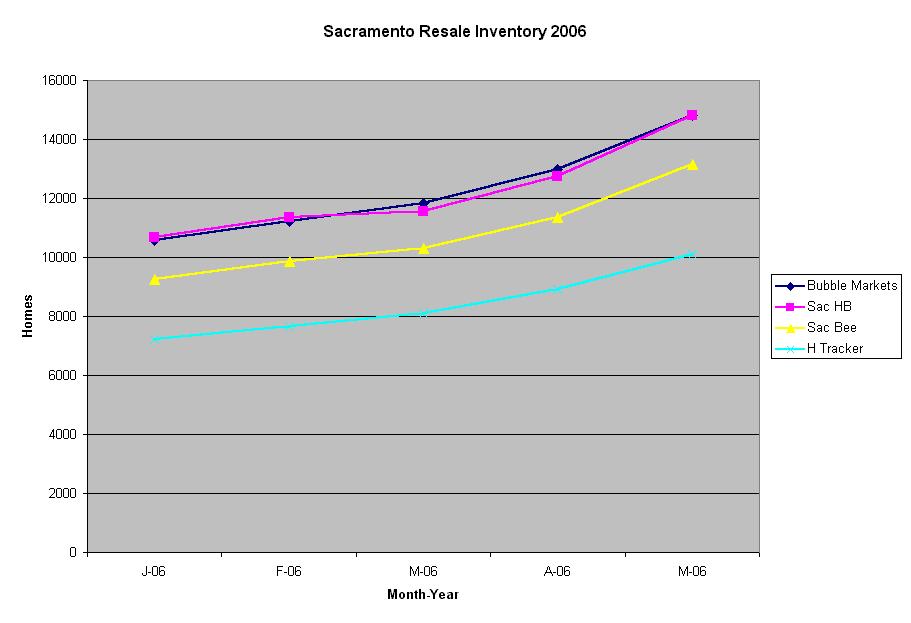
Inventory growth accelerated in May, posting the largest month-to-month gain for 2006, according to three inventory tracking sites. So far housing inventory has grown at least 47% in 2006.

Sacramento Housing Bubble:
4/30/2006: 12,754
5/31/2006: 14,822
+16% in May
+47% in 2006

Bubble Markets Inventory Tracking:
4/30/2006: 12,989
5/31/2006: 14,824
+14% in May
+47% in 2006

Housing Tracker:
5/1/2006: 8,914
6/1/2006: 10,087
+13% in May
+47% in 2006

Sacbee.com:
4/2006: 11,344
5/2006: 13,146
+16% in May
+54% in 2006
+149% in one year

(Note: The four sites use different sources for their numbers. Please see the individual sites for more information on methodology and areas of coverage.)

This graph shows housing inventory for the Sacramento housing market as reported in the Sacramento Bee since February 2005. If that's not enough inventory info for you, the Sacramento Real Estate Statistics blog breaks down the inventory data by price range.

Friday, June 02, 2006

Short Sales Return to the Sacramento Housing Market

News 10 reports on a growing trend in the Sacramento housing market.

Lenders are reporting more home owners are defaulting on their mortgages. But before those defaults turn into foreclosure, some sellers are turning to short sales -- if lenders agree.

Home owner Gloria Romero is in that position now. She bought her three-bedroom home in North Sacramento last year but has to sell it. She has listed the home for $250,000 hoping to cover her mortgage balance. Thursday she received her first offer -- $219,000. That's some $30,000 less than her mortgage.

So, Romero is turning to a short sale instead of letting the bank takeover the house. A short sale is when the lender accepts an offer that is less than the current balance. Not many lenders are accepting these negotiated transactions because it affirms the real estate market has settled from its accelerated growth that drove prices up in the first half of the decade. But for some home owners caught with having to sell their property and negative equity, it's a better alternative than having a foreclosure on their credit record.

Scott L. Williams is a realtor with Re/Max Real Estate. He says his office has gone from no short sales in seven years to nine such transactions in the last few months. "Back in the '90s, I became the short sale guru in Sacramento and did several hundred of them," Williams said.

The realtor says he's working with another home owner in Natomas who has to move and has received an offer of $399,000 for her home. That is about $60,000 less than what she owes on it. Like Romero, the home owner hopes the lender will agree to let the house sell for less than the mortgage balance or will make a counter offer.

Thursday, June 01, 2006

Nationwide Implosion?

From Forbes:

Implosion
A. Gary Shilling

This is the first nationwide housing bubble since the 1920s, and it's driven by three nationwide forces: low interest rates, loose lending practices and the desperate search for a stock substitute after the 2000--02 debacle. Previous real estate bubbles were regional, spurred by economic cycles like the rise and fall of the oil patch in the 1970s and 1980s, and southern California's aerospace leap in the late 1980s during the Reagan defense buildup, ending with the Cold War's demise....

With inventories high and sales falling, the ratio of inventory to sales flow is rising. Inventories for both new and existing homes have jumped from 3.5 months in 2003 to 5.8 months and 6 months, respectively. It is reasonable to expect those ratios to climb into the 6-to-8-month range of the real-estate-troubled early 1990s.

Already inventories since last year have jumped 91% in Boston, 236% in Miami and 149% in Los Angeles. Asking prices have been cut on one-third of listings in Boston, San Diego, Sacramento, Los Angeles and Miami. Nationwide median prices will probably fall at least 20% before the break is over. It will take a 35% fall to return prices to their long-run link to the Consumer Price Index; markets overshoot on the downside as well as the up.

Even a 20% price decline will be devastating for many homeowners. On average, those with mortgages have 37% equity in their abodes. Of those who borrowed or refinanced in 2005, 29% have zero or negative equity, calculates First American Real Estate Solutions.

A house-price collapse will be far worse than the 2000--02 bear market on Wall Street and will bring a serious global recession. Half of households own stocks or mutual funds, but 69% own homes. The resulting unemployment will kill many subprime borrowers' ability to make payments.

"The Biggest Little Housing Bubble in the World"

Awhile back, a reader e-mailed me to ask if I had any information about the Reno housing market. Certainly the Reno real estate market is closely tied to the Sacramento and Bay Area markets (think equity locust). So for Reno readers, you might be interested in a blog that I recently stumbled upon:

RENO - THE BIGGEST LITTLE HOUSING BUBBLE IN THE WORLD.
"Some would say that the Reno, Nevada Real Estate Bubble is about to burst. Let's discuss... "

Enjoy!

Sacramento Housing Starts Down 55%

The California Building Industry Association reports that single-family housing starts in the Sacramento metro area dropped 55% in April compared with the prior year. By contrast, statewide housing starts dropped 25%.

pdf report here

Sacramento Homebuilders "Slashing" Prices, Cutting Personnel

From CBS 13:

Is The Building Boom Going Bust?

Developers are not ignoring the housing glut and the rising interest rates. According to a national housing consultant, they're renegotiating land and lot purchases and in some cases even walking away from deals. Builders like Centex and D.R. Horton are not just cutting prices they're cutting personnel...

Today, the 30 year fixed mortgage hit 6.66% - a four year high. Now, builders are not just lowering prices. They're slashing them. At the Landing at Riverdale North, Beazer lopped $16,000 dollars off $425,000 dollar houses. In Folsom, more than $55,000 dollars off homes selling at $586,000 dollars...

David Garibaldi knows the buying power of patience. "By waiting a year we could have saved tens of thousands of dollars," he says. He and his wife might pay more in interest but that was offset by the enormity of the incentives and price cuts. "We really waited until prices went down to have a little leeway in the buying department," says Garibaldi.