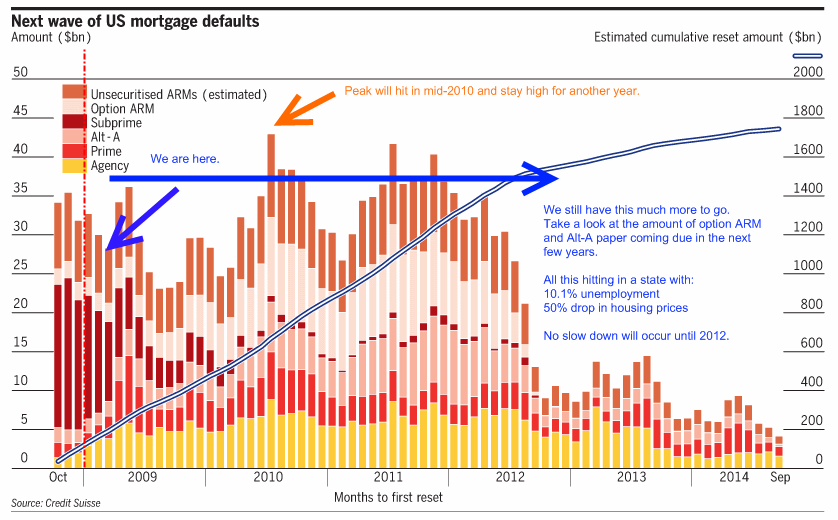
Friday, April 28, 2006

Sacramento Reduced

A commenter recently asked about price reductions in the area. Zip Realty recently reported that over 35% of listings in Sacramento have been reduced. I believe that's the highest statistic I've seen since I started this blog in January. According to Zip Realty, the Sacramento real estate market ranks #2.

What are you seeing in your neighborhood? Add your observations by clicking on the "comments" link below. I especially want to encourage those locals who have not commented before to add their input.

Thursday, April 27, 2006

More Votes of Non-Confidence in the Sacramento Housing Market

When it rains, it pours. First Beazer, now Pulte and Centex.

From MarketWatch:

Pulte Homes Inc. (PHM) Chief Executive Richard Dugas expressed cautious optimism that his home-building company will achieve its 2006 target for earnings in the range of $6 and $6.25 a share despite a sharp slowdown in demand for houses in certain markets and uncertainty in others. However, many analysts are skeptical the company will meet its goal...

Still, Dugas said market watchers shouldn't paint the entire housing industry with one broad brush as conditions vary from market to market. Hardest hit are markets that experienced huge price increases over the past two years. Dugas said markets such as Sacramento, San Diego and Northern Virginia, appear to be in the midst of a material correction where house prices are falling, cancellations are surging, traffic is slowing and incentives are up.
From SmartMoney:
Centex shares headed for the cellar, dropping more than 8% on Thursday, after the Dallas-based home builder missed quarterly earnings estimates, lowered guidance and announced it was walking away from land deals in some overheated markets...

That was underscored by a $28 million charge, representing about 14 cents a share, stemming primarily from the forfeiture of land option deposits in the Washington, D.C., San Diego and Sacramento, Calif., areas. Centex management told analysts on a conference call Thursday that although land prices aren't falling, that doesn't mean it's time to start building huge developments in those areas either. Rather, the company is trying to align better its land holdings to changing conditions in those markets.
By the way, more Sacramento Centex sales on the horizon.

Beazer Homes: Sacramento "Probably is the Toughest Market at the Moment"

Centex and Lennar are not the only builders being punished by the sinking Sacramento housing market. Now Beazer Homes singles out Sacramento as the market with the sharpest drop in new orders. In a conference call, a Beazer representative stated that Sacramento "probably is the toughest market at the moment" in the United States with "substantially reduced sales."

From Reuters:

Beazer Homes USA Inc. on Thursday reported a fiscal second-quarter profit from a year-earlier loss, but a weaker U.S. housing market pushed orders down 19 percent, prompting the company to lower its forecast and sending its shares down 4 percent.

Beazer, which sells homes largely to mortgage-rate sensitive, first-time home buyers, followed Pulte Homes Inc. and Centex Corp., who late Wednesday also reported double-digit declines in home orders as rising mortgage rates and housing prices pressured buyers. "This whole space, I thought it was bottoming out," said Keith Gangl, portfolio manager at Thrivent Investment Management. "Maybe it will take a little longer..."

Revenue, which reflects orders taken months ago, rose 30 percent to $1.27 billion, above analysts forecast of $1.19 billion. But orders for homes, which are not reflected in the revenue, fell 19.4 percent to 4,224, and were off 46.3 percent in the West. Sacramento, California, was particularly hard hit, as orders fell and cancellation rates rose.

"In a number of markets across the country, we have seen the pace of sales decline and price appreciation moderate relative to that experienced over the past several years, as evidenced by the lower net orders this quarter," Ian McCarthy, Beazer's chief executive, said in a statement.
From the press release:
Increased closings in Arizona, Colorado and Nevada were offset by a decline in California, which was particularly impacted by continued entitlement delays in Sacramento, which have led to slower than anticipated community openings, coupled with moderating demand in that market.

Net new home orders totaled 4,224 homes for the quarter, where increases in several markets in both the Southeast and Central regions were offset primarily by significantly lower new home orders in the West region. In addition, during the quarter the company experienced an increase in the rate of order cancellations from the prior year. In the West, sales declines in Arizona, California and Nevada resulted from both moderating demand and delays associated with community openings. Both of these issues were particularly pronounced in Sacramento, where new order declines were the most significant.

Wednesday, April 26, 2006

Sacramento Bee Publishes Corrections

I mentioned earlier a couple of errors that appeared in the Sacramento Bee's March housing article. This month I noticed an error in the April article. The story said:

Median sales prices, too, posted their third straight monthly gains in all but Yolo County.
This is incorrect. The median price in Sacramento, Placer, and El Dorado counties increased from the prior month in February and March, but not January. That is two straight months, not three.

Today, the Sacramento Bee published these corrections:
An April 21 story on Business Page D1 about March regional home sales and prices incorrectly stated the number of months in a row that median prices rose in Sacramento, Placer and El Dorado counties. Prices rose two months in a row. A March 17 story about February sales and prices on Business Page D1 also incorrectly noted a "continued upward momentum" for median prices in Sacramento, Yolo, Placer and El Dorado counties since October and November. Prices in all four counties fell at least once after those months. The story also should have said that February's regional sales fell by 30 percent over the same month a year earlier.
I really hope I don't have to play the role of the nag again in May.

Tuesday, April 25, 2006

March 2006 Median Price: Appreciation Continues Descent

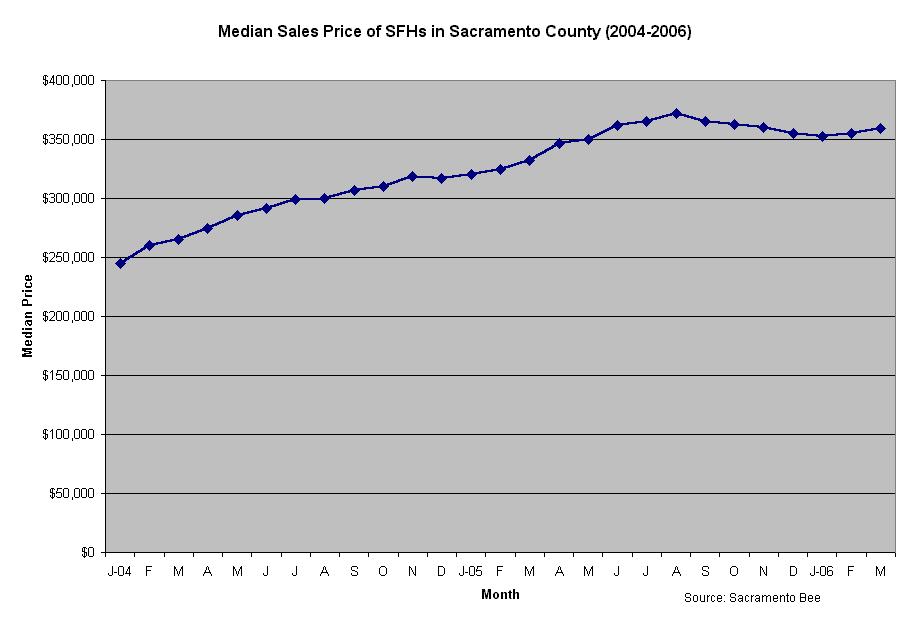
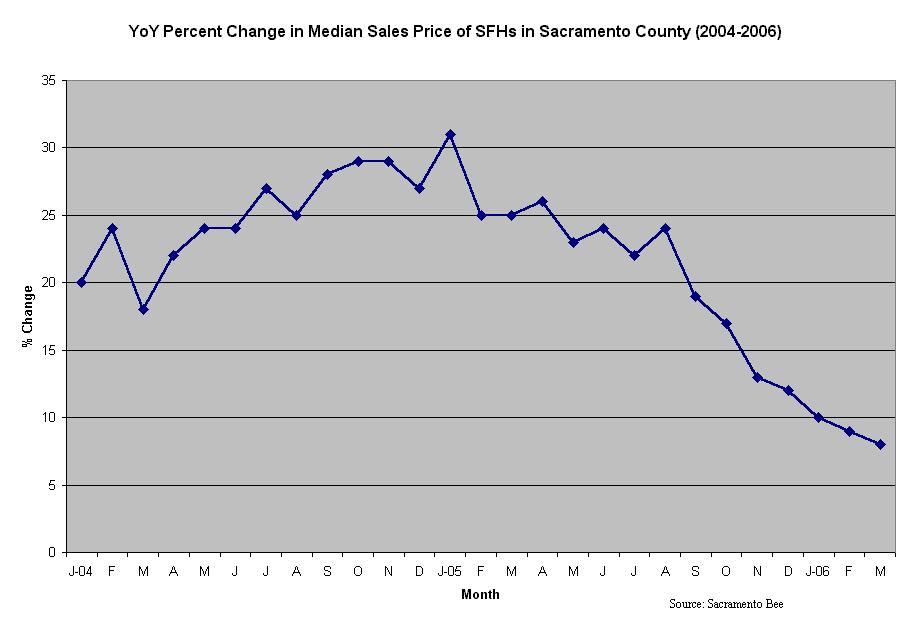
These graphs measure the median sales price of existing single-family homes in Sacramento County only. Click on any graph to enlarge it.

The first graph shows the percent change in price over the prior year. The time period is from January 2004 to March 2006. Appreciation has been slowing for seven consecutive months.


The second graph shows prices between January 2004 and March 2006.

Return to Home

The Waiting Game

The Sacramento new homes incentive parade continues. At last glance, this West Sacramento condo complex was offering free appliances and window coverings.

"The response to the free appliances and window coverings has been great," said Scott Bolli, director of sales for Pacific West Cos., an award-winning residential development company. "Riva already has so much to offer, and now you can get even more. But we're not sure how long this offer will last."
Apparently, the response was so great that Riva is now offering up to $50,000 discounts (and free two-tone paint!)
Riva, a community of attached homes in the Southport district of West Sacramento, will hold its second-phase grand opening today and Sunday with as much as $50,000 off some homes, special financing and other incentives."I don't think there's a better offer anywhere in or near Southport," said Scott Bolli, director of sales for Pacific West Cos. "I know some people have been waiting for the right time. Well, this is the right time. We've never offered so much for so little."
And this condo complex in Elk Grove wants to reward reluctant buyers "big time."
Jasmine, a community of attached homes in Elk Grove, will hold a special spring celebration with as much as $50,000 off some homes, as well as special financing and other incentives. "When we say this is a special celebration, we really mean it," said Scott Bolli, director of sales for Pacific West Cos., a residential development company. "We've never offered so much. If you've been waiting, it's paid off, big time."
Wow! I wonder what the payoff will be if one waits even longer!

Sunday, April 23, 2006

Regional Housing Sites

Thanks to the Bubblemeter and Sonoma Housing Bubble blogs and for bringing these two blogs to my attention:

Also, Southern California has a new housing blog: What Bubble?

For those in the far north of California, Humboldt State University has a site with a lot of good real estate data and graphs for Humboldt County.

Finally, Bubbletown News gathers headlines from regional and national housing blogs into one place.

Real Estate Broker: Time to Sell


What do real estate industry insiders really think about the current Sacramento housing market? This Q&A in the Sacramento Bee sheds some light:
Q: I'm 59 years old and own a property management company. I'm not looking to retire for another eight to 10 years. I own a duplex (two cottages on one parcel) that was purchased in 1993 for $170,000. It's now worth approximately $485,000.

My tax accountant, who also owns a real estate brokerage firm, is advising me to sell the duplex now and stockpile the cash (estimated at about $170,000 after having to pay $118,000 in capital gains taxes). His rationale is that cash will be king when the real estate market goes down, as it always does, and foreclosed properties will be purchased as a deal for those who have cash.

Is paying $118,000 in capital gains taxes worth it to get cash now?

- Linda, Sacramento

A: You are in the property management business but expect me to know what's going to happen to real estate values over the next few years?

Asset prices move by the psychology of the people making up the market as anything else. After all, your duplex has more than doubled in value over the past five years, not because rents have doubled, but because people were willing to pay more today than they used to. Why? This is a good question for any real estate investor to ponder.

Is there a chance real estate prices will fall? Sure. Price declines in the near future might be more likely than price increases. Only time will tell.

There are clearly times when it makes sense to sell an investment, pay the taxes and move on. This may be one of those times for you. You should never let tax consequences dictate your investments. I recall all too vividly those in the late '90s who wouldn't sell their stock because they didn't want to pay capital gains. In retrospect, a capital gain would have been much better than a capital loss.

If you sell your rental, you need to remember that you may be wrong and prices might continue to climb, or at least not fall. If that is the case, you need to be in a position to deal with that financially.

Saturday, April 22, 2006

"Property Values are Going Down, Down, Down"

A reader sent in a link to this Sacramento Craigslist ad:

MARKET SOFT AND YOUR HOME SITS EMPTY?

YOUR HOME DOES NOT HAVE TO SIT EMPTY, EVEN WITH THIS SOFT MARKET. YOU CAN GET GUARANTEED RENT WITH A LEASE OPTION TO PURCHASE AND HAVE YOUR HOME SOLD AT THE END OF THE LEASE TERM.

NO COMMISSIONS TO PAY, NO LANDLORD HEADACHES, GUARANTEED RENT FOR THE DURATION OF THE LEASE, AND NO MONTHLY FEES.

PROPERTY VALUES ARE GOING DOWN, DOWN,DOWN. STOP YOUR INVESTMENT LOSS BY OPTING TO PLACE YOUR PROPERTY INTO A "LEASE WITH OPTION TO PURCHASE" AND GET A FIXED PRICE NOW, BEFORE THE PRICES DROP FURTHER...

SAVE YOUR INVESTMENT PROPERTY BEFORE MARKET PRICES DROP FURTHER.

March 2006 Sales: 12th Straight Month of Negative Sales Volume Change

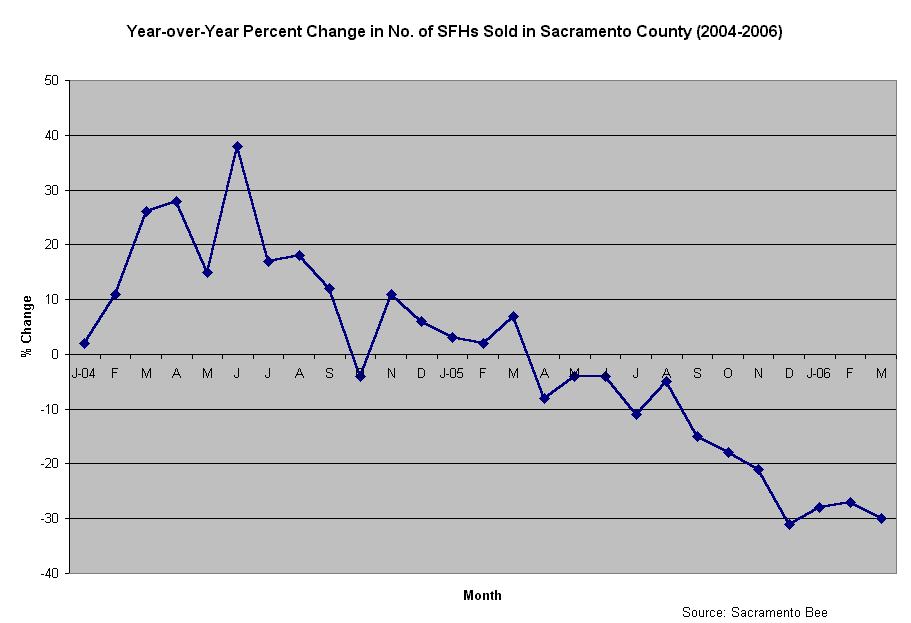
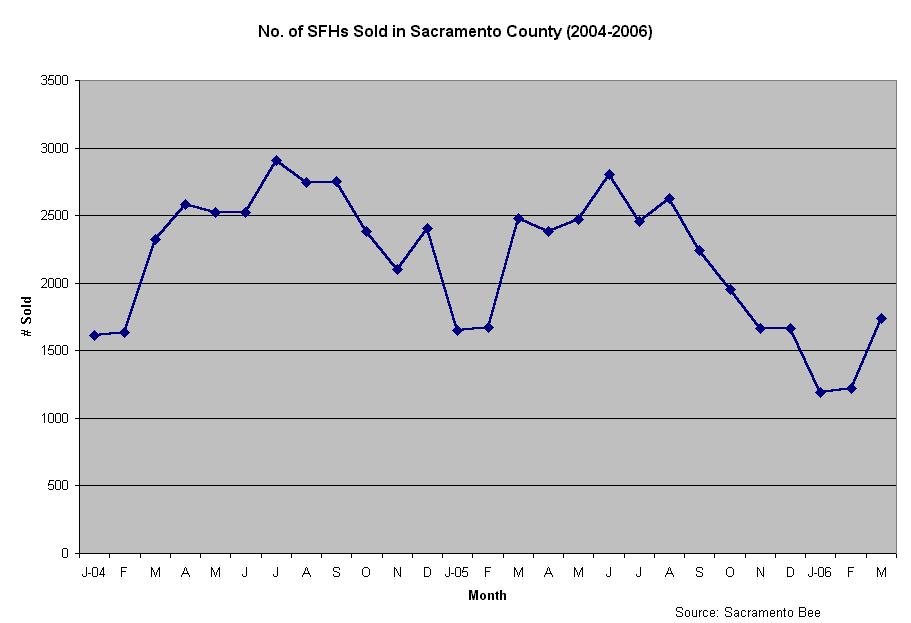
These three graphs show sales of existing single-family homes in Sacramento County only. Click on any graph to enlarge it.

The first graph shows the year-over-year percent change in the number of homes sold. March marked the 12th straight negative month.


This next graph compares the number of monthly home sales in 2004, 2005, and 2006.


The last graph shows the number of homes sold between January 2004 and March 2006.

Return to Home

Friday, April 21, 2006

Sacramento Rents "Stagnant" for 3rd Straight Year

A trio of articles about renting in the Central Valley.

From the Sacramento Bee:

Region's rental market stagnant for a third year

Once again, it's still a renter's market. But just how long that continues is now open for debate. For the third year in a row, rents in El Dorado, Placer, Sacramento and Yolo counties have remained largely unchanged, rising in the past 12 months just $13 to an average of $929, a new landlord survey shows. From the first quarter of 2004 to the same period of 2006, average capital-area rents have increased only 3.1 percent, according to the survey.

What's good news, though, for the 35 percent of the region's population that rents is hard on investors who normally bank on increases of 5 percent to 6 percent a year. "It's kind of flat. It's kind of anemic," said Chris Bates, spokesman for Novato-based RealFacts, which analyzes rental markets for the apartment industry.

The Sacramento area's slim rise in rents contrasts with those in other regions around the state and in the West. Average rents in Riverside and San Bernardino counties rose 7.3 percent in the past year to lead the state. Rents in Los Angeles, Phoenix and Las Vegas jumped at least 6 percent.

The RealFacts analysis of apartment communities in the four-county Sacramento region shows first-quarter 2006 rents edged up $3 from the fourth quarter of 2005. The average occupancy rate, too, largely was unchanged at 92.7 percent, compared to 92.8 percent at the end of last year.

Typically, apartment owners prefer an occupancy rate of 95 percent to 96 percent. In early 2001, area landlords were clearly in the driver's seat with 97.7 percent occupancy rates, according to RealFacts.

From the Stockton Record:
The San Joaquin County housing market has seen some fluctuations since last summer, but the apartments scene continues to hold steady. Occupancy is high and rents are up just slightly year to year in the county, according to a first-quarter report from RealFacts, a Novato real estate firm that tracks the apartments market. The new report said apartment rents in San Joaquin County averaged $840 in the first quarter of this year. That was up 2.6 percent from the first quarter of 2005.Occupancy rose 1.4 percent year-to-year, to 94.4 percent.

RealFacts spokesman Chris Bates that's pretty good for apartment-complex owners but not enough leverage to give them room to be more aggressive in raising rents because renters do have some choices. Owners like to see higher annual rent-increase rates, in at least the 5 to 6 percent range, he said.

Housing prices have softened in recent months, but they still have reached high enough levels that many people are priced out of the market, especially with rising interest rates, said Thomas, who is based in Stockton.
From ABC30 in Fresno:
Despite a cooldown, prices in the housing market are still driving many people away from the American dream of home ownership. Now, even renting is costing more. It's the best option for people who can't afford or are waiting to buy a home, but renting an apartment is becoming more difficult. Three years ago, a two bedroom apartment in a Clovis complex rented for $350 a month. Today, the same remodeled units are pushing $700 to $800 a month.

"I have had people say that they're looking for homes, but then they come back and tell me, 'My God, Todd, my house payment's going to be this much money, i can't afford that.' So they're finding out that maybe they're just going to sit tight," said apartment complex owner Todd Wolfe...

Local realtors say they're finding some people who are selling their homes and moving into apartments temporarily, while the real estate market levels off.

Appreciation at Lowest Level since June 2000, "For Sale" Sign Business Booming

The latest from the Sacramento Bee.

In the newest indicator that the region's long red-hot frenzy cycle has ended, year-over-year price appreciation dipped into the single digits in all but El Dorado County. There, March sales prices remained 13 percent above the same time a year ago, while Placer County prices were 6 percent higher than March 2005, according to DataQuick.

March sales prices in Sacramento and Yolo counties were still 8 percent higher than the same time last year. But for Sacramento County, the largest player in the region's real estate market, 8 percent was the lowest year-to-year gain since June 2000 vs. June 1999...

"My guys are telling me we are building 30 to 40 new signs a day," said Jim Eggleston, owner of The Sign Post, a Sacramento firm that builds front yard "For Sale" signposts for the region's real estate listings. "Where it's going is the big question," Eggleston said. "Are we going to reach 15,000? Are we going to reach 20,000? I don't know."

Thursday, April 20, 2006

Sacramento Region Sales Volume Change

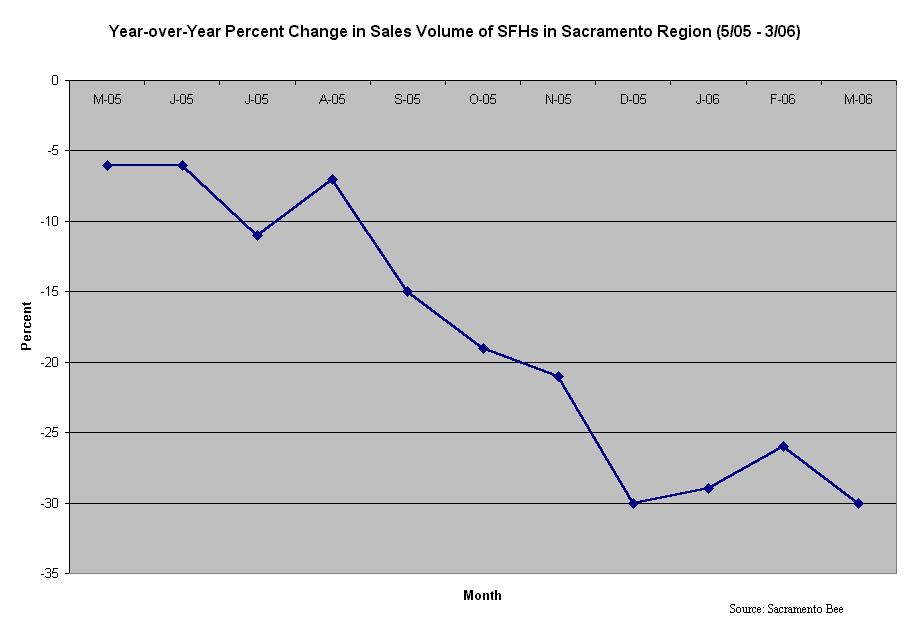
(Click to Enlarge)

This graph shows the year-over-year percent change in sales volume of existing single-family homes in the Sacramento Region from May 2005 to March 2006. The "Sacramento Region" includes Sacramento, Placer, El Dorado, and Yolo counties.

Dataquick: All Eyes on the Sacramento Market, Weakest March Since 1999

Sacbee.com has some March Dataquick statistics. The extended print edition should give more details tomorrow.

Sales of existing homes in the Sacramento metropolitan area jumped sharply in March from February levels, but the sales of 2,489 homes across four counties were still the lowest for a March since 1999.

Buying in the four-county region was off 29.5 percent in March 2006 from the same month in 2005, according to La Jolla-based DataQuick Information Systems. That's a far steeper drop than in most of the state's major urban counties, the firm reported. Elsewhere in California, March year-to-year dips in the number of sales ranged from 17 percent in San Diego County to 12 percent in Contra Costa County.

"Last year all eyes were on San Diego, and what we're noticing now is people are watching Sacramento just as closely to see if the market can really pull off this soft landing," said DataQuick analyst Andrew LePage.
I was wondering what happened to Andrew LePage, who was the long-time housing journalist for the Sacramento Bee. Looks like DataQuick snagged him.

The number of homes for sale in Sacramento, Yolo, El Dorado and Placer counties also continued to swell in March, reaching 10,316 compared to 3,799 the same time in 2004, according to Sacramento-based TrendGraphix...

Tuesday, April 18, 2006

Builders Step on the Brakes, Permits Fall "Dramatically" in March

From the Sacramento Bee:

Permits to build more new homes in the Sacramento area fell dramatically in March from the same time a year ago, many of the region's fastest-growing cities reported Tuesday. The reports, which often are an indicator of builder confidence in the housing market, mirrored a similar slowdown across the West, the U.S. Department of Commerce said Tuesday...

Roseville officials attributed their dip to holding up permits while waiting for infrastructure improvements in the city's growth areas. Lincoln officials said their decline may reflect the winding down of Sun City Lincoln Hills. In Elk Grove, part of the decline comes from last month's lack of multifamily permits after the city issued permits for 192 apartments in March 2005.

Whatever the reasons, builders in El Dorado, Placer, Sacramento and Yolo counties clearly stepped on the brakes in a housing market that is down from its 2003 peak of nearly 23,000 permits and has slowed more since last summer. Along with wet March weather, builders are contending with 30-year mortgage rates that reached a near four-year high of 6.49 percent last week and a growing inventory of unsold existing homes...

Last year, builders in the four-county Sacramento region were issued permits for 15,630 homes and 2,863 apartments and condos.

Chart at the bottom:

Lincoln
3/2005: 186
3/2006: 105

Roseville
3/2005: 121
3/2006: 39

West Sacramento
3/2005: 124
3/2006: 21

Elk Grove
3/2005: 495
3/2006: 30

Rancho Cordova
3/2005: 50
3/2006: 14

Toll Brothers Gets Cheesy, Centex Mum on Sales Results of "12-hour" Sales

Apparently, Sacramento is not the only market in the country with a glut of housing inventory. The AP reports on record national inventory and marketing ploys by homebuilders.

Spring is typically the busiest time of the year for home sales. But with mortgage rates rising and sales slowing, sellers find they have to work harder to get a sale.

In February, there were 3.03 million previously owned homes for sale, a level not seen since 1991, when 1.91 million homes were up for sale, according to the National Association of Realtors.

"Business is tough. The inventory of available properties has increased," said Martin Bouma, an Ann Arbor real estate agent. "You are looking at (the number of) buyers going down, and inventory is going up."

Some incentives offered by sellers include a year's worth of free landscaping or lawn care, free snow removal for a year or a year's worth of alarm service. And, that's just from the owners of existing homes - builders sitting on a mound of inventory have also had to come up with new ways of wooing buyers...

While some homes can be taken off the market place by their owners, home builders cannot afford to hold on to empty homes. So, some have offered their own incentives, such as helping to pay mortgage closing costs or upgrading kitchen appliances...

Dallas-based Centex Corp., meanwhile, has kicked off a series of 12-hour sales in Seattle, Las Vegas, Houston and Denver, among other markets. In Sacramento, Calif., Centex lopped off $100,000 from some multimillion dollar homes.

Centex likens its sales to a retailer clearing unsold inventory off shelves. A spokesman for the firm, Neil Devory, said the 12-hour sales have "tremendously increased traffic," but he would not disclose exactly how many sales actually resulted from the promotions. "We had significant numbers of contracts and reservations," Devory said.

At the same time, Toll Brothers' push to get customers across the threshold is a little more subtle, but just as persistent. Kira McCarron, the Horsham, Pa.-based home builder's chief marketing officer, said the company relies on print, Internet and some television and radio advertising.

But, what's going on at the model homes is what's different. "A message is crafted for each location," said McCarron. "We pick a hypothetical family or a couple we envision this home will be designed for."

For example, a refrigerator magnet in a Toll Brothers home may have a message to a fictitious family member about a relative that has to be picked up at a train station, demonstrating that mass transit is nearby. Or, a school jersey hung in a bedroom of the model home serves as a reminder of a good school district.

In addition to personal notes and school jerseys, Toll Brothers' marketing involves staging Easter egg hunts, Halloween parades as well as charity events or PTA meetings - another reminder of a neighborhood's school system - within a development. "We want them to feel emotionally connected to a place," said McCarron.

But aside from special events and upgrades to kitchen appliances, the single factor determining whether a home attracts buyers likely will be its price. "You can have the biggest circus on the street, but it comes down to price and having the right price," said Bouma.

Monday, April 17, 2006

"Low-Earning Realtor Wants Steady Job"

Ask Ella: Low-Earning Realtor Wants Steady Job

Dear Ella,

I have been a full-time Realtor for the past eight years.

Prior to real estate, I was a highly regarded administrative assistant, which is what I hope to return to doing.

Due to a less-than-desirable real estate market, my earnings will not impress an interviewer unfamiliar with the tough nature of the business.

Being a Realtor is not easy; we are not paid until a home is sold. Often we spend money, time and effort only to have our potential clients walk away simply because they changed their minds.

In my mind I would be a fabulous candidate for any employer. I worked extremely long hours and have been creative, energetic, positive and fun, even in a down market. I stayed motivated and positive and received little to no financial compensation. Imagine how grateful and hardworking I would be if I were earning a regular paycheck.

How do I convey how valuable I could be to a company? How can I get them to see me as a great asset rather than a gamble? How do I get a potential employer to understand that I'm grateful for all that I've learned as a Realtor but am more than ready to leave this profession behind to give my new career 110 percent?
More

Placer Inventory at Highest Level Since at Least 1997

The Sacramento Business Journal has some March MLS data for the Placer County housing market.

The association also reported more than 2,210 homes were on the market, more than double the figure in March 2005. The county has the most homes on the market since January 1997, the oldest historical data released, and the fourth month to top 2,000 homes in the past seven months.

The listing service reported 389 existing homes sold last month in the county, much better than the 245 homes each in January and February, but far from the 507 in March 2005 -- and the slowest for that month in three years.

Sacramento Homeowners Party like it's 2004?

From the Sacramento Bee:

After four years in which Sacramento-area homeowners greatly expanded their spending by borrowing almost $22 billion against soaring home values, lenders believe there's plenty more coming - even with rising interest rates and a plateau in home prices.

While years of double-digit percentage growth for home equity loans has slowed slightly, bankers, pool contractors and home remodelers say the spending binge fueled by home equity appears on firm ground to continue in 2006. "Compared to the last few years, it's slower than it has been, but it's still relatively strong," said Sandy Thompson, Sacramento district manager of Minneapolis-based US Bank.

Thousands of area businesses and a regional economy have prospered as homeowners lavished their rising equity-based wealth on home remodeling, swimming pools, motorcycles, boats, cars and colleges. Many economists say the surge of consumer spending is closely tied to rising home values and worry that falling values could trigger the opposite.

Since 2002, more than 300,000 homeowners in Sacramento, El Dorado, Placer and Yolo counties have borrowed or opened equity-based lines of credit for $21.9 billion, according to La Jolla-based DataQuick Information Systems...

In Woodland, DeJong said customers who spent $2,000 to $4,000 for countertops five years ago now tap home equity to spend $10,000 to $15,000. "There's still a lot of money in this region," he said. "You'd just be surprised what people spend."

Saturday, April 15, 2006

Sacramento Inventory Tops November High-Water Mark

Existing home inventory in the Sacramento housing market now exceeds the high-water mark reached in November 2005, according to all three inventory tracking sites. Welcome to spring!

Sacramento Housing Bubble
11/15/2005: 12,004
4/15/2006: 12,011

Bubble Markets Inventory Tracking
11/10/2005: 11,980
4/14/2006: 12,198

Housing Tracker
11/14/2005: 8,286
04/14/2006: 8,334

Local Closeup: Davis Inventory

Commenter Fishtaco sent in this chart that shows Davis MLS inventory since the end of January. The data is derived from the Sacbee website using all prices ranges with no limits (no land or multiplexes). "From the open houses I have been to realtors have said the listings are up anywhere from 70-100% YOY."

Feel free to submit information about your local housing market. Photos, graphs, or observations are much appreciated.

Friday, April 14, 2006

Buyers: WE'RE NOT GONNA TAKE IT ANYMORE!

A few months ago, Sacramento real estate agent Jimmy Castro urged "investors" not to "dump" their properties. Now he has shifted tactics and is addressing potential buyers:

For today's home buyer, the question will come up at some point -- should I wait to purchase? Will the home prices drop? Will they escalate more? Will interest rates increase?

These are all very valid concerns, so I'm not going to waive them off, point to historic appreciation of real estate overall, and tell such a buyer to just dive in. Nevertheless, there are several other reasons why the ownership of real estate, despite the market, is a wise move. [Read more]
Perhaps many potential buyers have deaf ears like this man:
For months, Los Angeles-based aerospace consultant Doug Roberts has stewed over a real estate deal that went sour last November. It was bad enough that the seller first accepted but then rejected his full-price offer of $699,000 for the modest three-bedroom house near the airport, Roberts says, but even worse that the busy Realtor he was working with took three weeks to call him back to break the bad news.

"I was in limbo for almost a month, not knowing whether I had a deal or not," Roberts says. "The seller was a real jerk, and the agent wasn't any better."

But Roberts' anger turned into laughter last week, when the same Realtor he finally fired last December called to say that the previous deal with the other buyer had fallen apart and the house is now back on the market -- for $50,000 less than he offered to pay last fall.

Despite the price reduction, Roberts isn't biting. "I told the Realtor to get lost, and I told her to tell the seller the same thing," he says. "They treated me like garbage when the market was strong, but now it's a different story that sales are tanking.

"A year from now, that same house is probably going to be worth $200,000 less and the agent will be working at McDonalds."

Thursday, April 13, 2006

ARMed and in Danger

A Sacramento Bee columnist looks at the impending ARM implosion.

Home ownership: It's the American dream. But thousands of homebuyers who have taken a giant leap to achieve that goal may be on the brink of a financial disaster. The reason? The Federal Reserve has raised interest rates 15 times since 2004 and it still might not be finished. As a result, those with adjustable-rate mortgages or other cut-rate mortgages soon will be seeing significant increases in their monthly payments.

Financial adviser Gary Webb says homebuyers who barely qualified for adjustable-rate, interest-only mortgages are the most troubled. Webb, owner of Webb Financial Group in Bloomington, Minn., says many new homebuyers had "budgets that were so snug to begin with, there's no wiggle room. As a result, as interest rates rise, some likely will lose their homes," he warns. "It's happening now and it will happen even more in the future as the Fed continues to raise rates a quarter point at a time," he adds.

Mike McGee, owner of Winchester McGee Financial in Rancho Cordova, says many people who couldn't qualify for a fixed-rate loan took out ARMs and other low-rate mortgages "simply to keep their monthly payment affordable." McGee says many low-rate loans were fixed for a set period of time, say three to seven years, but then were due to be adjusted upward. "When that happens, there's certain to be some real sticker shock," he says. He advises homeowners facing higher payments to figure out what they can do to absorb the increase. "Right now," he says, "a lot of people are coming back to me asking for a 30-year, fixed-rate mortgage."

Greg McBride, senior financial analyst with Bankrate.com, monitors interest rate movements daily and he sees nothing but trouble ahead for many with adjustable-rate mortgages, or ARMs. "If you have an ARM and you haven't been caught yet, you are about to be," he says. "And it could be very expensive." How bad can it be? McBride says that if you took out a $200,000, interest-only mortgage three years ago when some interest rates were less than 4 percent, your monthly payment could be close to doubling in the not-too-distant future...

Webb, who's been in the financial services business for nine years, says that while refinancing is an option, many homeowners can't afford to take on the average 30-year, fixed-rate mortgage at 6.0 percent. "If that's the case, they have limited options," he says. "They can cut their expenses or ask for help from family and friends."

Wednesday, April 12, 2006

Wall Street Journal: Sacramento Leads California in Sales Decline

Is the Sacramento housing market the weakest real estate market in California? The Wall Street Journal has this tidbit:

Many cities that experienced fast run-ups in home prices during the past five years are now seeing sales cool the fastest. Homes that just last year were selling so rapidly that they stayed on the market for just days or even hours -- condominiums on the Florida coastline, desert haciendas in California and Arizona, town houses in Washington, D.C. -- are now languishing without buyers or even prospects. Many once-booming markets are seeing double-digit declines in sales.

Home sales have been slowing for several months, but real-estate agents in some of these formerly red-hot markets have been surprised at how suddenly market conditions have deteriorated in the past few months.

The Florida Association of Realtors reported recently that sales of existing single-family homes were down about 20% in February when compared to the same month a year ago -- and they were off as much as 47% in Naples. In California, sales dropped 15% in February compared with last year, led by a 30% decline in Sacramento, according to the California Association of Realtors. February sales were off year over year by about 19% in Washington, D.C., and down about 25% in and around Phoenix.
Tip of the hat to Ben Jones.

Tuesday, April 11, 2006

David Lereah, Whoopee Cushions, and Other Tidbits

Follow the verbal gymnastics of David Lereah (chief economist of the National Association of Realtors) at the David Lereah Watch blog. Brought to you by the Bubble Meter blogger.

Speaking of David Lereah, NPR recently had a piece in which the housing market was compared to a whoopee cushion. Can't say I've heard that one before!

Yesterday, NPR had a segment on the housing market, spotlighting rising inventory and the situation in Boston. The report mentions that the country has seen an extraordinary 35% increase in unsold inventory over the last year. (By comparison, Sacramento has seen an increase of 175+%).

Nitricacid.blogspot.com often posts interesting information about the Sacramento housing market. The latest is a Google Earth file of all the for sale listings in Sacramento County.

The Marin Real Estate Bubble blog continues to produce thought-provoking posts like this. And BubbleTrack asks "What The Heck Is A Soft Landing, Anyway?"

Monday, April 10, 2006

Lunch Truck "Glory Days" Over?

The economic impact of a slumping housing market is not limited to just the mortgage and construction industries. The Stockton Record reports on big troubles in the lunch truck business.

It is not without irony that the horn on Miquel Vasquez's catering wagon plays "First Call," the trumpet theme that calls racetrack horses to the starting gate. Vasquez makes a number of daily weekday stops at construction areas in San Joaquin County. But home-building activity has declined since last summer as a result of a drop in buyer demand as well as unusually rainy weather in recent weeks, and his number of potential customers has plunged likewise. That leaves him and more than a few competitors jockeying for position to find customers.

One recent lunch hour, he and partner Manuel Gomez found themselves at a corner of the once-bustling Mossdale Landing development, west of Interstate 5 in Lathrop, battling it out for workers looking for a quick meal. As he chatted about how much business had slid, a competitor pulled her truck up just feet from his catering wagon, stopped in the middle of the quiet street and flipped open a side awning, just in case some workers might saunter up for lunch.

"See, this is the problem," he said in exasperation. "Too many people stop to sell food, and business is very slow." Other catering-truck owners sang the same song, bemoaning slow business after a good run last year...

Vasquez quit his Bay Area job driving a garbage truck to start his mobile catering business a year and a half ago. Now, he said, customer traffic has been so slow of late that he wonders how he and his partner will make it. Sales are down about half, he estimated...Some days, they lose money. "I'm hoping, because it's my own business, we can make it, because I'm trying to do something for myself," Vasquez said. "I just want to be able to survive, even if I'm not making a lot of money, not getting rich. I think it may be over, but I'm not losing hope..."

Celia Martinez, who works a catering truck that patrols Mossdale Landing, said the change has been startling. Her job is hard work, she said, but business used to be so good. "Right now, all the construction is very slow," she said after fixing hot meals for only a few customers during a recent lunch hour. "A year and a half ago, business was very good. Then a year ago, the other trucks came - fast. I counted seven out here the other day..." Martinez estimated that on a good day, business is down by at least one-fourth. She, like other food vendors, hopes construction and the weather both will take a turn for the better and at least start returning to the glory days...

Jesus Maldonado bought his catering wagon two months ago, so he didn't even see last year's boom time. But he wanted to stop commuting to an East Bay truck-driving job and was hoping for the best as he set up stops in north Stockton construction areas. "It's been OK," he said. "I'm afraid it won't be good."

Going Underwater?

A reader sent in these photos of Stockton (overvalued by 80%). Feel free to send in photos that give us a flavor of your local housing market. You can find my e-mail address here.


Saturday, April 08, 2006

New Home Appreciation at 0.3%

After years of rapid appreciation, the year-over-year median net price for a new home rose a paltry 0.3%, according to the Sacramento Bee. Soft landing or hard?

Regionwide, a new home's median net price, which takes into account discounts and incentives offered by developers, rose to $484,147 for the quarter, $1,483 - or 0.3 percent - higher than a year earlier.

In some communities, median prices - the point at which half of the homes sold for more and half for less - actually dropped substantially. In Folsom and Lincoln, for instance, median prices of new homes during the first three months of 2006 were down 9.4 percent and 4.1 percent, respectively, over the first quarter of 2005...

A new home is now on the market for an average of 12 weeks, according to the Gregory figures...[U]nsold home inventory grew for the fourth straight quarter.

Catherine Munsee, manager of information services for the Gregory Group, said that developers may not be getting premium prices for new properties because, after the region's long building boom, there are now plenty of attractive almost-new homes on the market. "We're talking 1-to 3-year-old homes that are competing with new home products," she said.

Friday, April 07, 2006

Sacramento New Home Sales Hammered: Sacramento Down 59%, Yuba Down 93%

New home sales continue to be the leading indicator of a declining market here in Sacramento. Are any other overheated markets out there experiencing such sharp drops?

Regional YOY Sales Volume Down 57% for 1st Quarter:

New-home sales were 57 percent lower in the first quarter of this year than the first three months of 2005, extending the trend of a cooler market that began last year...

Homebuilders in Sacramento, Yolo, Placer, El Dorado, Sutter and Yuba counties sold 2,081 homes from January through March 2006, compared to 4,812 in the same three months last year, said Greg Paquin. He owns The Gregory Group, a local company that analyzes the market...

Sacramento County saw a 58.6 percent decline, from 2,660 to 1,101, with larger drops in Elk Grove and Natomas but increased sales in Folsom. Yuba County saw the sharpest percentage drop, down 92.8 percent in a year from 497 sales in first-quarter 2005 to 36 in the first three months of this year...

The conventional observation is that the sales downturn is partly the result of rising home prices, along with escalating interest rates. But the mix of bad weather, slow processing of land for development and news reports on declining sales are putting a damper on deals, said Brendan O'Neill, executive vice president of operations for Beazer Homes in the Sacramento area.
Incentives Triple & Discounts Noted:
The decline has builders sweetening incentives, which nearly tripled from early 2005 to the first part of this year...

Builders are feeling a bit pressed, however. They are increasing incentive gifts to make deals. Paquin said the average concession in the quarter was $10,465, compared to $7,207 in the fourth quarter and $3,600 in the first quarter of last year. More builders are cutting prices too, he added.
Construction Activity Drops:
Declining home sales were responsible for a simultaneous drop in the overall construction volume for the region. New homes had been the main force in the building market since 2002...

Meanwhile, overall construction in the region has dropped this year. During January and February, the most recent data available, the value of building permits issued in Sacramento, Yolo, El Dorado and Placer counties was $576 million, down from $726 million for the same period last year, according to the Construction Industry Research Board.

Thursday, April 06, 2006

Say Goodbye to Cat Odor, No Rush to Buy in Redding

More on the Redding housing market from the Redding Record Searchlight.

It wasn't too long ago that many homes in Shasta County would sell within a day after hitting the market. For the most part, those days are history.

Home sales have declined on a year-to-year basis for five straight months, the number of listings on the market has nearly doubled from a year ago and the rate of appreciation is slowing. It adds up to a market that has emboldened buyers. For the first time in years, they have the power to negotiate.

"Sellers tend to jump on the bandwagon late. They still want to believe it's a sellers' market, but it's really kind of level playing field," said Greg Lloyd, board president for Shasta Association of Realtors...

Holden Lewis of Bankrate.com said sellers need to have tempered expectations. "As a seller, you have to be prepared to be disappointed because you're not getting the kind of appreciation that people were getting a year ago," Lewis said...

Ron Largent, a real estate agent with Keller Williams in Redding, recently asked an agent to evaluate a house that had been on the market for a while. The agent was greeted at the door by a cat. When he walked in the house, it smelled like cat. A year ago, when it was a sellers' market, somebody looking at that house might have shrugged off the cat odor -- nothing a bottle of Pine-Sol couldn't eliminate. Today, "you're not going [to] get beyond the front door with a person who doesn't like cats," Largent said.

With an abundance of homes on the market in Shasta County, when compared with a year ago, sellers have to be more creative to leave an impression. Chicago author Mark Nash, who wrote "1001 Tips for Buying and Selling a Home," said having food and refreshments available at an open house could encourage buyers to browse longer. Coffee and bottled water are simple pick-me-ups that would-be buyers will appreciate, Nash added.

Buyers shouldn't feel rushed to make a decision.

"A year ago, or even last summer, a buyer had a price range and you drove around and showed them two houses. When you got back to the office, you'd ask them to make a decision because both homes might be gone," Lloyd said. "Now it's back to the point where we (real estate agents) don't have to sound like used-car salesmen."

March Roundup: Inventory Continues to Rise; Price "Rally" Declared

Inventory continued to flow into the Sacramento housing market in March 2006, according to three tracking blogs. (Note: The three sites use different sources for their numbers. Please see the individual sites for more information on methodology and areas of coverage.)

Sacramento Housing Bubble:
2/28/2006: 11,345
3/31/2006: 11,555
+1.9% in March
+14.8% in 2006

Bubble Markets Inventory Tracking:
2/28/2006: 11,215
3/31/2006: 11,833
+5.5% in March
+17.4% in 2006

Housing Tracker:
03/01/2006: 7,663
04/01/2006: 8,103
+ 5.7% in March
+18.2% in 2006

On the other end of the blogosphere, the Sacramento Real Estate blog declares a price "rally" for Sacramento County. According to the agent/blogger, both the median and average home sale prices increased in March.

Wednesday, April 05, 2006

When Will the Rain Stop in Sacramento?

The most entertaining thing about having a blog is seeing what search terms people use to find your blog. Last night, someone typed this into Google: when will rain stop Sacramento. I guess Google is now God.

Yes, it has been raining a lot here in Sacramento. With the rain comes talk of flooding and breaking levees. The media has had several stories lately about the inadequacies of the levee systems that surround the region. Yes, Bay Area investors, Sacramento has "levees," as in New Orleans/Hurricane Katrina levees.

Here are a few headlines of late dealing with housing and levees:

Tempting fate: Betting the houses, Yuba OKs floodplain units to pay for levee repairs
Tempting fate: Living on the edge, W. Sac levees less secure than advertised
Tempting fate: Sutter boom forges ahead
Tempting fate: Are we next? Sacramento's flood peril is highest in U.S.
Natomas flood safety disputed, New studies suggest area lacks minimal level of protection
Developers immune from flood liability

PMI on Sacramento: 58% Risk of Home Price Declines

PMI Mortgage Insurance Co. released the results of their latest risk study:

"Fourteen of the top 50 MSAs now have risk scores above 500, meaning they face a 50 percent or greater risk of home price declines in the next two years, up from 11 MSAs last quarter."

  1. San Diego-Carlsbad-San Marcos, CA (598)
  2. Santa Ana-Anaheim-Irvine, CA (589)
  3. Boston-Quincy, MA (588)
  4. Nassau-Suffolk, NY (586)
  5. Riverside-San Bernardino-Ontario, CA (579)
  6. Sacramento-Arden-Arcade-Roseville, CA (577)
"There are now eight areas with Affordability Index scores below the vulnerability threshold of 70: San Diego, Santa Ana, Riverside, Sacramento, Oakland, and Los Angeles, CA, and Fort Lauderdale and Miami, FL."

Tuesday, April 04, 2006

Housing Bubble Casualties: Professionals 'Suckered' into Oak Park

The Sacramento Bee examines the demographic shifts that have accompanied the housing boom.

On a pleasant evening in mid-March, about two dozen people gathered in the driveway of a high-water bungalow on Third Avenue in Oak Park to chat and eat birthday cake. It could have been any neighborhood get-together. But this party had a serious edge. It was a monthly vigil held to show solidarity for Beth Kivel and Kirsten Tripplett, whose house in the 3600 block of Third Avenue was firebombed Jan. 15...

During the past five years, as real estate prices soared in the region, Oak Park saw an influx of professionals such as Tripplett, a biologist, and Kivel, 45, a professor of leisure studies at California State University, Sacramento. Drawn by relatively low prices and a supply of potentially charming old homes near Sacramento's downtown, these new arrivals have brought energy and political clout to a neighborhood that has been downtrodden for decades.

About half the 11 board members of the Oak Park Neighborhood Association have lived in Oak Park less than three years, said board member Nate Solov, who moved from midtown a year and a half ago.

Real estate values have more than quadrupled in the past six years, from a median of $53,500 in 2000 to $238,500 in 2006. It's an eye-popping increase, but the neighborhood remains a bargain by Sacramento standards.

Now, brightly painted bungalows sit beside rundown homes circled with chain-link fences. New houses are rising from empty lots on nearly every street.

But drug dealing and prostitution persist, and Oak Park's violent crime rate is about twice as high as the city average. Activists complain about slumlords who do little to screen tenants and a proliferation of problem liquor stores...

By the time Bud Aungst bought his house on Y Street 13 years ago, he said, he could hear so many gunshots at night he "learned to tell the difference between a rifle and a pistol." The atmosphere has improved since then, he said.

Ron Emslie, 58, who has lived in Oak Park on and off all his life, agreed and thinks the newcomers have helped. "Before, there wasn't any money here, and if there's no money, people don't have an interest," Emslie said. "Now, even if the (newcomers) got suckered in here, which quite a few did, they have an investment - and it's not peanuts. It's a substantial amount."

For some who moved to Oak Park in the rush of the early 2000s, the reality proved worse than expected. Celeste Brown and her husband sold their 1920s bungalow on Eighth Avenue in 2003 after living there less than three years. "I'm a little jaded now," Brown said. "I put a lot of my time and effort into that neighborhood for two and a half years, and I saw very little return." "Just getting the drug dealers and prostitutes out of there is a major hurdle," she added.

Monday, April 03, 2006

Who Watches the Watchmen (aka Sacramento Bee)?

For those "bubble watchers" out there who thought the March 17th Sacramento Bee article was a bit too rosy, you were probably right. I've already discussed what I thought was curiously omitted from the article. However, the following are two problems that I believe are factual errors. If I'm missing something, please let me know.

Problem #1
The article stated:

After five straight months of falling sales prices for Sacramento County homes, values edged up slightly in February, signaling a potential rebound for the region's most populated county. The county's median price - the point at which half the homes sold for more and half for less - climbed nearly 1 percent from January levels, reaching $355,000, the La Jolla research firm DataQuick reported Thursday. Sales prices in Yolo, Placer and El Dorado counties also rose about 1 percent. That continued the upward momentum seen in all but El Dorado County since October and November. Home prices in El Dorado County fell in January after rising in November and December.
The highlighted line suggests that the median sales price in Yolo and Placer counties rose in January and December (and possibly November). The only problem is, that didn't happen. According, to previous Bee articles, the Placer County median (like El Dorado County) declined in January (by $39,500). The Yolo County median declined in December (by $26,500).

The only possible candidate for "continued...upward momentum" would be Yolo County's January & February increases. Of course, that would have to be labeled: "That continued the upward momentum seen in Yolo County alone since December."

The bottom line is this: there has been no "continued...upward momentum...since October and November" in Placer, Yolo, El Dorado, or Sacramento counties.

Placer County
Sep. 2005: $494,500
Oct. 2005: $487,750 [-6,750 from the prior month]
Nov. 2005: $480,000 [-7,750]
Dec. 2005: $485,000 [+5,000]
Jan. 2006: $445,500 [-39,500]
Feb. 2006: $461,000 [+15,500]

Yolo County
Sep. 2005: 431,000
Oct. 2005: 419,000 [-12,000]
Nov. 2005: 436,500 [+17,500]
Dec. 2005: 410,000 [-26,500]
Jan. 2006: 412,000 [+2,000]
Feb. 2006: 421,500 [+9,500]

Problem #2
While this is admittedly a minor error, it nonetheless weakens rather than strengthens the writer's "rebound" hypothesis.

The article said:
Regionally, February's 1,743 home sales - 65 more than January - began to reverse gloomy year-to-year trends of the past two months. Though sales were still 26 percent lower than February 2005, they improved on January's 29 percent year-to-year decline, and 31 percent in December, according to DataQuick.
The December regional sales figure was actually 30%. It looks like the author mistakenly inserted the Sacramento County figure instead of the regional number for December. Here's what the Bee previously said about December:
But offsetting the tighter market last month was a substantial decline - 30 percent - in sales compared with record resale activity in December 2004. The 2,392 homes that resold in Sacramento, Placer, El Dorado and Yolo counties in December was the lowest sales total for that month in four years, DataQuick Information Systems reported Thursday.

Saturday, April 01, 2006

Sacramento Ranks High on Ratio of Risky Loans & Investment Homes

Business Week has a very useful table ranking the vulnerabilities of 30 metros areas, including Sacramento. As usual, the Sacramento housing market ranks near the top on the majority of risk indicators.

  • Change in House Prices 2000-2005 (%)
    • 122%
    • Ranked 4th (most appreciation)
  • Housing Opportunity Index (high numbers are most affordable, 1-100)
    • 7
    • Ranked 4th (least affordable)
  • Luxury Housing Affordability Index (numbers above 100 are more affordable)
    • 93%
    • Ranked 7th (least affordable)
  • Cost of Renting in Proportion to Cost of Owning (lower percentages mean renting is cheaper)
    (%)
    • 46%
    • Ranked 4th (cheaper to rent)
  • Homes Bought as Investments, 2005 (%)
    • 15%
    • Ranked 4th (highest)
  • Purchase loans requiring interest only, 2005 (%)
    • 50%
    • Ranked 6th (highest)
  • Purchase loans permitting negative amortization, 2005 (%)
    • 18%
    • Ranked 4th (highest)
  • House Prices in America valuation (numbers above zero mean overvaluation) (%)
    • 64%
    • Ranked 2nd (most overvalued)
DEFINITIONS:

CHANGE IN HOUSE PRICES
Change in average home prices from the fourth quarter of 2000 to the fourth quarter of 2005.
Data: Office of Federal Housing Enterprise Oversight.

HOUSING OPPORTUNITY INDEX
The percentage of nex and existing homes sold in the fourth quarter of 2005 that were affordable by a family earning the metro area’s median income.
Data: National Association of Home Builders.

BW'S LUXURY HOUSING AFFORDABILITY INDEX
BusinessWeek's own index of the affordability of luxury homes. It measures whether a family whose income is at the 90th percentile of area incomes (90% of families earn less; 10% earn more) can afford a house whose price is at the 90th percentile of all house prices in that area. It takes into account mortgage rates. As of fourth quarter, 2005.
Data: Fidelity National Inc., Federal Housing Finance Board, Dept. of Housing & Urban Development.

COST OF RENTING IN PROPORTION TO COST OF OWNING
Monthly cost of renting a house as a percentage of the monthly cost of owning a similar house, including mortgage payments and maintenance. As of 2005.
Data: Torto Wheaton Research, a unit of CB Richard Ellis.

HOMES BOUGHT AS INVESTMENTS
Percentage of homes purchased with a mortgage that are bought as investment properties, as noted on loan documents, in 2005.
Data: LoanPerformance.

PURCHASE LOANS REQUIRING INTEREST ONLY
Percentage of homes purchased with a mortgage requiring interest payments only, as noted on loan documents, in 2005.
Data: LoanPerformance.

PURCHASE LOANS PERMITTING NEGATIVE AMORTIZATION
Percentage of homes purchased with a mortgage allowing negative amortization, as noted on loan documents, in 2005. Interest that is owed but not paid is added to the loan’s principal.
Data: LoanPerformance.

HOUSE PRICES IN AMERICA VALUATION
Percentage of overvaluation (positive numbers) or undervaluation (negative numbers) based on a formula that takes into account house prices, interest rates, household incomes, population densities, and historical price patterns.
Data: Global Insight Inc. and National City Corp.